Imagine waking up with a throbbing, white-hot pain shooting through your jaw. Today, you’d swallow a couple of Advil, call your local clinic, and maybe swing by Shoppers Drug Mart for some numbing gel. But if you were living in the freezing Altai Mountains of Siberia 59,000 years ago, your options were terrifyingly primal. You either lived in agonizing pain, or you let someone take a sharpened rock to your mouth. Recent fossil discoveries reveal that our extinct ancient cousins actually chose the rock, successfully pulling off Neanderthal dental surgery long before modern humans figured out how to floss.
Neanderthal Dental Surgery
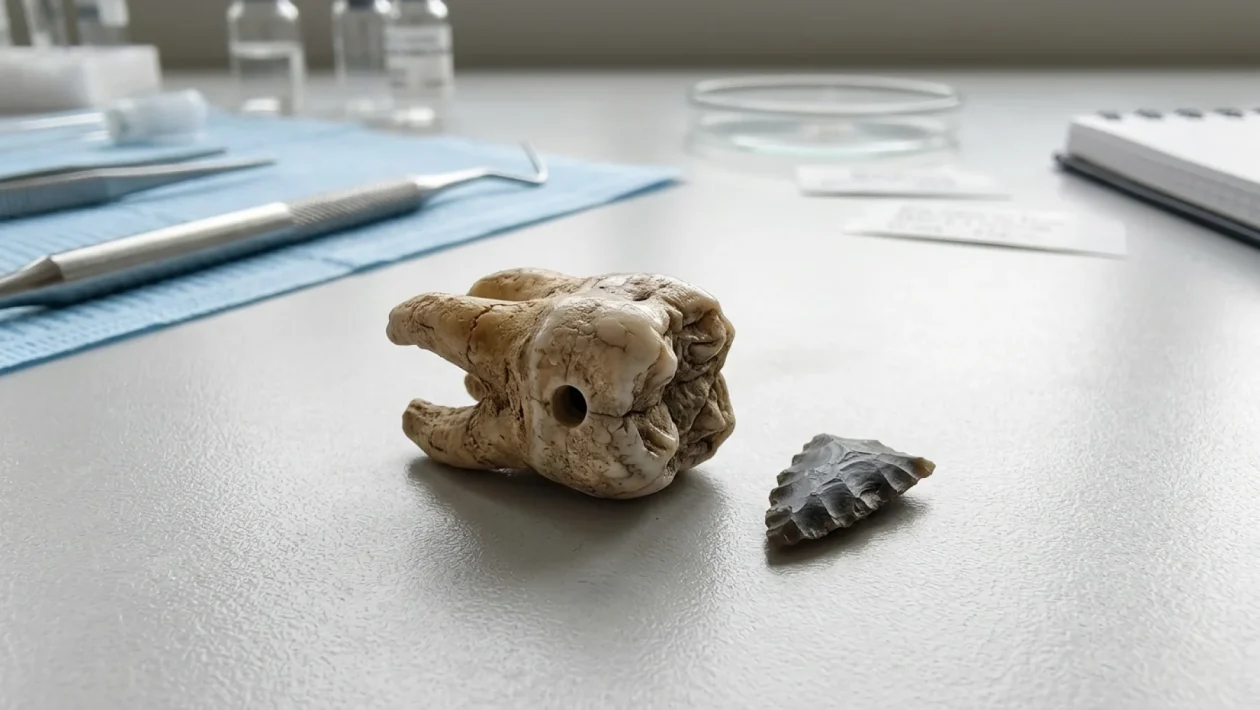
Let’s get right into the gritty details of this incredible find. Researchers recently examined a lower molar pulled from Russia’s Chagyrskaya Cave, and what they found completely blew their minds. This wasn’t just a cracked tooth from chewing on tough mammoth jerky.
Under high-power magnification, scientists spotted a deliberate, manually drilled hole aimed right at a nasty patch of tooth decay. It was undeniable proof of calculated, invasive medicine.
To put this into perspective, the oldest known evidence of Homo sapiens doing this kind of dental work was found in Italy, dating back roughly 14,000 years. That means Neanderthals were successfully operating on rotting teeth a staggering 45,000 years before we were.
The 59,000-Year-Old Stone Drill Operation
So, how exactly does a prehistoric “dentist” pull off this kind of procedure without anesthetic, bright lights, or a motorized drill? Paleoanthropologists, including the University of Toronto’s Bence Viola, noted that the surgical hole was incredibly precise. This wasn’t a desperate, flailing self-help job.
Someone else did the drilling, and they clearly had serious experience. Here is the likely step-by-step process of how this brutal but effective ancient operation went down:
- Diagnosis: The practitioner located the exact source of the debilitating pain inside the patient’s mouth.
- Tool Selection: A specific, sharp stone tool was chosen from the tribe’s inventory, perfectly sized to act as a hand-cranked drill.
- Restraint and Trust: The patient braced themselves while the primitive dentist carefully reached inside their mouth.
- Precision Drilling: Using controlled, repetitive finger movements, the practitioner manually bored into the hard enamel to scrape out the infected, decayed tissue.
Let’s compare the modern dental experience with what our tough-as-nails ancestors had to endure:
| Modern Root Canal | Neanderthal Operation |
|---|---|
| Local anesthesia and laughing gas | Raw willpower and maybe a leather strap to bite on |
| High-speed rotary drill | Hand-twisted sharp stone flake |
| Sterile, climate-controlled clinic | Drafty, freezing Siberian cave |
That Rewrites Human History
For decades, pop culture has painted Neanderthals as knuckle-dragging brutes who communicated in simple grunts. This tiny, 59,000-year-old tooth shatters that outdated stereotype into a million pieces. Invasive medicine requires intense communication, planning, and deep social bonds.
“The one that I cleave to is that this person was in such pain that they reached out to someone else and said, ‘I need help.’ The more we know about Neanderthals, the more we know how social they were and how similar to us they were.” – Anthropologist John Olsen
To successfully complete this procedure, the patient had to understand a highly complex, forward-thinking concept: enduring severe, immediate physical torture for the promise of long-term medical relief. You simply cannot explain that level of trust and strategy with a caveman grunt.
Frequently Asked Questions
Did Neanderthals have dedicated doctors?
While they probably didn’t have individuals walking around with “Dr.” titles, the precision of the drilling suggests some members of the tribe possessed specialized, repeated experience in treating injuries and illnesses.
Are we related to these ancient patients?
Yes! Neanderthals died out about 40,000 years ago, but because they regularly interbred with Homo sapiens, most people today still carry a small but significant percentage of Neanderthal DNA.
🤝 Good luck trying to complain about your next dental cleaning after reading about this Siberian survivor. Our ancient ancestors were incredibly tough, deeply compassionate, and way smarter than the history books ever gave them credit for.
💡 When you realize that early humans were looking out for each other and developing medical strategies 59,000 years ago, it makes our shared human history feel a whole lot more connected.
📱 Share your thoughts on this prehistoric medical miracle with a friend who constantly puts off going to the dentist.
👇 Drop a comment below if you think you could have survived a stone-age cavity drilling, or if you’re suddenly feeling extremely grateful for modern Novocain!