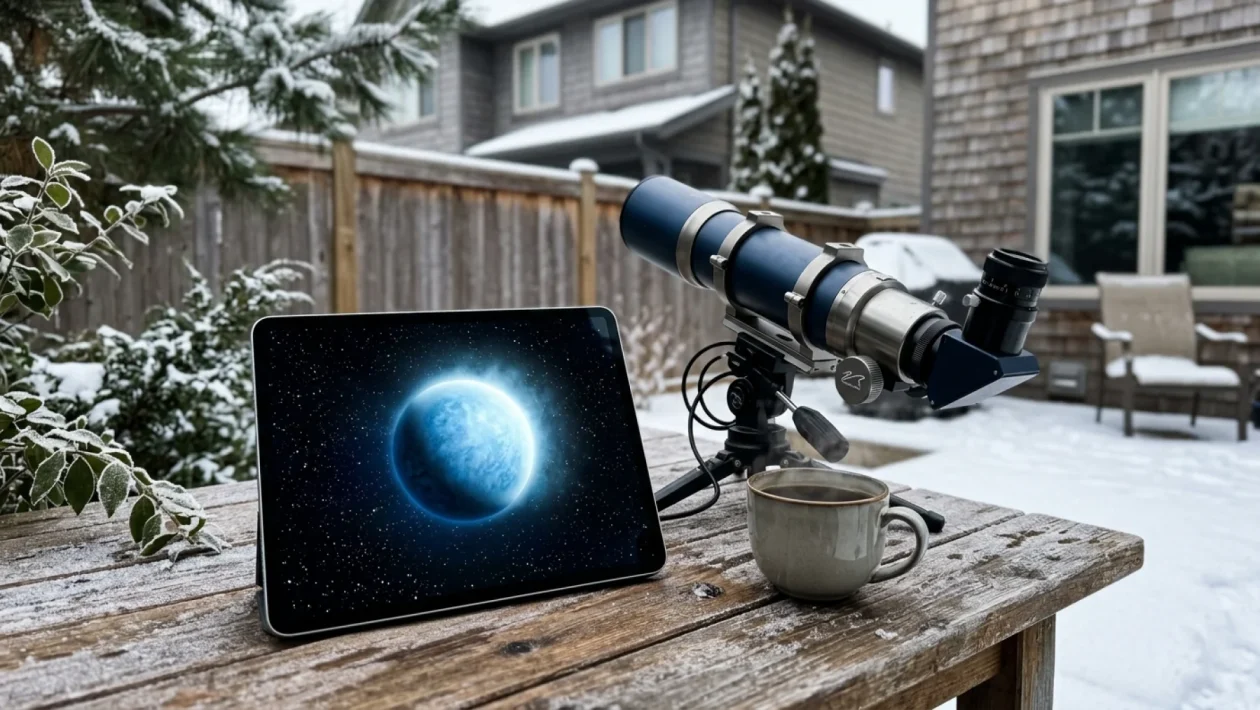
Look up at the night sky tonight and realize our cosmic backyard just got a little more crowded. Astronomers have officially spotted a tiny, frozen rock floating way past Pluto—and get this: it has its own atmosphere. We used to think the outer edges of the solar system were just dead, empty chunks of ice, but this completely rewrites the rulebook. Scientists are scrambling to figure out how a dwarf planet this small is clinging to a blanket of gas in the absolute coldest, darkest corners of space.
The Icy World Beyond Pluto Explained
This isn’t just another random asteroid floating in the dark. We are talking about a bona fide mini-planet out in the distant Kuiper Belt. To put the extreme cold into perspective, you would need survival gear significantly tougher than a heavy-duty Canada Goose expedition parka just to last a millisecond out there.
Temperatures plunge to nearly absolute zero, yet somehow, this little guy is holding onto trace gases. It defies all conventional physics.
Here is a mind-bending fact for you: This icy world sits roughly 4 billion miles from the Sun. At that distance, sunlight takes over six hours just to reach its surface, making it little more than a dim star in a pitch-black sky.
How Scientists Actually Find A Tiny New Planet
You might be wondering how on Earth we spot something so impossibly small and dark from our own backyards. It is not like looking through a pair of hunting binoculars.
The Canadian Space Agency and their international partners rely on some seriously heavy-duty orbital tech to scan the void. It takes immense patience and some incredibly clever math.
Here is exactly how they pull off this cosmic detective work:
- Starlight Dimming: Astronomers watch distant stars for years, waiting for a microscopic flicker in brightness.
- The Transit Method: When a distant object passes directly in front of a star, it blocks a tiny fraction of that star’s light.
- Atmospheric Filtering: High-powered telescopes analyze the starlight passing through the object’s atmosphere to figure out exactly what chemical gases are present.
What This Means For Us: The Kuiper Belt Comparison
Why should you care about a frozen rock billions of miles away? Because it proves that our solar system is incredibly active and full of surprises. If a tiny object way out there can hold an atmosphere, it completely shifts our understanding of planetary evolution.
“Discovering an atmosphere on an object this small, this far from the sun, is like finding a hot cup of coffee in the middle of an Arctic blizzard. It defies our basic expectations of the outer solar system.”
Here is a quick breakdown of how this newcomer stacks up against our old friend Pluto:
| Feature | Pluto | The New Icy World |
|---|---|---|
| Location | Inner Kuiper Belt | Deep Kuiper Belt |
| Atmosphere | Nitrogen & Methane | Trace Gases Detected |
| Planetary Status | Dwarf Planet | Unclassified Icy Body |
Frequently Asked Questions
Could we ever send a probe to this icy world?
Absolutely, but it takes serious patience and engineering. For context, the famous New Horizons probe took nearly a decade of high-speed travel just to reach Pluto.
Does finding an atmosphere mean there is life?
Not a chance. At hundreds of degrees below freezing, this environment is way too harsh for biology as we know it. The gases on this planet are likely frozen solid for most of its orbit, only turning to gas when it inches slightly closer to the Sun.
🤝 It really puts things into perspective when you think about how much we still don’t know about our own cosmic neighborhood.
💡 As we head out to sit around the fire pit this spring of 2026, look up at the stars and remember there are still profound mysteries waiting to be solved right out past Pluto.
📱 Share your thoughts in the comments below—do you think we should be spending more of our budget exploring these distant icy rocks?
👇 Keep looking up, stay curious, and good luck with your own stargazing this weekend!