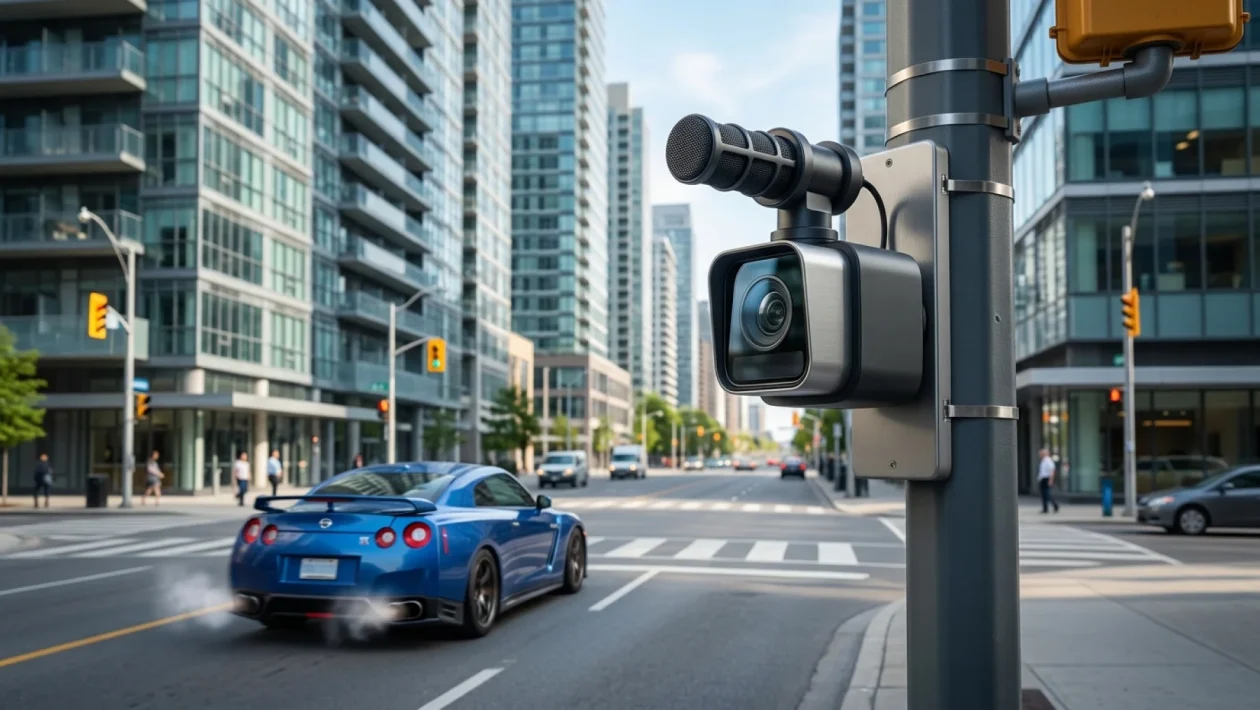
It’s 2 a.m., you’re dead asleep, and suddenly it sounds like a stock car just launched through your bedroom window. We have all been jarred awake by a needlessly loud exhaust treating our quiet streets like a personal drag strip. Toronto noise cameras are officially on the table at city hall this spring to finally squash this nocturnal nuisance. If you are completely exhausted from the constant, rattling engine revving, a high-tech solution is right around the corner.
Toronto noise cameras
City Councillor Lily Cheng is leading the charge this May 2026 to bring acoustic monitoring to our neighborhoods. Currently, catching a moving vehicle that violates the sound bylaw is practically impossible for city staff. These automated devices act just like photo radar, but they are designed specifically for your ears.
Here is exactly how this system works on the street level:
- A highly sensitive acoustic microphone continuously monitors ambient traffic sounds.
- When a vehicle exceeds the legal decibel threshold, the radar pinpoints the exact source of the roar.
- A high-resolution camera instantly snaps a clear picture of the offending license plate.
- Police review the audio-visual data and mail a steep ticket directly to the registered vehicle owner.
The automated tech
Moving vehicles represent the ultimate loophole in our current enforcement system. If you complain about a loud car speeding away, the city simply logs it as data rather than launching an investigation. This new tech mounts directly inside traffic signal stands, keeping it completely out of reach from vandals.
You can’t just slap a cheap, modified exhaust from Canadian Tire on your car and expect to blast through the neighborhood undetected anymore. The upgrade from human bylaw officers to digital enforcement is massive.
| Current Enforcement | Noise Camera Tech |
|---|---|
| Relies on stationary measurements | Tracks moving vehicles instantly |
| Requires human bylaw officers on site | Operates 24/7 without human fatigue |
| Impossible to ticket a fleeing car | Captures plates at high speeds automatically |
Silencing street racers
As our city grows upward, the urban environment naturally amplifies every single obnoxious muffler. Downtown residents know this pain intimately, as towering glass structures create massive acoustic echo chambers. Kathleen Payne, from the advocacy group No More Noise Toronto, perfectly explains why this is an escalating health issue.
“All these beautiful tall condo towers create noise corridors. The sound bounces back and forth — it’s not just affecting people at ground level.”
This isn’t just about annoyance; it’s about public safety and serious city revenue. To put the financial impact into perspective, Toronto’s red light cameras raked in a staggering $45 million last year. Edmonton is already aggressively pursuing this exact same acoustic technology, proving this is quickly becoming a nationwide crackdown on distracted, reckless driving.
Hitting bad drivers with massive fines
If you get caught treating the local avenue like a racetrack, it is going to hurt your wallet. Fines for violating these noise sections currently range from $500 to $900 per infraction. However, rolling out this financial penalty system isn’t without its legal speed bumps.
The city still needs the province to officially step in and approve tying these specific fines to license plate data. Furthermore, local paralegals are already preparing to drag these tickets into court. Legal experts argue that just like early red light cameras, the calibration of these microphones will be heavily scrutinized by defense teams.
Frequently Asked Questions
How loud does a car have to be to get a ticket?
Under the current bylaws, engine noise from a stationary vehicle cannot legally exceed 96 decibels. For context, an aggressive living room vacuum cleaner runs at about 85 decibels, meaning you have to be making serious, deliberate noise to trigger a penalty.
Can these microphones secretly record my private conversations?
Privacy advocates have definitely raised this concern. However, proponents of the technology insist the system is heavily regulated; it only captures short bursts of audio that definitively break the legal noise threshold, ignoring normal street chatter.
Will the province actually allow Toronto to use these?
That remains the million-dollar question this spring. City staff have formally asked the Ministry of Municipal Affairs and Housing to clear the way for a pilot project, but the province has yet to officially green-light the necessary regulatory changes.
🤝 It’s time to take back our neighborhoods and finally secure a decent night’s sleep without the jarring soundtrack of a makeshift street race.
💡 Whether you are a frustrated downtown condo dweller or a suburban homeowner trying to keep your kids asleep, this automated enforcement could be an absolute game-changer for your quality of life.
📱 Share your thoughts directly with your local city councillor today if you want to see this pilot project fast-tracked onto your street.
👇 Good luck out there, stay safe on the roads, and let’s all cross our fingers for a much quieter, peaceful summer!