Bypassing the Hardware Store
Commercial nail guns dominate professional job sites, but they come with strings attached. Most require bulky air compressors, cumbersome hoses, or expensive proprietary batteries.
For fabricators and metalworkers, there is a highly practical alternative. By utilizing basic welding techniques and scrap metal, building a mechanical DIY nail gun is an achievable workshop challenge.
The Engineering Concept
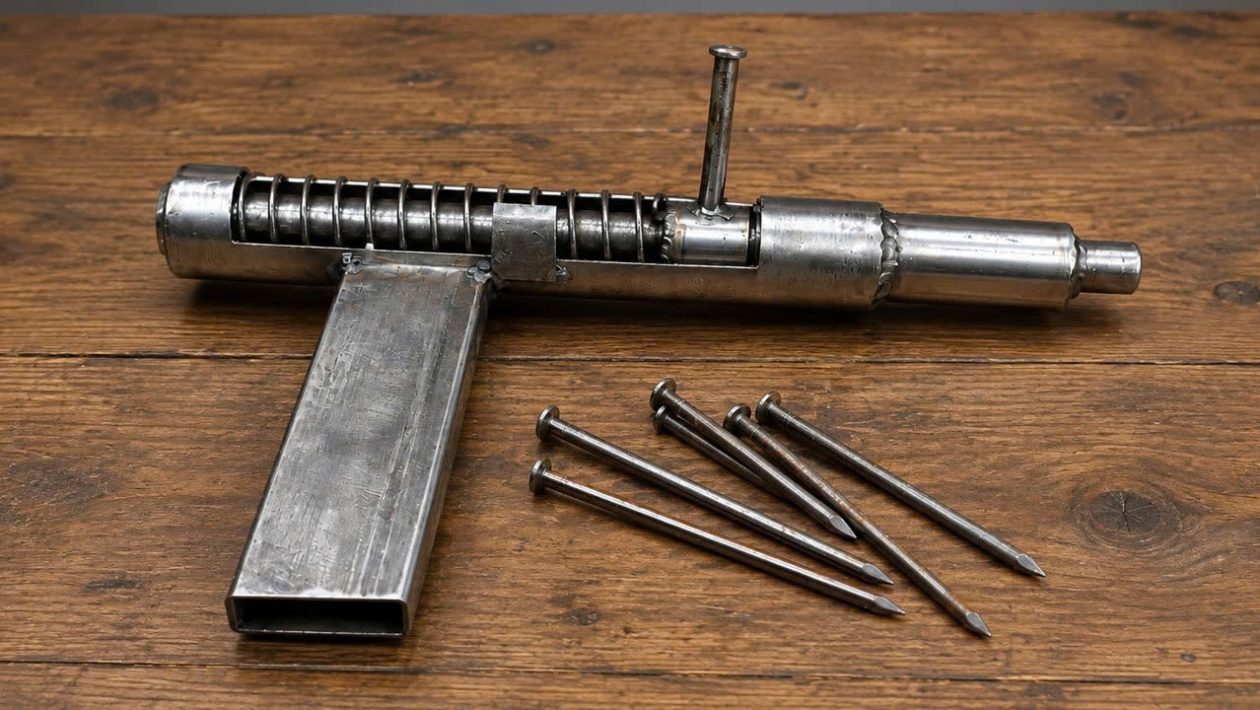
A homemade nail gun relies on raw mechanical force rather than compressed air. The core of the tool is a spring-loaded plunger housed securely inside a metal barrel.
When the user pulls the mechanism back and releases it, a high-tension spring drives a solid steel pin forward. This pin strikes the nail head, driving the fastener directly into the wood with a single, powerful blow.
Sourcing Workshop Materials
This project requires zero exotic parts. The gun’s main frame is built entirely from standard square steel tubing and thick-walled round pipe.
The internal striking pin must be cut from hardened steel. A standard mild steel rod will quickly mushroom and jam after repeated impacts. A heavy-duty compression spring provides the driving force, while an angle grinder and a basic MIG or stick welder handle the physical fabrication.
Fabricating the Main Housing
Construction begins with the barrel. Cut the round pipe to length, ensuring the inner diameter closely matches the striking pin. The fit must be tight enough to maintain perfect alignment, but loose enough to prevent friction during the strike.
Next, fabricate the handle from the square tubing. Tack the pieces together and verify the angle with a square before laying down the final bead. Achieving a solid, fast corner weld here is critical for the tool’s structural integrity and the operator’s grip.
Building the Magazine Track
A functional nail gun requires a reliable feed system. Fabricators typically weld a slotted metal channel parallel to the main barrel to hold the fastener strips.
A secondary, lighter spring constantly pushes the row of nails upward along this track. Every time the main plunger retracts past the opening, the spring tension forces the next nail directly into the firing chamber.
Tolerances and Calibration
This entire build hinges on precise measurements. If the feed channel is even a fraction of an inch too wide, the nails will twist and inevitably jam the mechanism.
Internal welds must also be flawless. Any weld spatter, slag, or metal burrs left inside the barrel will cause the high-speed striking pin to seize up completely. Fabricators must grind all internal contact surfaces flush before final assembly.