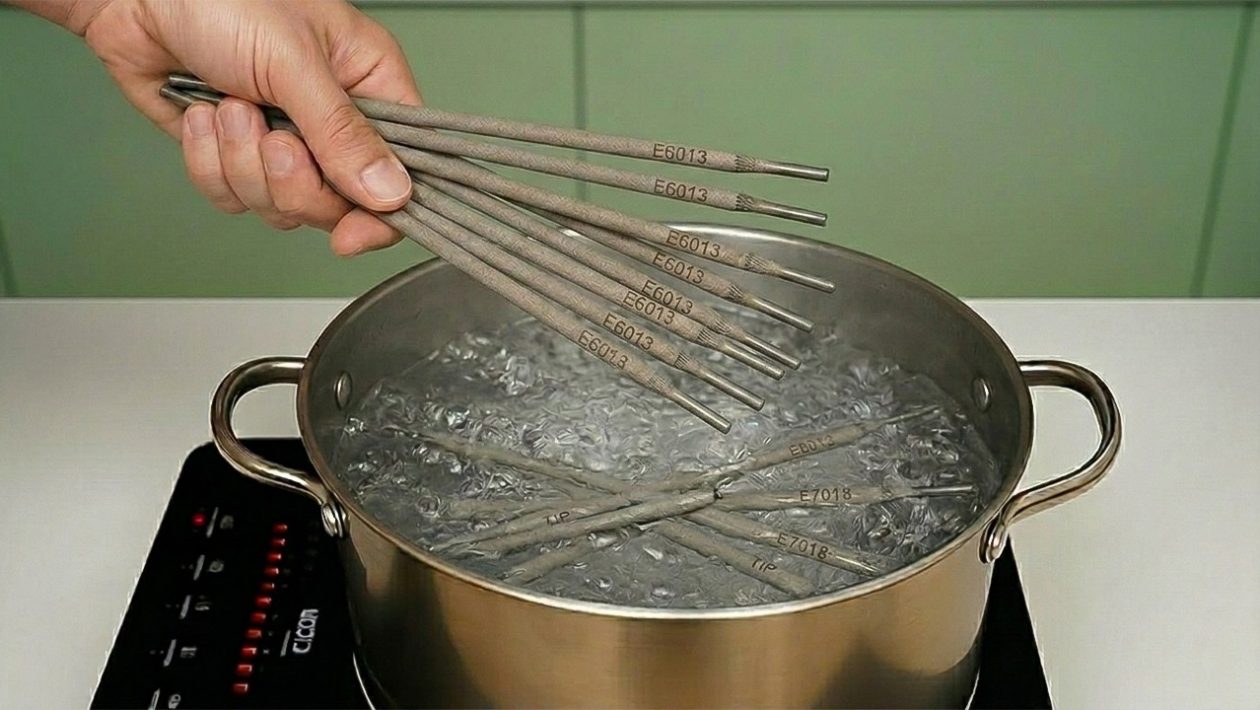
Internet forums and DIY communities occasionally circulate a peculiar piece of workshop advice involving boiling a welding rod. While it sounds like a bizarre internet myth, the practice is actually rooted in basic chemistry and practical workshop economics.
Standard stick welding electrodes consist of a solid, high-quality steel core covered in a thick layer of rigid flux. While that flux is necessary for shielded metal arc welding, the pristine steel wire underneath has massive utility on its own.
The Chemistry of the Coating
The flux on a conventional welding rod is held together by specific binding agents. Manufacturers most commonly use sodium silicate or potassium silicate, frequently referred to as liquid glass.
When submerged in boiling water, these silicate binders begin to break down. The intense heat and persistent moisture penetrate the porous flux, softening the protective shell.
Within several minutes of boiling, the hardened coating swells and separates from the metal. It can then be effortlessly wiped away, leaving a perfectly clean, straight piece of bare steel wire.
Why Mechanical Removal Fails
Some fabricators attempt to remove flux by aggressively tapping the rod with a chipping hammer or crushing it in a vise. This mechanical method is inherently flawed.
Striking the rod often leaves stubborn, microscopic chunks of flux clinging to the metal, which will contaminate future welds. It also creates airborne dust and frequently bends or dents the steel core.
Boiling offers a clean chemical separation. It guarantees an unblemished, perfectly straight wire with zero dust inhalation risks and no physical damage to the metal.
Workshop Economics and Practical Uses
The primary reason fabricators boil welding rods is simple cost efficiency. Common stick electrodes, such as 6013 or 7018 rods, are remarkably cheap and widely available at any local hardware store.
Conversely, purchasing dedicated straight steel wire or specialized gas tungsten arc welding (TIG) filler rods costs significantly more per pound. By stripping the flux off cheap stick electrodes, welders instantly secure high-quality TIG filler wire on a strict budget.
Beyond traditional welding, this thick, bare wire is invaluable for general fabrication. Mechanics and DIY hobbyists use it to bend custom tension springs, create heavy-duty hooks, clear clogged automotive fluid lines, or build structural armatures for metal art.
Executing the Process Safely
The extraction requires nothing more than a scrap metal pot, water, and a reliable heat source. The rods are completely submerged and brought to a rolling boil until the coating turns into a soft sludge.
Operators must carefully extract the hot metal using proper tongs or heavy workshop gloves. A quick, firm wipe with a heavy rag removes the remaining silicate residue entirely.
Because bare, untreated steel is highly susceptible to flash rusting, the newly stripped wires must be dried immediately. Wiping the cooled rods with a light coat of machine oil ensures the salvaged metal remains pristine until it is ready for use.