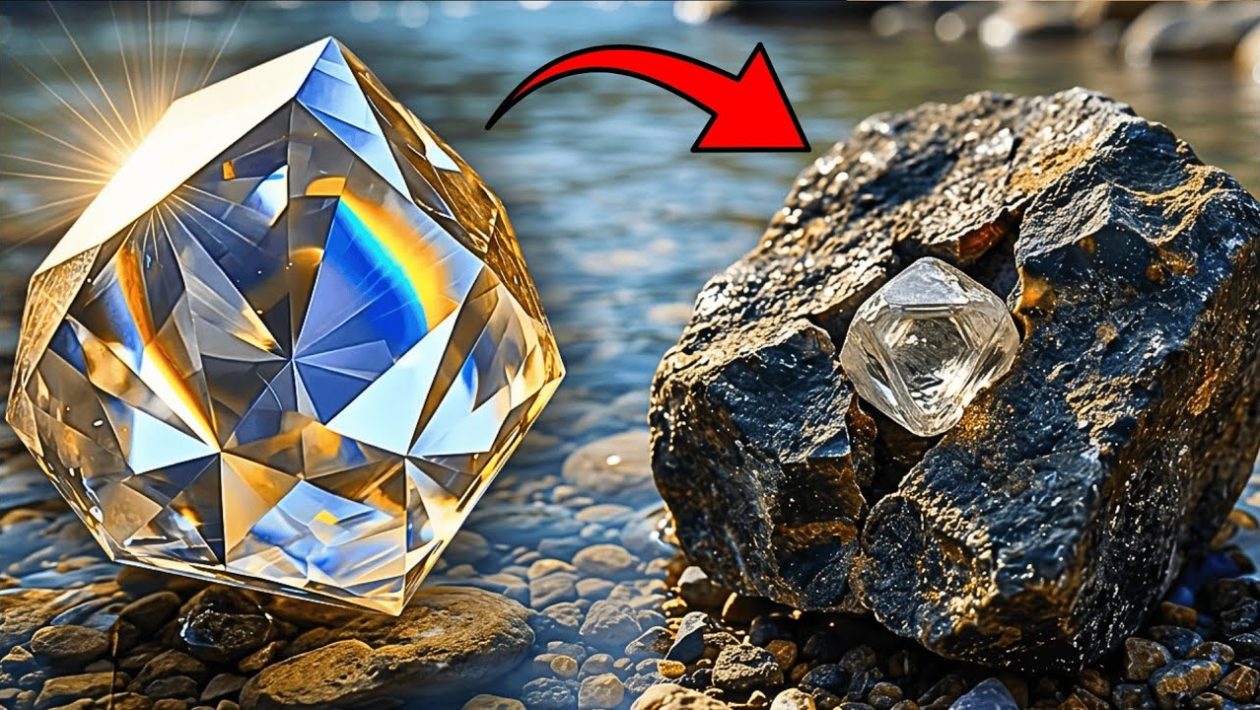
The Hunt for Hidden Riches
Millions of hikers traverse the American landscape every year, crossing deserts, riverbeds, and mountain trails. Most view the rocks beneath their boots as simple gravel or landscaping. However, for the trained eye, these geological formations serve as a roadmap to high-value diamond deposits.
Diamonds do not simply materialize on the surface. They are brought up from the Earth’s mantle via deep-source volcanic eruptions. As these volcanic pipes erode over millions of years, they scatter specific minerals—indicator minerals—across the surrounding terrain. If you find these seven stones, you are standing exactly where you need to be.
1. Kimberlite
Kimberlite is the primary host rock for diamonds. It is a rare, potassic volcanic rock that originates deep within the mantle. In the United States, particularly in areas like Arkansas and parts of the Rocky Mountains, identifying kimberlite is the “holy grail” for prospectors. Its presence suggests that a volcanic pipe is nearby, potentially acting as a conduit for diamonds brought to the surface.
2. Ilmenite
Often referred to as “picroilmenite” when found in diamond-bearing contexts, this mineral is a magnesium-rich variety of ilmenite. It is incredibly durable and resistant to weathering. Because it survives longer than many other minerals in stream beds, it serves as an excellent tracer. When prospectors find concentrated amounts of ilmenite in river gravels, they know they are moving closer to a source.
3. Chromite
Chromite is a dark, heavy, metallic mineral that often appears alongside diamonds in kimberlite pipes. Its chemical signature, particularly high chromium content, is a diagnostic tool for geologists. Finding chromite is a strong hint that the geological environment is favorable for diamond formation.
4. Pyrope Garnet
Pyrope garnets are often called “diamond indicators” for good reason. These deep red, magnesium-rich garnets form under the same high-pressure, high-temperature conditions as diamonds. While garnets are common, specific variations found in the proximity of volcanic pipes are telltale signs that the ground has been subjected to the intense conditions required for carbon crystallization.
5. Chrome Diopside
Often mistaken for emerald due to its vibrant, deep green color, chrome diopside is a key indicator mineral. It is relatively soft and prone to weathering, meaning if you find these crystals in their gemmy, unweathered state, you are likely very close to the primary kimberlite source. It does not travel far from its origin, making it a highly reliable “proximity alarm” for hunters.
6. Eclogite
Eclogite is a metamorphic rock that forms deep within the Earth’s crust. It is often found as xenoliths—fragments of deep-seated rock brought to the surface by volcanic activity. Because eclogite is formed in the same mantle conditions where diamonds are stable, its presence is a high-confidence indicator of diamond-bearing potential.
7. The Diamond Indicator Trail
The “trail” refers to the alluvial dispersion of these minerals. As a kimberlite pipe erodes, it creates a “fan” of indicator minerals that wash downstream into creeks and riverbeds. By systematically sampling gravels and tracking the concentration of these indicator minerals, prospectors can map the path back to the pipe’s location.
Practical Exploration
Understanding these minerals transforms a standard hike into a targeted search. While the United States contains numerous geological formations where these stones are present, identifying them requires patience and a basic understanding of geology. Success in this field is rarely about luck; it is about recognizing the chemical and physical story told by the rocks at your feet.
For those interested in seeing these indicators in the field, this overview provides the fundamental diagnostic traits required to distinguish valuable geological markers from common landscape stone. Whether you are in the volcanic fields of the West or the ancient riverbeds of the South, keep your eyes on the ground—you might be standing on a geological signature that has remained ignored for decades.