The Hidden Potential of Basic Hardware
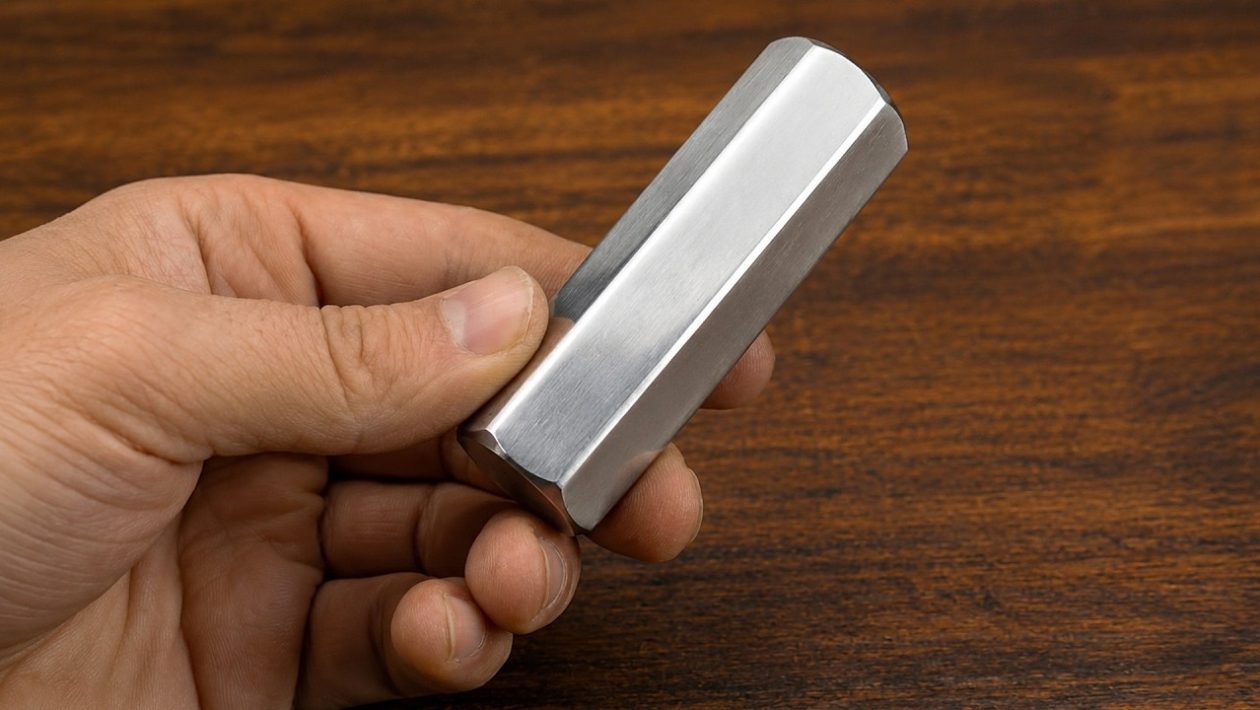
Experience breeds ingenuity in the woodshop. When a veteran 60-year-old carpenter looks at a simple steel hex nut, he does not just see a standard fastener. He sees the structural foundation for precision workshop equipment.
Commercial woodworking tools command a massive premium. However, the geometric perfection of a heavy-duty hex nut provides exactly what high-end jigs require: flat reference faces and perfectly tapped internal threads.
Transforming Fasteners into Cutting Tools
Cutting threads directly into hardwood eliminates the need for expensive brass inserts. A standard hex nut can easily be modified into a highly effective wood tap.
By using a triangular file to cut cross-flutes into the internal threads, the nut becomes a specialized cutting die. When driven forcefully onto a hardwood dowel, these newly sharpened edges slice perfect threads directly into the timber.
Building Micro-Adjustable Marking Gauges
The six flat sides of a hex nut offer built-in parallel reference points. By embedding a large hex nut into a wooden fence, carpenters can create a custom marking gauge that rivals expensive factory models.
A bolt with a sharpened steel pin threaded through this nut creates a micro-adjustment mechanism. A single full rotation of the bolt moves the cutting pin by exact mathematical increments, dictated strictly by the thread pitch.
Slip-Proof Drill Depth Stops
Accuracy is everything in cabinetry and joinery. Store-bought drill depth collars frequently slip under pressure, ruining the workpiece.
A thick hex nut drilled and tapped for a small set screw provides a permanent, heavy-duty depth stop. The wide, flat bottom of the nut ensures the drill bit halts squarely on the wood surface at the exact required depth.
The Economics of Workshop Innovation
Innovation does not always require a massive budget or automated machinery. A specialized tapping kit or marking gauge can easily cost upward of $100 at a specialty hardware store.
Repurposing a 50-cent piece of zinc-plated steel replaces the need for that expensive equipment. Decades of practical woodworking experience teach a simple truth: the most valuable tools in the shop are often the ones you engineer yourself.