The Decomposition Myth
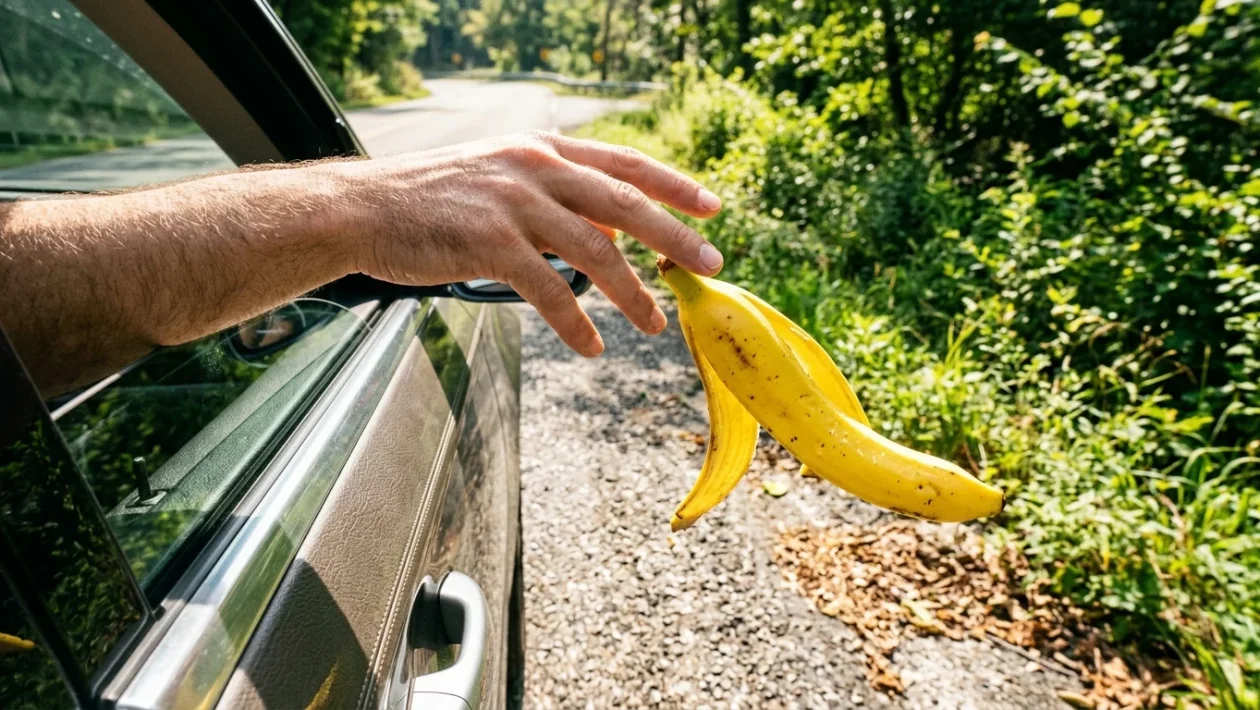
Throwing a banana peel out the car window feels like a victimless crime. Because fruit is natural, most people assume a discarded scrap will quickly melt away into the earth.
Wildlife experts say that assumption is entirely wrong.
Banana peels break down rapidly in the moist, highly active environment of a compost bin. The shoulder of a highway or a rocky hiking trail offers the exact opposite conditions.
“Dryness, direct sun, compacted or contaminated soil, and minimal microbial activity slow decomposition,” says Lauren Click, executive director of Let’s Go Compost. She notes that in these environments, a single peel will often be preserved for months, if not years.
Click challenges skeptics to leave one peel in a proper compost bin and place another on a concrete patio. Without direct contact with healthy soil, the natural breakdown process stalls completely.
Eroding Wildlife Instincts
Littered food scraps do more than clutter the landscape; they create severe behavioral problems for local fauna.
Dr. Rae Wynn-Grant, a wildlife ecologist and co-host of Mutual of Omaha’s Wild Kingdom Protecting the Wild, has spent years observing how these seemingly harmless gestures impact animals. Wild creatures are naturally self-sufficient, but an influx of human food alters how they survive.
“When they begin to associate humans with easy meals, those instincts can erode and alter their natural foraging patterns,” Wynn-Grant explains. “I’ve seen this kind of dependency lead to nutritional imbalances and unnatural behavior.”
The Deadly Roadside Trap
Wildlife survival relies heavily on a natural fear of humans. Constant access to food waste actively diminishes that boundary.
When animals learn that the side of a road guarantees a free meal, they return repeatedly. This habituation pulls them out of their natural habitats and places them directly in the path of oncoming traffic, putting both motorists and wildlife at risk.
The consequences are expensive and frequently fatal. “Habituation can lead to property damage, vehicle collisions, and in worst cases, animals being euthanized because they’re deemed a threat,” Wynn-Grant says.
Supermarket Fruit is Junk Food for Wildlife
Just because a banana is plant-based does not mean it belongs in a wild ecosystem.
Modern agricultural fruits are heavily modified. Humans have selectively bred bananas to feature tough skins for long-distance shipping and dramatically elevated sugar levels for taste.
“Our fruits and vegetables are cultivated for human palates, with sugar and salt content that can be totally foreign to wildlife physiology,” Wynn-Grant warns.
Even if an animal eats wild fruit in its natural habitat, grocery store varieties are fundamentally different. These unnatural, sugar-heavy diets trigger digestive issues, delay physical development, and can even disrupt seasonal cues for migration and breeding.
The solution requires minimal effort: keep your food waste in the car or your backpack until you can drop it into a secure trash can or an active compost bin.