
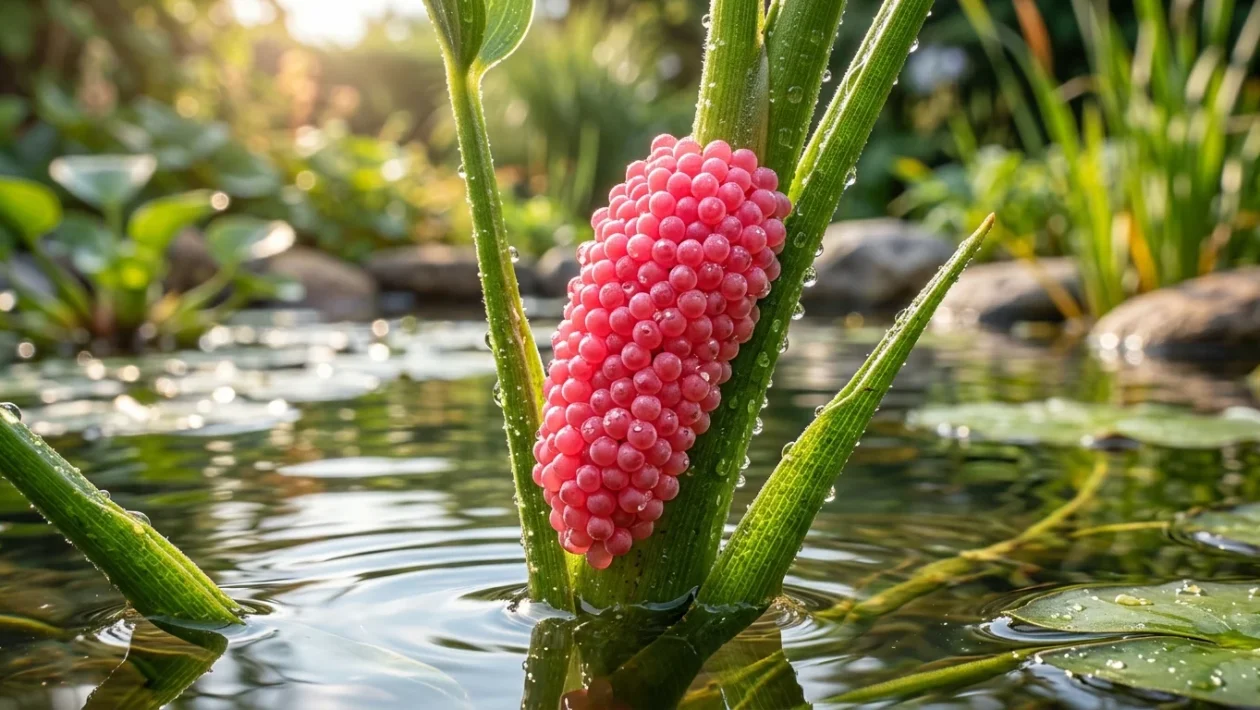
Cluster of bright pink apple snail eggs clinging to a plant stem.
A Beautiful but Dangerous Discovery
Stumbling upon a cluster of bright pink eggs in your garden might look like a fascinating discovery. In reality, it is a biological red flag.
These striking egg clutches belong to the Apple Snail, an invasive species strictly prohibited across Spain and the broader European Union.
Cluster of bright pink apple snail eggs attached to a surface outdoors.
If you spot them, environmental officials urge you to keep your distance and report the sighting immediately.
The Apple Snail Threat
The eggs belong to mollusks of the Pomacea genus, commonly known as Apple Snails. Part of the Ampullariidae family, these gastropods are globally recognized as highly destructive pests.
Their voracious appetite and high resistance to adverse conditions make them an ecological nightmare. They pose a direct threat to local biodiversity by devastating native aquatic plants and algae.
They are particularly notorious for destroying rice paddies, causing massive economic losses for the agricultural sector.
Because of this, the Apple Snail is officially listed in the Spanish Catalog of Invasive Alien Species. The law strictly prohibits owning, transporting, or trading these animals.
According to Spain’s Ministry of Agriculture, Fisheries and Food, detecting this species triggers immediate government intervention. Authorities must establish demarcated zones in fields and waterways to eradicate the pest and actively monitor the area.
How to Identify the Invader
Apple Snails are amphibious survivors. They can easily adapt to alternating periods of severe drought and heavy rainfall.
The invaders are easily identified by two distinct traits: the unusually large size of the adult snails and their signature pink egg clusters.
Females lay these pink masses above the waterline to protect them from aquatic predators. You will typically find them clinging to tall aquatic plants, tree trunks, and concrete pillars.
A History of Eradication in Spain
The species first breached Spanish ecosystems in 2009, invading the Ebro Delta in the Tarragona province.
In 2015, authorities confirmed another outbreak in the Bajo Ampurdán region. Fortunately, aggressive eradication efforts were successful, and no new specimens have been found there since.
Currently, the Apple Snail has not spread to other Spanish rice-growing regions or river basins.
However, officials remain on high alert. If you suspect you have found Apple Snail eggs, you must notify the Plant Health authorities of your autonomous community immediately to prevent a new ecological crisis.



