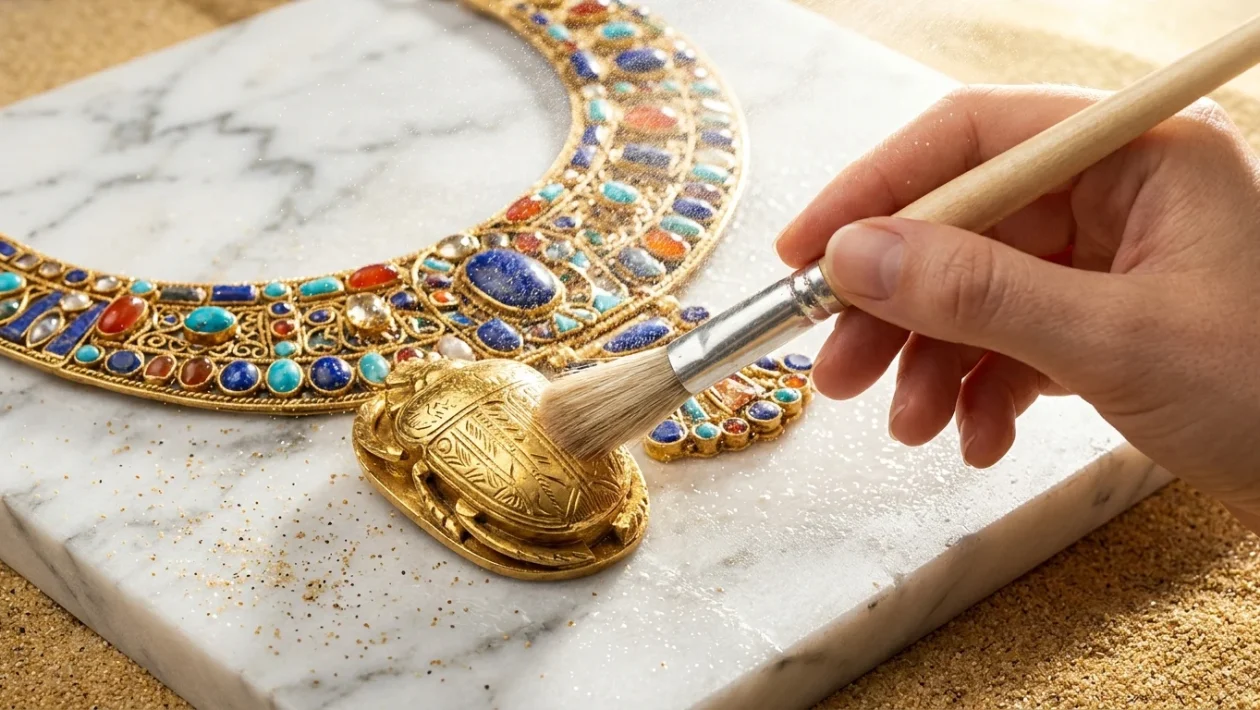
Solid gold death mask and artifacts from the ancient Egyptian tomb of Pharaoh Tutankhamun.
More than a century after its discovery, the tomb of Pharaoh Tutankhamun remains an unmatched archaeological triumph. Uncovered in 1922 by British archaeologist Howard Carter, the burial site contained over 110 kilograms of pure gold.
This immense hoard includes intricately crafted jewelry, royal amulets, and complex funerary objects designed to guide the young pharaoh into the afterlife.
A $90 Million Treasure Beneath the Sand
At today’s market rate of roughly $2,300 per ounce, the raw gold alone is valued at over $90 million. However, the historical significance of the pristine artifacts far outweighs the metal’s commodity price.
Located in the Valley of the Kings near Luxor, Egypt, the tomb sat largely undisturbed since Tutankhamun’s death in 1323 B.C. Excavators cataloged more than 5,000 items inside the confined space.
The most iconic pieces from the haul include a massive solid gold sarcophagus, ceremonial war chariots, and an 11-kilogram gold death mask that has become the face of ancient Egypt.
Untouched Since 1323 B.C.
It took Carter more than five years of meticulous digging through desert rubble to finally locate the hidden entrance. When he breached the sealed burial chamber by lantern light, his financial backer, Lord Carnarvon, asked what he saw.
Carter famously replied that he saw “wonderful things.” The brutally dry desert climate had perfectly preserved the ancient gold, maintaining its original, thousand-year-old brilliance.
Egypt’s Intransferable Heritage
Despite being discovered by a British team, every artifact remains the exclusive property of the Egyptian State. Following the 1922 excavation, authorities immediately blocked the traditional “partage” system, ensuring no pieces were legally exported to foreign museums.
Strict cultural heritage laws continue to protect the collection today. The vast majority of these treasures are preserved and displayed at the Egyptian Museum in Cairo.
The Egyptian Ministry of Antiquities firmly considers the 110-kilogram gold haul an untransferable symbol of national identity. Over the decades, the government has repeatedly rejected all foreign acquisition attempts, cementing King Tutankhamun’s legacy exactly where it belongs.