The Myth of the Master Key
The idea of a single key capable of opening every lock on Earth is a persistent mechanical myth. Lock designs vary drastically across the globe, ranging from simple warded locks to complex disc detainers and biometric systems. No physical object can bridge that mechanical divide.
However, a specific tool exists that comes remarkably close to bypassing the vast majority of standard household locks. Security professionals and locksmiths refer to this tool as a bump key.
Targeting the Pin-Tumbler Vulnerability
In the United States, traditional pin-tumbler locks secure roughly 90 percent of residential doors. A properly crafted bump key exploits a fundamental physics vulnerability within this exact design.
A standard lock contains a series of spring-loaded pins, each divided into two distinct segments: key pins and driver pins. To turn the internal plug and unlock the door, these pins must align perfectly at an internal boundary called the shear line.
Standard keys use varied cuts to lift each pin to the correct height. A bump key discards this individual alignment entirely, relying instead on kinetic energy.
Crafting a 999 Key
Creating a bump key requires a standard key blank that matches the target lock’s keyway. In the US, this usually means starting with a standard Kwikset or Schlage profile.
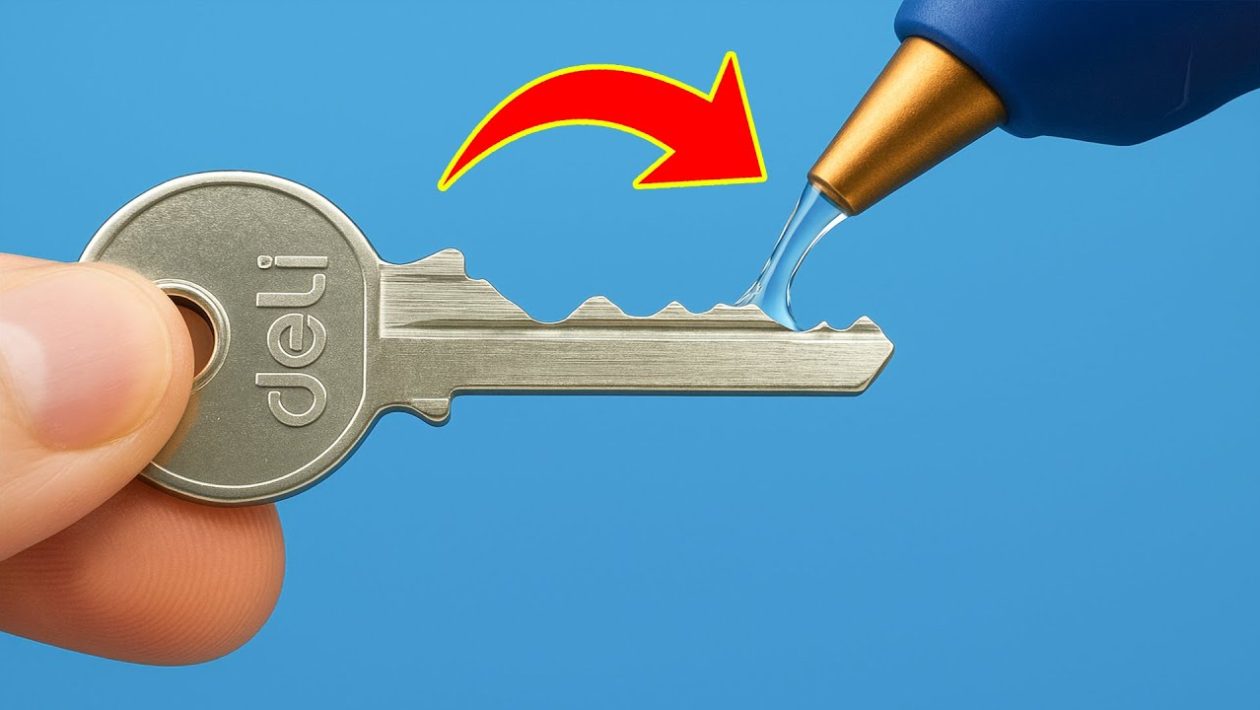
Every cut on the blank is filed down to its absolute maximum depth, leaving behind a row of uniform, sharply angled peaks. Locksmiths routinely refer to this setup as a “999 key.” This name stems from the deepest possible cut code used on professional key-cutting machines.
The resulting key looks jagged and unnatural, resembling a tiny saw blade rather than a functioning security tool.
The Mechanics of Bumping
Deploying a bump key requires timing and precision rather than brute force. The operator inserts the altered key into the lock, stopping just one notch short of full insertion.
The process follows a rigid mechanical sequence:
- Tension: The user applies slight rotational pressure to the key, turning it in the direction the lock normally opens.
- Impact: A sharp, precise strike is delivered to the head of the key using a heavy tool, like a screwdriver handle or a specialized bump hammer.
- Transfer: The strike forces the key inward. The jagged peaks slam into the bottom key pins.
Exploiting Kinetic Energy
This method operates on the exact same principle as Newton’s cradle. The kinetic energy from the strike travels through the bump key and into the bottom pins.
This energy instantly transfers to the top driver pins, launching them upward violently. For a fraction of a second, the driver pins clear the shear line entirely. Because the user is already applying rotational pressure, the lock cylinder turns before the springs can push the pins back down.
Security Limitations
While highly effective in emergency lockout situations, the “universal” label falls short in reality. A bump key only works if its physical profile fits inside the lock. A Kwikset bump key cannot slide into a Schlage keyway.
Furthermore, modern security hardware has evolved to combat this exact exploit. High-security locks equipped with specialized trap pins, magnetic elements, or purely electronic mechanisms remain entirely immune to bumping.
Understanding this mechanic serves a vital dual purpose. It provides a functional emergency entry method when keys are lost, while simultaneously exposing the inherent vulnerabilities bolted to millions of front doors.