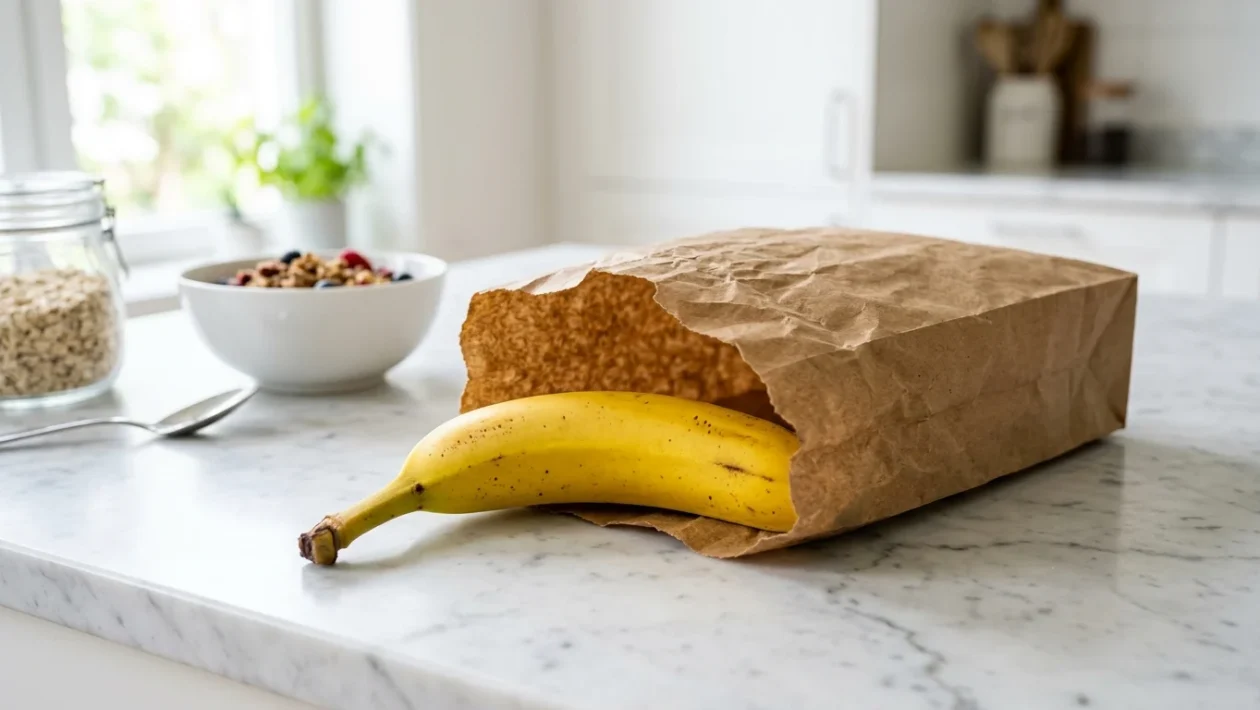
Generations of home cooks have relied on a simple trick to speed up banana ripening: toss the fruit into a brown paper bag. The theory assumes the bag traps ethylene, a natural plant gas, forcing the starch to quickly convert into creamy, sweet fruit.
But according to food science, the beloved kitchen hack is a sham.
Randy Beaudry, Ph.D., a postharvest physiologist and plant biochemist at Michigan State University, points out that consumers have surprisingly little control over a banana’s chemical timeline.
The Secret Life of Bananas Before the Supermarket
Long before a banana hits the grocery store display, its fate is already sealed. Distributors ship the green fruit to massive regional centers and hold them in specialized, climate-controlled rooms.
Inside these rooms, commercial distributors intentionally expose the fruit to ethylene to manually kickstart the aging process.
“They trigger them to ripen over a single day at a specific temperature, and then they maintain them at a specific temperature,” Beaudry explains. “By the time [the banana] reaches the retail store, it’s going to ripen, no matter what you do to it.”
Why the Paper Bag Trick Fails
The paper bag method operates on the false premise that bananas generate massive amounts of ethylene on their own. In reality, they are remarkably poor producers of the gas.
Because bananas emit so little natural ethylene, isolating them in a paper bag creates no meaningful concentration of the chemical.
“It’s absolutely untrue,” Beaudry says of the popular paper bag theory. “They’re a low producer of ethylene … it’s almost meaningless.”
The Real Catalyst: Temperature
If trapping plant gas doesn’t work, what does? Heat.
“The only thing that would speed ripening up would be enclosing it in an environment where the temperature goes up,” Beaudry notes.
Moving a banana to a consistently warm spot in your kitchen accelerates the chemical reactions. If a paper bag appears to work, it is only because the paper slightly insulates the fruit and traps ambient heat.
How to Hit Pause on a Ripe Banana
Once a banana reaches peak sweetness, the refrigerator is your best tool to stop the clock.
Cold temperatures drastically slow the fruit’s metabolism, preserving the soft interior. The chill causes the peel to rapidly lose moisture and turn an unappetizing brown or gray, but the damage is strictly cosmetic.
“You’ll see like a graying of the outside … but the fruit on the inside should be just fine,” Beaudry says.
Just be prepared to eat a refrigerated banana immediately upon removing it from the fridge. Moving the chilled fruit back to room temperature shocks the halted metabolism, causing it to overripen at warp speed.
If your bananas cross the point of no return on the counter, skip the science experiments and mash them for banana bread.