Urban Mining in the Digital Age
That cracked, obsolete smartphone sitting in your junk drawer holds a well-kept secret. It is a miniature gold mine.
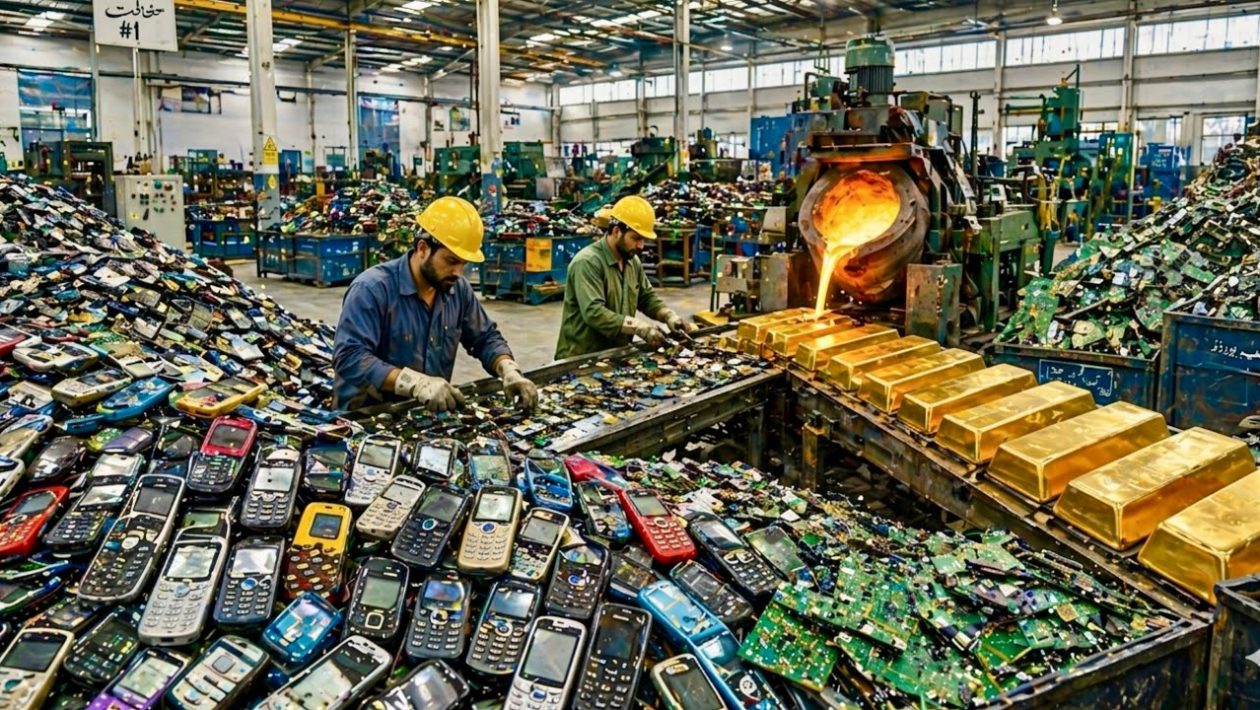
Modern electronics rely on precious metals to function, and smartphones are no exception. Instead of digging metal out of the earth, recyclers are now turning to “urban mining” to harvest pure 24K gold directly from discarded electronic waste.
Why Smartphones Need Precious Metals
Gold is highly valued in electronics manufacturing for a simple reason: it does not corrode. It offers excellent electrical conductivity that remains stable over years of heavy use.
Inside a mobile phone, gold plating covers the printed circuit boards, connection pins, and microchips. While a single phone contains only a fraction of a gram, processing thousands of devices yields a highly profitable amount of precious metal.
Step One: The Mechanical Tear-Down
The gold recovery process always begins with manual or automated dismantling. A smartphone is a complex sandwich of glass, plastic, lithium-ion batteries, and metal.
Technicians strip away the outer casings and shatter-resistant screens. The hazardous batteries are carefully removed and sent to specialized recycling streams to prevent fires.
What remains is the prize: the heavily plated motherboard. These green circuit boards are gathered in massive bulk quantities before moving on to the extraction phase.
Step Two: Stripping the Base Metals
The gold on a circuit board is surrounded by less valuable base metals like copper, silver, and nickel. To isolate the gold, the boards undergo a rigorous chemical bath.
Recyclers typically use nitric acid or a similar chemical solution to break down the board. This acid strips away the copper and base metals, dissolving them into a liquid while leaving the ultra-thin gold foils completely intact.
The surviving gold flakes are then filtered out of the dark, metallic solution and washed thoroughly to remove residual acids.
Step Three: Dissolving the Gold
To purify the extracted flakes, the gold itself must be dissolved. Chemists use a highly corrosive mixture of hydrochloric and nitric acids, historically known as aqua regia.
Aqua regia is one of the few chemical solutions capable of dissolving pure gold. When the gold flakes are submerged, they vanish, transforming into a bright yellow liquid containing dissolved gold chloride.
Any remaining impurities, like bits of plastic or stubborn trace metals, are filtered out of this liquid. What falls through the filter is a perfectly clean, gold-bearing solution.
Step Four: Precipitation and Smelting
The final chemical step is turning the liquid gold back into a solid. A precipitating agent, such as sodium metabisulfite, is added to the bright yellow mixture.
This triggers a rapid chemical reaction that forces the gold to drop out of the liquid as a heavy, brown mud. Despite its dull appearance, this mud is 99.9% pure gold.
The brown powder is rinsed, dried, and placed into a specialized crucible. Using a high-temperature blowtorch or industrial furnace, the powder is melted down at over 1,900 degrees Fahrenheit.
As the heat intensifies, the muddy powder glows glowing red and pools into a brilliant, shining bead of pure 24K gold, ready to be cooled, weighed, and reintroduced into the global market.