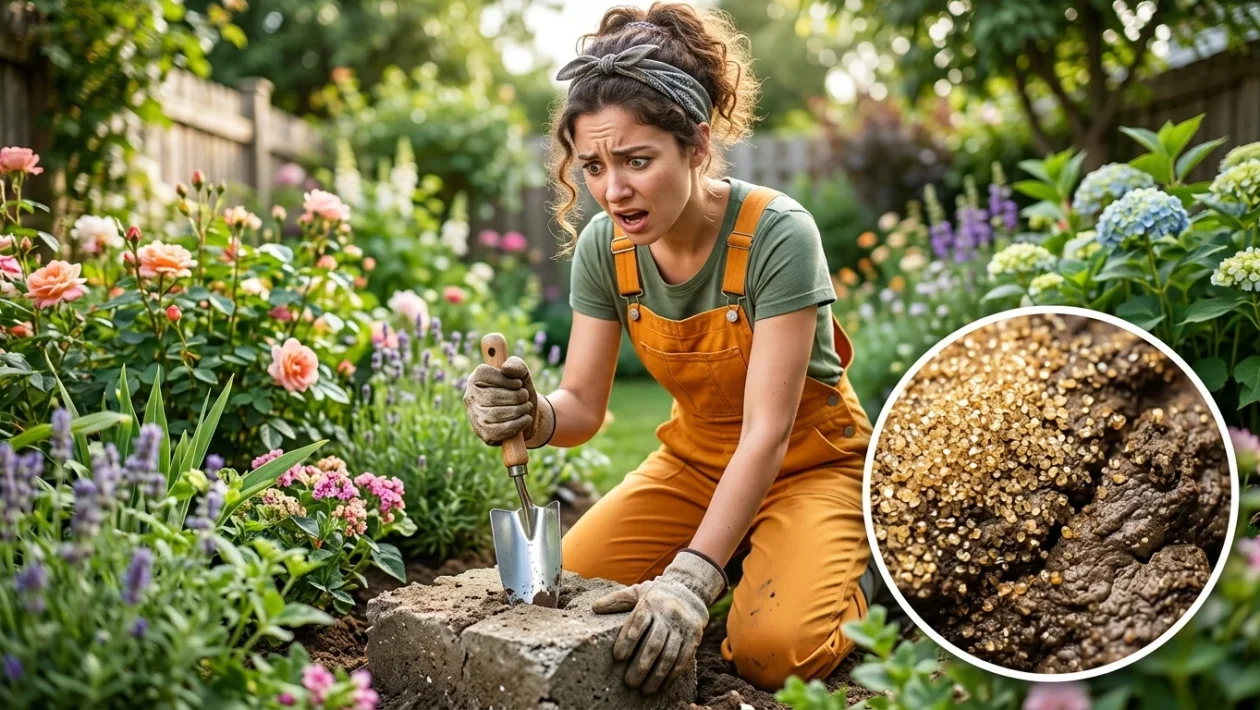
Digging into heavy clay soil often feels like striking pavement. Worse, it traps moisture for days, suffocating plant roots and rotting your favorite shrubs.
To fix the drainage, many gardeners instinctively reach for a bag of sand. It seems logical, but experts warn this common shortcut is actually a recipe for disaster.
The Concrete Reaction
Sand drains quickly on its own. But when you mix it into heavy clay, that positive trait instantly disappears.
Clay particles are microscopic and naturally cling together. When you add sand, these tiny clay fragments wedge themselves tightly into the empty spaces between the larger sand grains.
The result? You accidentally manufacture a concrete-like brick right in your garden. The soil remains just as dense, heavy, and poorly drained as before.
Technically, you can break up clay with sand, but the math is brutal. You would need to remove half of your existing clay and replace it with an equal volume of coarse sand. Even if you did all that heavy lifting, the resulting sandy mix would lack the basic nutrients plants need to survive.
The Right Way to Fix Clay Soil
Instead of sand, organic matter is the proven solution for heavy clay. A healthy ratio is one part organic material to two or three parts native garden soil.
For brand-new flower beds, till about two inches of composted leaf mold or fine pine bark into the top six inches of soil. Because repeated tilling actually makes clay compaction worse over time, you should only till during the first year. If you are working in a small space, rely on a garden fork or shovel to protect the soil’s natural structure.
If your garden is already planted, avoid digging entirely. Topdress the area with a few inches of wood chips, straw, leaf mold, or pine bark. It requires patience—often taking a few years—but it will naturally transform the soil texture from the top down.
A Different Rule for Trees and Shrubs
Amending the dirt inside a planting hole is a bad idea when planting most trees and shrubs.
If your property is dominated by heavy clay, plant trees on a raised berm to guarantee water drains away from the trunk. Dig a hole two to three times wider than the root ball, but only use the native unamended soil to backfill it.
Once planted, finish the job by spreading a thin layer of compost and a couple of inches of mulch over the surface.
The Rare Exception for Sand
There is exactly one scenario where adding sand makes sense: when cultivating plants that explicitly demand sharp drainage and poor soil.
Succulents, alpine plants, blanket flowers, and lavender naturally thrive in sandy environments. To grow them in a clay yard, you must dig out and replace at least half the native soil with sand to achieve the necessary drainage. Even then, you may still need to fold in a bit of compost to ensure they get enough nutrients.