
The Outbreak’s Epicenter
Infections linked to a severe parasite outbreak are finally showing signs of slowing in Michigan. However, public health experts caution that the crisis is far from over, and contaminated produce likely remains in the nation’s food supply.
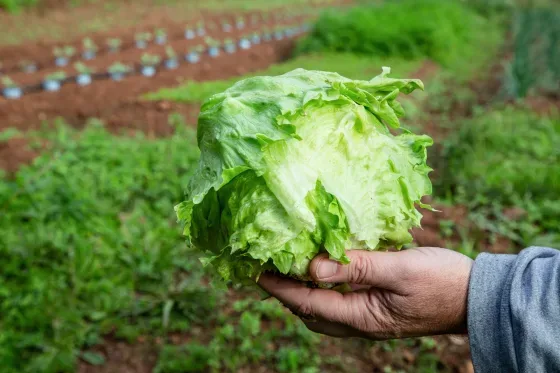
A person holds a freshly harvested head of iceberg lettuce in an agricultural field.
On Tuesday, the Centers for Disease Control and Prevention reported more than 18,000 suspected or confirmed nationwide cases of cyclosporiasis. The illness is caused by a microscopic parasite transmitted through human feces.
In nine states, investigators traced the illness back to shredded iceberg lettuce sourced from Taylor Farms de Mexico. Meanwhile, unexplained case clusters have popped up in other states, including New York and North Carolina.
Michigan Bears the Brunt
Michigan remains the primary hot spot. The Michigan Department of Health and Human Services confirmed Tuesday that over 9,500 residents have contracted the parasite over the last two months, resulting in roughly 160 hospitalizations.
Dr. Natasha Bagdasarian, Michigan’s chief medical executive, believes the state’s outbreak may have peaked. Emergency room visits for diarrhea are dropping, and a recent spike of roughly 475 cases since Friday was attributed to a reporting delay at a single health care system.
It has been over a week since Taylor Farms voluntarily recalled its iceberg lettuce from grocery stores, food service suppliers, and some Taco Bell locations. The Food and Drug Administration has not commented on its ongoing trace-back efforts.
Hidden Cases and Testing Hurdles
Despite the optimistic trends, significant blind spots remain. People experiencing mild symptoms are likely going undetected due to strained medical resources.
“I do have a big caveat,” Bagdasarian said. “We have heard recently from some of our health systems that because of backlogs in their labs, and because of limitations with testing supplies, they have been limiting tests to those who are severely ill, or those who are immunocompromised.”
Public health interventions—like advising consumers to peel, cook, and discard the outer leaves of produce—have helped curb the spread. However, Bagdasarian is unconvinced that a single lettuce recall solved the problem, noting that many sick patients reported never eating lettuce or visiting fast-food chains.
Tracking the True Source
Without access to real-time genetic sequencing, matching a specific contaminated crop to a patient remains incredibly difficult.
Jennifer McEntire, founder of the consulting firm Food Safety Strategy, noted that tracing produce is a logistical nightmare. Fresh products change hands constantly, passing through various brokers and distribution centers before reaching the plate.
Health officials strongly suspect other herbs are involved in this season’s outbreaks. In April, New York officials traced a smaller cyclospora cluster to cilantro at a Brooklyn restaurant, though they couldn’t definitively confirm the link.
Last week, North Carolina officials reported 561 cyclospora cases, pointing to cilantro and parsley as the likely culprits. Neither the New York nor the North Carolina outbreaks have been connected to Taylor Farms lettuce.
Widespread Contamination
Former acting FDA commissioner Dr. Stephen Ostroff suggested other illnesses could originate from different crops grown in the same region of central Mexico as the Taylor Farms facility.
Frank Yiannas, former FDA deputy commissioner for food policy and response, agreed that multiple products are likely tainted.
“If, in fact, all the lettuce is pulled from the market, consumers should not be surprised that they continue to see states report illnesses, and they identify food vehicles other than lettuce,” Yiannas said.
Michigan experienced two distinct waves of infection this summer: one peaking between June 21 and June 28, and another from July 5 through July 12.
Barbara Kowalcyk, director of the Institute for Food Safety and Nutrition Security at George Washington University, suspects these waves indicate two separate batches of contaminated produce. She warned that ongoing pollution of irrigation or processing water could easily spread the parasite across multiple crops.
“There’s still a lot that we don’t know,” Kowalcyk said, pointing out that the ongoing hunt exposes severe vulnerabilities in the nation’s public health infrastructure.
“We still need increased capacity. We aren’t investing enough in science. We’re not investing enough in research,” Kowalcyk said.