Maximize Your Strawberry Yield
July is the critical month when strawberry plants push their energy into both berries and new runners. Retaining every single runner is a common gardening mistake that ruins future yields.
For a thriving new patch, you must select only the strongest daughter plants from healthy mother bushes. Weak, spotted, or distant runners should be clipped and discarded immediately.
The primary rule of propagation is avoiding daughter plants from diseased or stunted mothers. Weaknesses are inherited, meaning a poor mother plant guarantees a poor harvest next year.
Selecting the Strongest Seedlings
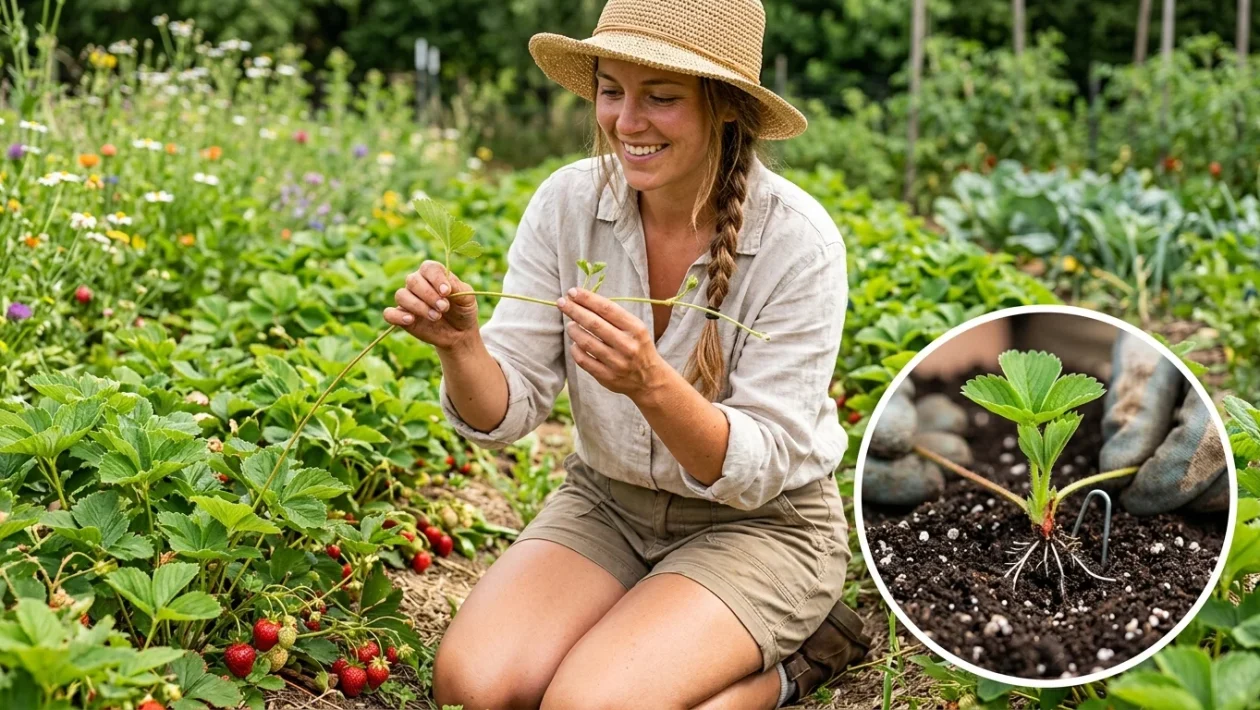
The first rosette on a runner is generally the strongest and most viable. Look closely for a live growth point, a few healthy leaves, and visible native roots.
If a plant relies entirely on a long runner and lacks its own root system, it is too early to separate it. Avoid leaving all daughter plants attached to a single mother bush.
This drains the mother plant’s energy and results in weak, spindly seedlings that struggle to survive the winter.
Health Checks Before Planting
Inspect the leaves for spots, silver trails, or severe deformities. The center crown must be alive and actively pushing out new foliage.
Drying edges caused by extreme summer heat require observation but are not always a sign of disease. Do not rip the rosette out of the earth just to check its roots.
Gently scrape the edge of the soil to see if the root ball holds together firmly. If propagating in pots, ensure the roots haven’t become a tangled, bound mess.
Rooting and Proper Transplanting
Pin the chosen rosette to moist, loose soil using a small garden staple or a stone. Be careful never to bury the growth point.
If the summer sun is punishing, provide temporary shade without covering the plants in stifling plastic. Once the plant forms its own roots and doesn’t wilt when detached, it is ready for separation.
Do this on a cloudy day or in the late evening. Prepare the new bed by removing perennial weeds, loosening the soil, and ensuring proper drainage.
Surviving the August Heat
Separating runners too late leaves plants with virtually no time to establish themselves before autumn. Transplanting into hot, dry soil almost always guarantees severe wilting.
Never remove all the leaves during transplanting, as the plant relies on them for photosynthesis and recovery. Monitor soil moisture down at the roots, rather than just checking the surface.
If a plant wilts only during the heat of the day, it likely just needs more shade. If it remains wilted early in the morning, check for over-drying or incorrect planting depth.