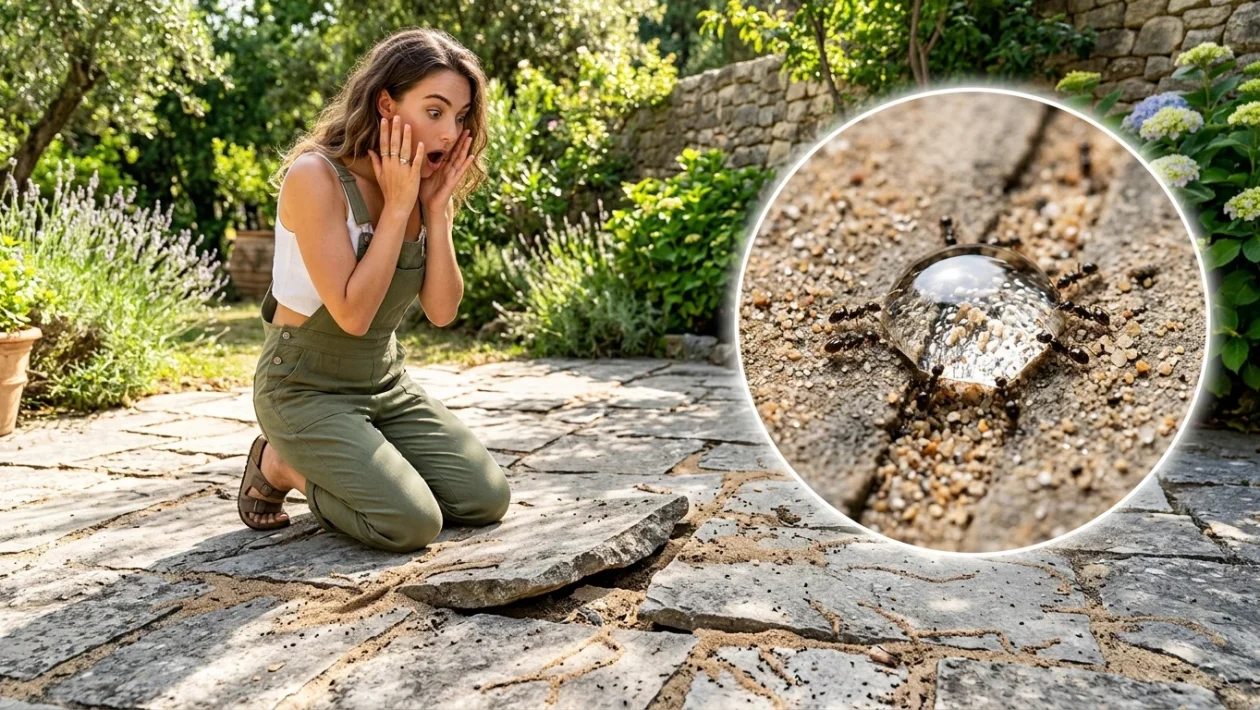
Ants play a crucial role in the ecosystem by aerating soil and controlling other insect populations. But when they decide to colonize the spaces between your paving stones, their endless tunneling quickly transforms from a natural wonder into a property hazard.
Over time, these industrious insects excavate the sand holding your patio, walkway, or driveway together. This causes heavy pavers to shift, creating uneven surfaces that can trip anyone walking by.
Before reaching for a standard can of bug spray, you need a tactical approach that targets the root of the problem.
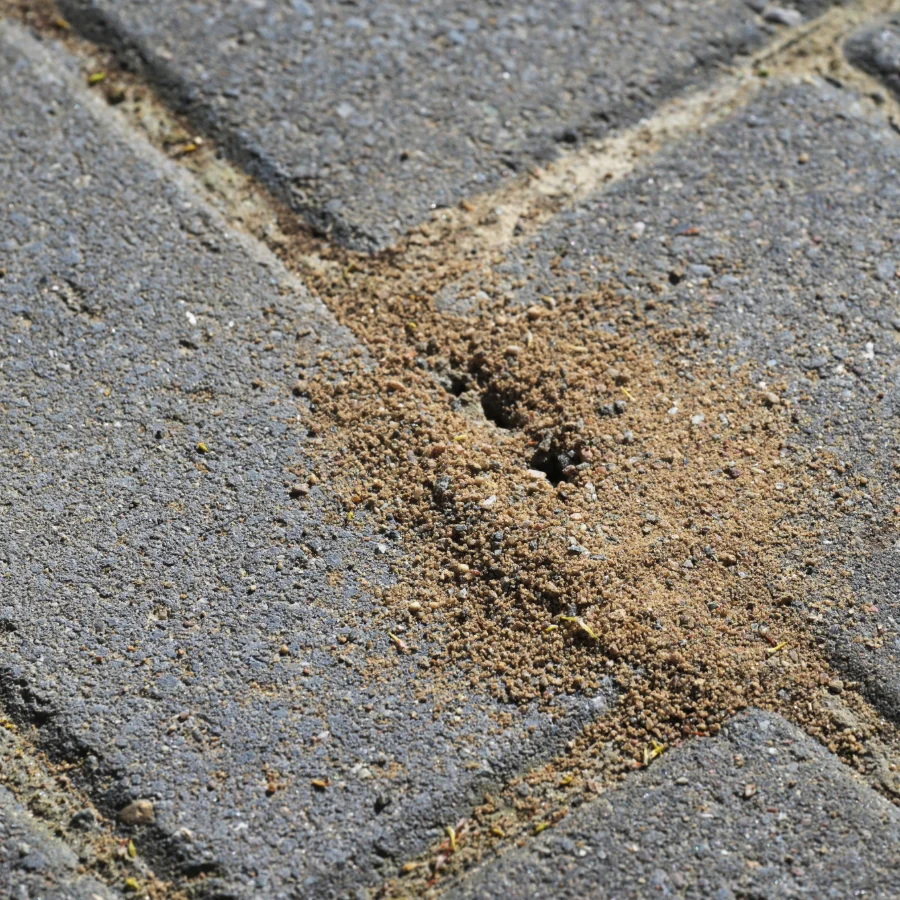
Ant hole on sandy brick pavement.
The Biology Behind the Dirt Piles
Spraying the ants you see crawling across your patio provides a temporary illusion of progress.
“Like wasps and bees, ants live in a social colony with workers and a queen,” says Eric Benson, PhD, professor emeritus and extension entomologist with Clemson University. “You’re dealing with hundreds or thousands of ants beneath your pavers.”
Because standard sprays only kill surface foragers, the colony easily replaces them. The queen remains unharmed, multiplying deep beneath the stones.
Landscape designer Katherine Aul Cervoni, founder of Staghorn NYC and The Cultivation by Kat, notes that paved environments are prime real estate for these insects.
“Ants love those dry, sandy joints,” Cervoni says. “If they find a weak spot between pavers where the sand is failing, they can tunnel right underneath, which causes instability.”
Deploying Outdoor Baits
To eliminate the colony, you have to trick the workers into delivering poison directly to the queen. Outdoor ant baits, available in liquid or gel form inside weather-resistant containers, are the most effective weapon.
Place these stations near active foraging trails. The workers will consume the toxic bait and carry it back underground to share with the babies and the queen.
Benson advises putting out all your purchased baits at once rather than saving some for later. “It’s hard to over-treat with baits, and you also have no idea how big the nest is,” he says.
Baits should be replaced after a month because they evaporate and lose effectiveness. As Benson points out, “Most insects also like fresh food.” Always follow label instructions to keep these products safely out of reach of children and pets.
Adapting to the Colony’s Diet
You might notice an initial spike in ant activity around the bait stations. Do not panic—this simply means the workers have found the trap.
Within a week, the population should noticeably decline. If it doesn’t, switch brands. Ants cycle through different dietary cravings throughout the year, sometimes preferring sugars and carbohydrates, and other times seeking protein.
If minor activity persists, sweep away the dirt mounds and use a targeted ant spray equipped with a long, thin nozzle. Injecting this directly into the entry holes can suppress activity in high-traffic spots.
If the infestation remains entirely unmanageable, contact a licensed pest control professional to assess the scale of the colony.
Repairing the Paving Stones
Once the ants are under control, you must address the structural damage. Ants exploit degraded polymeric sand, which naturally breaks down over time due to weather, wear, and freeze-thaw cycles.
Repairing the joints is a straightforward do-it-yourself project. The first step is completely removing the compromised material.
“You need to clean out the old, compromised sand first,” Cervoni advises. “Sometimes pressure washing helps clear it out, or you can use a stiff brush or scraping tool, such as a flat-head screwdriver, for the joints.”
After clearing the gaps, sweep fresh polymeric sand into the joints. The final and most critical step is wetting the sand exactly according to the manufacturer’s directions to ensure it cures into a hardened, ant-resistant barrier.