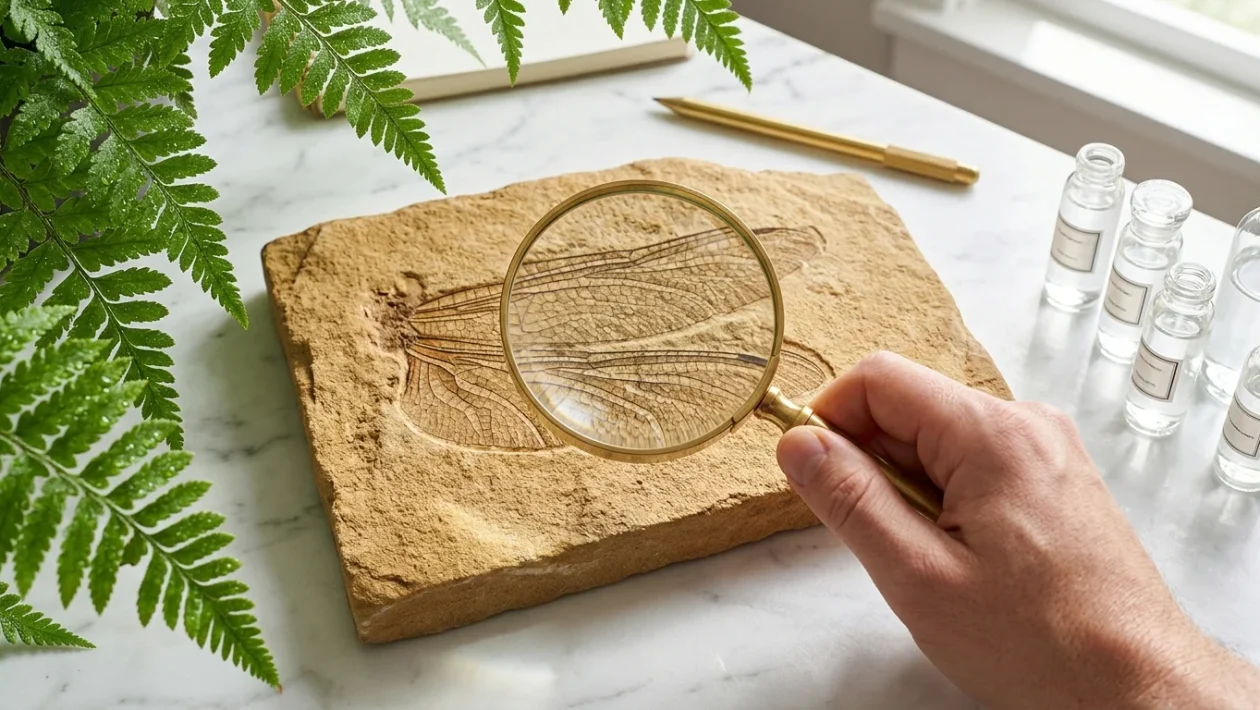
Close-up of a 75-million-year-old fossilized dragonfly wing preserved in stone
Filling a Massive Evolutionary Gap
Researchers from McGill University have unearthed a 75-million-year-old partial dragonfly wing in Alberta’s Dinosaur Provincial Park. The discovery identifies a completely unknown lineage of ancient insects.
“This fossil fills an evolutionary gap of more than 30 million years in the history of dragonflies,” the research team stated, underscoring the magnitude of the find.
Published in the Canadian Journal of Earth Sciences, the study names the new species Cordualadensa acorni. Its unique characteristics required scientists to establish an entirely new taxonomic family, Cordualadensidae.
A Mesozoic First for Canada
This wing represents the first Mesozoic dragonfly ever identified in Canada. The discovery fundamentally shifts the scientific understanding of the insect fauna that coexisted with massive dinosaurs.
Before this dig, the only insect record recovered from this world-renowned paleontological site was a microscopic aphid preserved in amber. Cordualadensa acorni introduces a completely different and exceedingly rare preservation method for the region: fossilized stone impressions.
The exceptional preservation of the wing’s fine veins allowed researchers to meticulously reconstruct the dragonfly’s anatomy.
Built for Endurance and Migration
Structural analysis of the wing reveals precise adaptations for gliding. This indicates that Cordualadensa acorni was capable of prolonged flights and possibly extensive migrations.
With an estimated wingspan of 12 centimeters, the insect was a formidable presence in the Mesozoic food web. It operated as a highly efficient predator of smaller insects while simultaneously serving as prey for flying reptiles and small dinosaurs.
The discovery proves that insects played an essential role in ancient ecological balance, despite often being overshadowed by massive vertebrate fossils.
An Accidental Student Discovery
The groundbreaking fossil was actually discovered by an undergraduate student during a routine academic field excavation. This unexpected find is now prompting scientists to examine local rock formations previously dismissed as poor candidates for insect preservation.
The species name “acorni” was chosen to honor John Acorn, a prominent Canadian science communicator. His television program Acorn, the Nature Nut inspired an entire generation of naturalists and scientists.
His legacy is now officially inscribed into paleontological history, marking a new chapter for fossil insect research in North America.