Woodturning demands precision, and standard practice usually dictates discarding logs with massive knots or deep hollows. These irregularities can catch tools on the lathe and compromise the structural integrity of a spinning vessel.
However, natural flaws present unique opportunities for functional art. By utilizing a natural hollow as a frame, woodworkers can embed custom elements, transforming what might be considered scrap wood into a striking centerpiece.
Framing with Natural Flaws
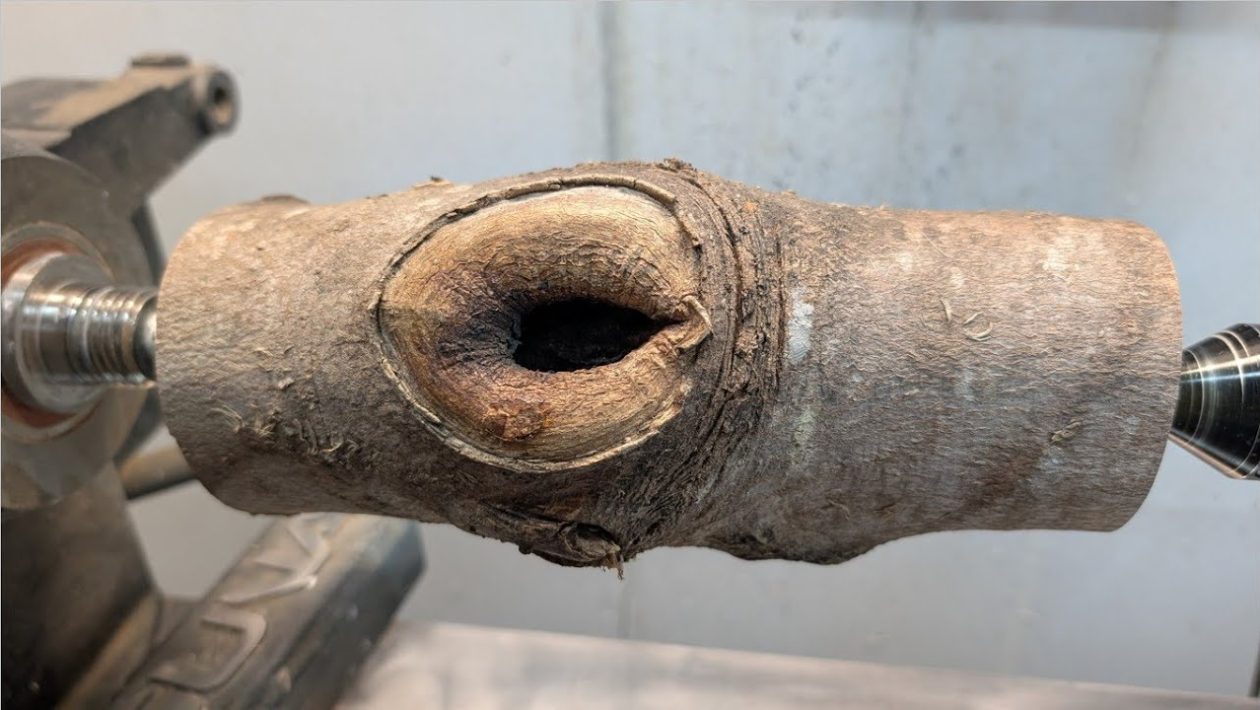
Sycamore wood offers a tight, interlocking grain that shapes beautifully on a lathe. When a log features a severe knot or void, traditional turners might simply cut it away to reach solid wood.
Instead of removing the defect, the hollow can serve as a natural bezel. This organic framing is ideal for holding intricate focal points, such as a glass or resin “dragon eye” insert.
Working with severe voids requires careful planning before mounting the blank to the lathe. The piece must be balanced, and the hollow must be stabilized to prevent the surrounding fibers from splintering under a bowl gouge.
Creating a Functional Hollow Form
Turning a water bottle goes far beyond basic bowl shaping. The project requires excavating a deep, narrow cavity while maintaining a uniform, thin wall thickness.
Specialized hollowing rigs and swan-neck tools are necessary to clear out the interior without widening the neck of the bottle. The presence of a large knot complicates this process, as the varying density of the end-grain and side-grain can easily grab the cutting edge.
Embedding a dragon eye into the side of the vessel adds a critical layer of complexity. The insert must sit securely within the void, requiring exact measurements during the final exterior shaping phase.
The Power of a Resin Finish
A wooden water bottle cannot fulfill its primary purpose without a completely waterproof seal. Bare or lightly oiled wood absorbs moisture, which inevitably leads to warping, cracking, and bacterial growth.
To make the bottle fully functional and durable, a comprehensive resin coating is essential. Encasing the entire turned piece in a high-quality, food-safe epoxy resin creates a deep, glass-like barrier.
This finishing step does more than just waterproof the interior and exterior. The clear resin acts as a magnifying lens for the sycamore, making the natural grain patterns pop while permanently locking and protecting the dragon eye insert.
Balancing Aesthetics and Engineering
Crafting a functional vessel with heavy inlays requires a constant balance between artistic vision and mechanical engineering. The epoxy resin must cure evenly across a curved surface.
Woodturners often utilize a slow-turning rotisserie setup while the resin cures to prevent drips, runs, and sagging. Once fully hardened, the surface is wet-sanded and polished to a high-gloss finish.
The final product yields a heavy-duty, striking piece of functional fantasy art. The rigorous process proves that structural flaws in raw timber can dictate the most compelling designs.