
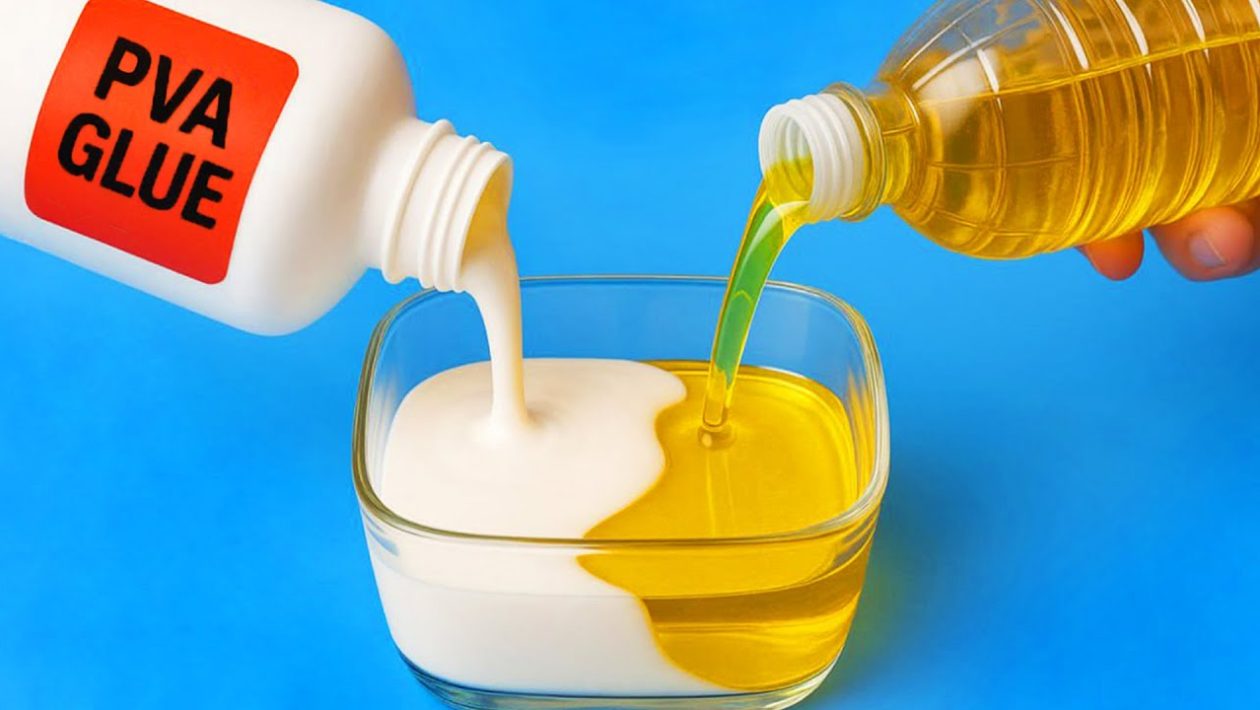
The Chemistry Behind the Combination
White PVA glue is a staple in households and workshops across the country. On its own, standard polyvinyl acetate has a glaring weakness: moisture ruins it.
Add ordinary cooking oil to the mix, and you change the physical properties of the adhesive completely. Mixing oil and a water-based glue initially sounds like a recipe for a separated mess.
However, vigorously stirring cooking oil into PVA glue creates a stable emulsion. As the glue dries and its water content evaporates, the oil molecules remain trapped within the polymer structure.
This trapped oil forms a hydrophobic barrier throughout the dried adhesive. The result is a highly effective, homemade waterproof sealant made entirely from basic supplies.
How to Create the Waterproof Mixture
To make this emulsion work, ratios matter. You cannot simply pour equal parts of both ingredients into a bowl and expect it to set properly.
Start with a standard white school glue or carpenter’s wood glue. Gradually add a small amount of everyday cooking oil, such as canola, vegetable, or sunflower oil.
A reliable starting ratio is one tablespoon of oil for every half-cup of PVA glue. You must stir the mixture vigorously for several minutes to force the ingredients to bind.
Stop mixing only when the liquid turns completely opaque, thick, and uniformly creamy. If you see separated streaks of oil, keep stirring.
Practical Applications for the Home
This homemade waterproof mixture excels in light-duty DIY applications. It acts as an excellent, low-cost wood sealer for outdoor craft projects or garden stakes.
When applied to highly porous surfaces like cardboard, raw MDF, or untreated plywood, it dries into a flexible, water-resistant skin.
Crafters frequently use this blend as a protective topcoat for papier-mâché, homemade clay items, or custom outdoor planters. It provides a durable finish that easily sheds casual moisture or light rain.
Understanding the Limitations
While this trick upgrades basic glue into a water-resistant tool, it is not a replacement for commercial-grade marine epoxy or silicone caulk.
It will not seal a pressurized plumbing leak or hold together structural elements exposed to constant underwater submersion.
The addition of oil also alters the curing timeline. Because the trapped oil acts as a barrier, it dramatically slows down the evaporation of the water inside the glue.
Projects using this modified mixture generally require 24 to 48 hours in a dry, well-ventilated space to fully cure and achieve their waterproof properties.




