
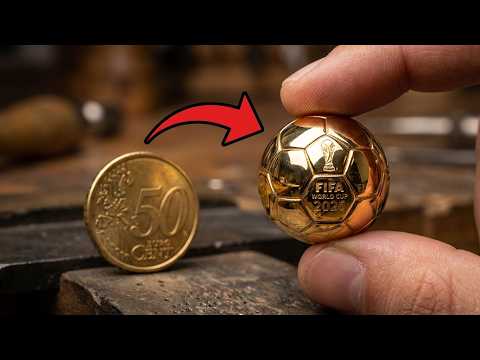
The Ultimate Trophy From Pocket Change
The FIFA World Cup Golden Ball represents the absolute pinnacle of individual football achievement. Recreating this iconic award requires more than just casting metal into a simple mold.
Transforming ordinary 50-cent coins into a highly detailed replica of the 2026 Golden Ball merges traditional jewelry craftsmanship with advanced metalworking. The process breaks down everyday currency and rebuilds it into a mirror-polished tribute to the beautiful game.
Deconstructing the TRIONDA Match Ball
The 2026 official match ball, known as the TRIONDA, features a highly distinct geometric layout. Replicating this design in metal means translating synthetic leather panels and aerodynamic texturing into a solid, unyielding medium.
A spherical canvas is notoriously difficult to map. Metalworkers must carefully calculate the exact surface patterns to reflect the original football’s complex geometry.
Every groove and intersecting line of the TRIONDA design has to be scaled perfectly. If the initial layout is off by a fraction of a millimeter, the entire pattern will fail to connect on the opposite side of the sphere.
Overcoming the Cupronickel Challenge
Modern 50-cent coins are primarily struck from cupronickel, an alloy of copper and nickel. While highly durable for public circulation, this metal is rigid and stubbornly resists hand-shaping.
Melting these coins requires a high-temperature crucible capable of exceeding 2,100 degrees Fahrenheit. The molten alloy is then poured into a custom mold, creating a dense bar of raw material.
Because cupronickel work-hardens rapidly when bent or hammered, the metal must be frequently annealed. This involves heating the metal with a torch until it glows a dull red, resetting its crystalline structure to keep it malleable.
Forming the Spherical Base
Creating a solid metal football is entirely impractical due to the massive weight of the alloy. Instead, the raw ingot is passed through precision reduction gear, such as the rolling mills manufactured by Pepetools, to create flat, uniform metal sheets.
These sheets are cut into discs and driven into steel dapping blocks. By striking the metal with corresponding heavy punches, artisans slowly compress and stretch the flat discs into perfect half-spheres.
The two hemispheres are then carefully aligned, clamped, and silver-soldered together. The resulting equatorial seam is aggressively filed completely flush, making the sphere appear as a single, unbroken form.
Precision Detailing with Jeweler’s Files
With the blank sphere formed, the focus shifts to microscopic precision. The TRIONDA’s unique panel textures must now be carved entirely by hand.
This phase requires an arsenal of specialized hand tools. Professional jeweler’s files, such as those made by the Swiss manufacturer Vallorbe, allow artisans to cut sharp, exact lines directly into the curved surface.
These high-carbon steel files remove the tough cupronickel fraction by fraction. The process demands a steady hand to ensure the carved metal surface accurately mirrors the synthetic grip patterns of the actual World Cup ball.
Achieving the Mirror Finish
A raw metal sphere covered in deep file marks looks nothing like a world-class trophy. The final, and arguably most physically demanding stage, is the polishing process.
Artisans work through progressively finer grits of abrasive paper, stripping away the deep scratches left by the carving tools. Each pass creates a smoother, more uniform surface.
Once the metal is completely flush, high-speed buffing wheels loaded with specialized polishing compounds are applied to the sphere. This intense friction brings out a flawless, mirror-like finish.
The result is a dense, gleaming piece of handcrafted geometry. It successfully elevates a handful of pocket change into a meticulously engineered piece of football memorabilia.




