Stop Throwing Away Damaged Clothes
A snagged sweater or a torn pair of jeans does not mean the garment is ruined. Replacing clothing over minor damage is an expensive habit.
Basic garment repair requires no special skills, and you do not need a sewing machine to get professional results. Understanding a few fundamental hand-sewing and no-sew techniques can save your wardrobe.
Here are seven proven methods to repair holes in almost any fabric.
1. The Invisible Ladder Stitch
This technique is strictly for split seams, where two pieces of fabric have simply come apart. It is highly effective for repairing the sides of shirts, the inseams of pants, or even torn upholstery.
You thread a needle and pass it back and forth between the two folded edges of the open seam, creating a pattern that looks like ladder rungs. When you pull the thread tight, the stitches vanish completely inside the fold.
The result is a clean, seamless closure that looks exactly like the original machine stitch.
2. Iron-On Mending Tape
If you refuse to pick up a needle, fusible bonding web or iron-on mending tape is the fastest solution. This is ideal for small holes in t-shirts or thin cotton garments.
Turn the garment inside out and pinch the hole closed. Place a small piece of the mending tape over the damage, cover it with a pressing cloth, and apply a hot iron for a few seconds.
The heat melts the adhesive, sealing the hole instantly. The repair is machine-washable and barely visible from the outside.
3. Traditional Darning
Darning is the mandatory fix for knitted fabrics, such as thick sweaters and wool socks. Pulling a hole shut on a knit garment will cause the fabric to pucker and distort.
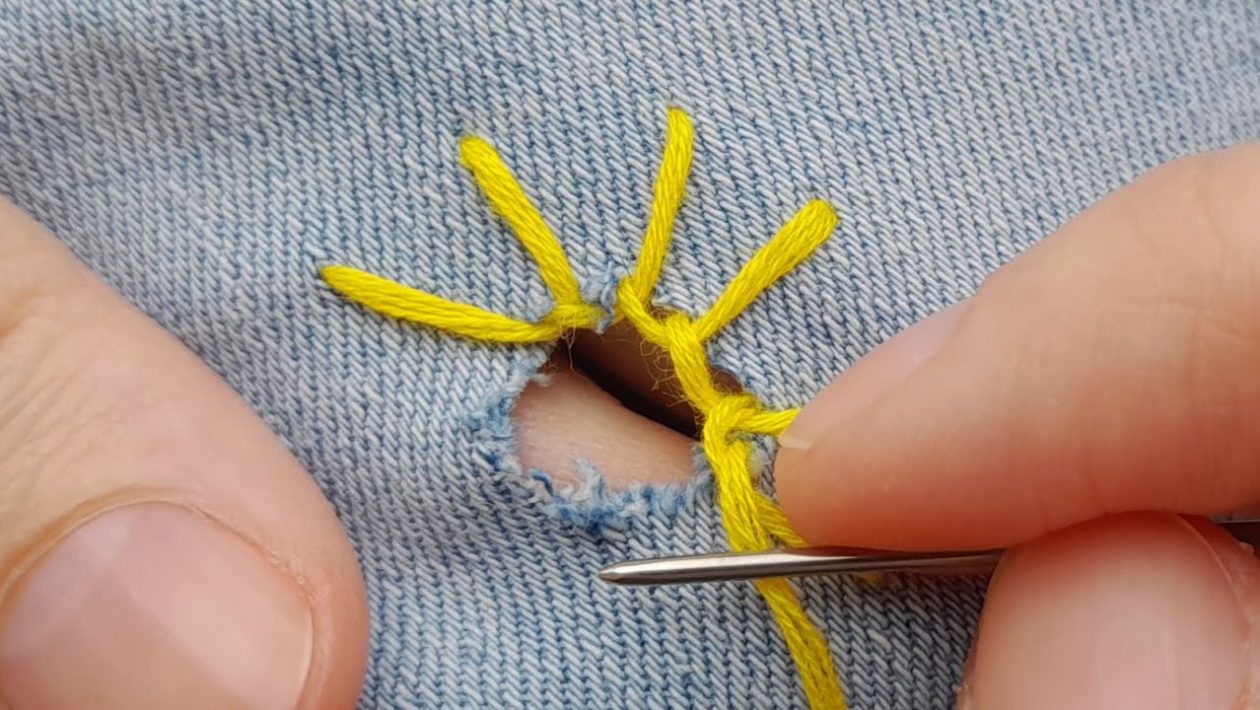
Instead, darning recreates the missing fabric. You use a needle and matching yarn to anchor a series of parallel threads across the hole.
Once the vertical threads are in place, you weave your needle horizontally over and under them, creating a tiny new grid of fabric that seamlessly fills the gap.
4. Sashiko Visible Mending
Sometimes, trying to hide a large hole in denim or heavy canvas only draws more attention to it. Visible mending takes the opposite approach by turning the repair into a design element.
Sashiko is a traditional Japanese mending technique. You place a scrap fabric patch directly behind the hole.
Using a thick, contrasting thread—often white thread on blue denim—you sew simple running stitches back and forth over the entire area. This securely anchors the patch while adding a striking geometric texture to the garment.
5. The French Knot Cluster
Moth holes often leave tiny, circular punctures in delicate knits or thin cotton shirts. A standard stitch will pinch the fabric awkwardly.
A French knot is a simple embroidery technique where the thread is wrapped around the needle before pulling it through the fabric, creating a small, raised bead of thread.
By placing one or two French knots directly over a tiny moth hole using a matching or contrasting thread, you cover the damage while leaving the garment lying perfectly flat.
6. Fusible Interfacing for Tear Reinforcement
When a pair of jeans develops a wear-and-tear rip right in the middle of the thigh or knee, the surrounding fabric is usually dangerously thin. Stitching the hole directly will just cause the fragile fabric to rip again.
Cut a piece of fusible interfacing slightly larger than the weak area. Iron it onto the inside of the jeans to stabilize the entire section.
Once the fabric is reinforced from behind, you can hand-stitch the actual tear closed without fear of the thread ripping through the weakened denim.
7. Appliqué and Patching
Burn holes or massive tears often destroy too much material to weave or pull back together. In these cases, covering the damage entirely is the only viable option.
Fabric patches can be ironed on or stitched directly over the hole. For a cleaner look, you can cut a piece of matching fabric from an unseen area of the garment, such as the inside of a pocket.
Sew the donor fabric over the hole using a tight whipstitch around the edges to prevent fraying and secure the patch for the remaining lifespan of the garment.