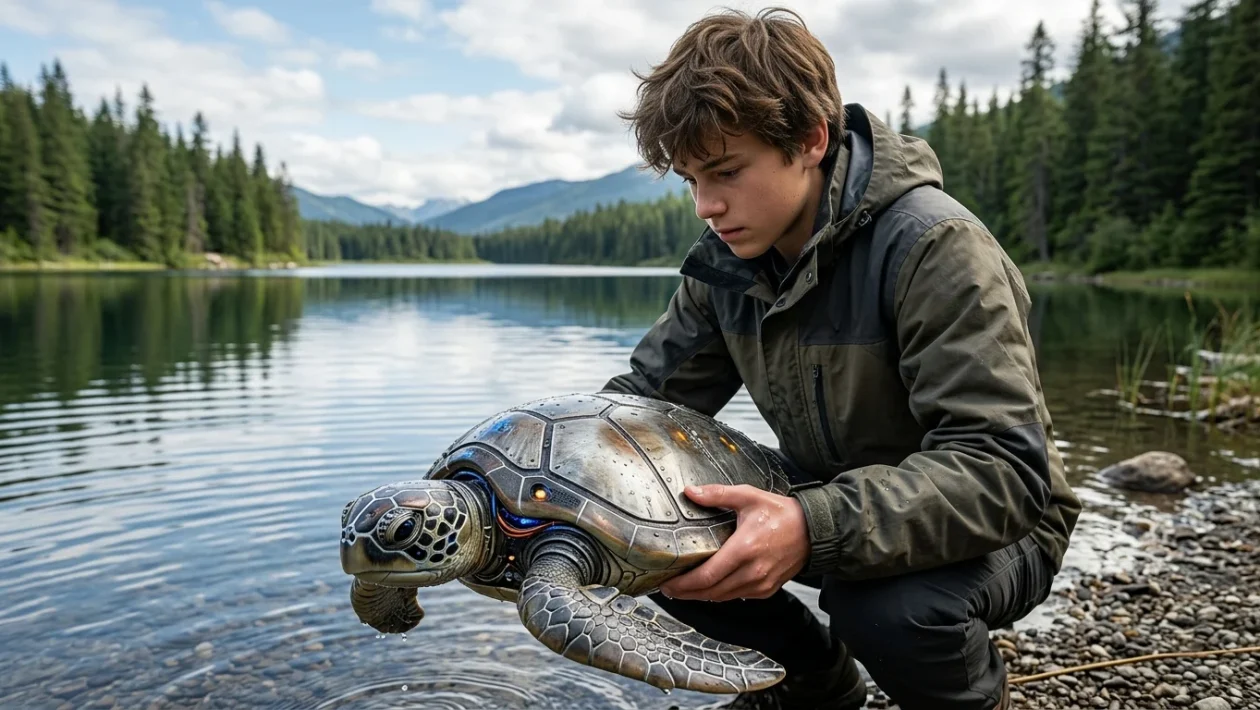
Evan Budz operating his autonomous bionic robot turtle in a Canadian lake.
In the summer of 2024, Evan Budz watched his invention sink to the bottom of his grandparents’ pool in Canada. The 16-year-old was trying to build an autonomous sea turtle robot.
“I remember some of my first tests. I would put my robot in the water, and it would sink right to the bottom,” Budz told Business Insider. “It wouldn’t swim. It wouldn’t regulate its depth. It was like a brick.”
That backyard failure sparked months of intensive engineering. Budz eventually transformed his sinking prototype into an autonomous bionic turtle capable of tracking aquatic pollution.
His breakthrough earned him a $50,000 scholarship at the 2026 Regeneron International Science and Engineering Fair. To win, Budz equipped his bionic turtle with an underwater 3D holographic camera and custom AI models designed to detect microplastics.
Inspired by the Backcountry
The concept originated during a family camping trip in Ontario’s backcountry earlier in 2024. While paddling through remote lakes, Budz spotted a snapping turtle.
“I saw a snapping turtle swimming in the water with fluidic movement and very natural motion. I was quite inspired to develop a robot that mimics it,” Budz said.
He spent about five months and roughly 2,000 hours building the robotic shell. According to Budz, a turtle design provides the perfect vehicle for environmental research.
“They are very efficient swimmers, which is key when designing a bionic robot. I wanted to ensure my turtle could swim on long-range missions without the need for constant recharging or battery dying,” he said.
The natural shape allows the robot to blend into aquatic ecosystems. Its large frame also easily houses scientific payloads like sensors and holographic imaging systems.
Hunting Microplastics with AI
After perfecting the robot’s motion with advice from experts at a local aquarium, Budz developed algorithms for autonomous navigation. The robot regulates its own depth and follows predefined search patterns entirely without human control.
In the summer of 2025, Budz shifted his focus to the onboard technology. He spent another 2,000 hours building a 3D holographic camera and training AI models to distinguish microplastics from living organisms.
“That process included optimizing the physical hardware to achieve a high enough imaging resolution to identify microparticles and microplastics that might only be 10 microns in size,” Budz said.
The onboard system captures 3D holograms of particles in the water, which the AI then analyzes. By the time he presented his project, the software boasted a 94% accuracy rate.
Testing the hardware required racing against Canada’s harsh climate. Budz had to complete his final field tests in local lakes before winter froze the water over.
Disrupting Laboratory Bottlenecks
Budz built his robot to bypass traditional, “convoluted” laboratory testing. Currently, analyzing water for microplastics requires physical sampling.
“Since it’s laboratory-based, it can take many days to complete analysis of even a small number of samples and it’s very expensive,” Budz said. He noted these methods are highly impractical for remote environments lacking highly trained personnel.
The scale of the pollution problem is massive. The Ocean Conservancy estimates that 11 million metric tons of plastic waste enter the ocean every year, impacting over 1,300 marine species.
Budz’s bionic turtle analyzes microplastics directly in the water, offering a faster and far more accessible environmental monitoring tool.
A Surreal Victory
His innovative approach secured the Gordon E. Moore Award for Positive Outcomes for Future Generations at the Regeneron science fair.
Hosted by Regeneron Pharmaceuticals, Inc. and the Society for Science, the event featured over 1,700 high school students globally. The competition awarded over $7 million in total prizes to this year’s winners.
“It was very surreal to have won this big award. I remember standing on the stage, and my name was called,” Budz said. “So many thoughts racing through my head, a bit of disbelief hearing my name called for that, but it was a very awesome experience overall.”
Budz plans to use his $50,000 scholarship to study science or engineering at a university. He remains focused on finishing high school while looking for opportunities to share his research and advance the field.