A close-up view of an HDMI cable connector.
Your old HDMI cables might not handle the 4K resolution at 120 Hz demanded by the latest hardware, but they are far from useless. Tossing them into a drawer or a trash can is a missed opportunity.
A close-up view of an HDMI cable connector.
Thanks to standard backward compatibility, a cable manufactured over a decade ago still connects seamlessly to modern televisions, laptops, and older gaming consoles. Repurposing these cables saves money and directly reduces electronic waste.
The Standard That Changed Everything
High-Definition Multimedia Interface (HDMI) arrived in 2003 and immediately became the universal standard for audio and video transmission. It simplified a famously chaotic hardware landscape.
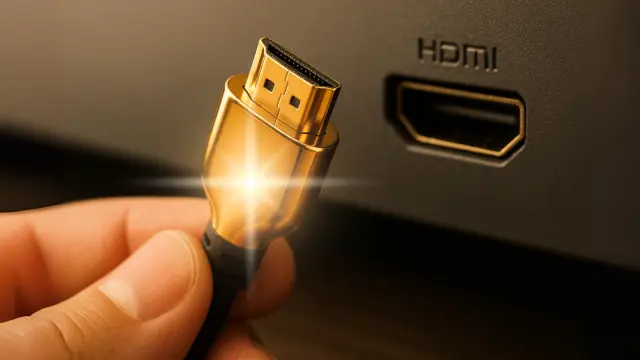
An HDMI cable ready to be plugged into a device port.
Before 2003, connecting a home entertainment system required a messy web of component cables, RCA plugs, and separate audio wires. HDMI unified the entire process into a single digital connector, delivering high-fidelity image and sound with minimal interference.
The Evolution of Display Technology
The standard evolved rapidly to keep pace with an aggressive audiovisual industry. HDMI 1.4 introduced 3D support and early 4K video, though it was strictly limited to 30 frames per second.
HDMI 2.0 delivered the necessary bandwidth for a fluid 4K experience at 60 Hz. This update fundamentally changed the baseline for modern gaming consoles and home televisions.
The leap to HDMI 2.1 expanded data bandwidth massively. It unlocked 8K resolution and introduced crucial features like Variable Refresh Rate (VRR) for gaming and Enhanced Audio Return Channel (eARC) for premium sound systems.
The tech industry is already preparing for HDMI 2.2. This upcoming standard promises even greater bandwidth, enhanced latency management, and dedicated support for high-frequency gaming.
The Power of Backward Compatibility
Every single technological leap has catered to hardcore gamers and home theater enthusiasts, yet the physical connector remains essentially the same. This is the true strength of the HDMI standard.
A cable purchased ten years ago will plug directly into a brand-new screen and transmit a perfectly stable signal. You will not get the cutting-edge 8K or ultra-fast refresh rates, but the basic connection will not fail.