The Chemistry of Curing
Construction materials rely on precise chemistry to perform safely. When experimental builders introduce foreign substances into standard mixes, the results severely alter structural integrity.
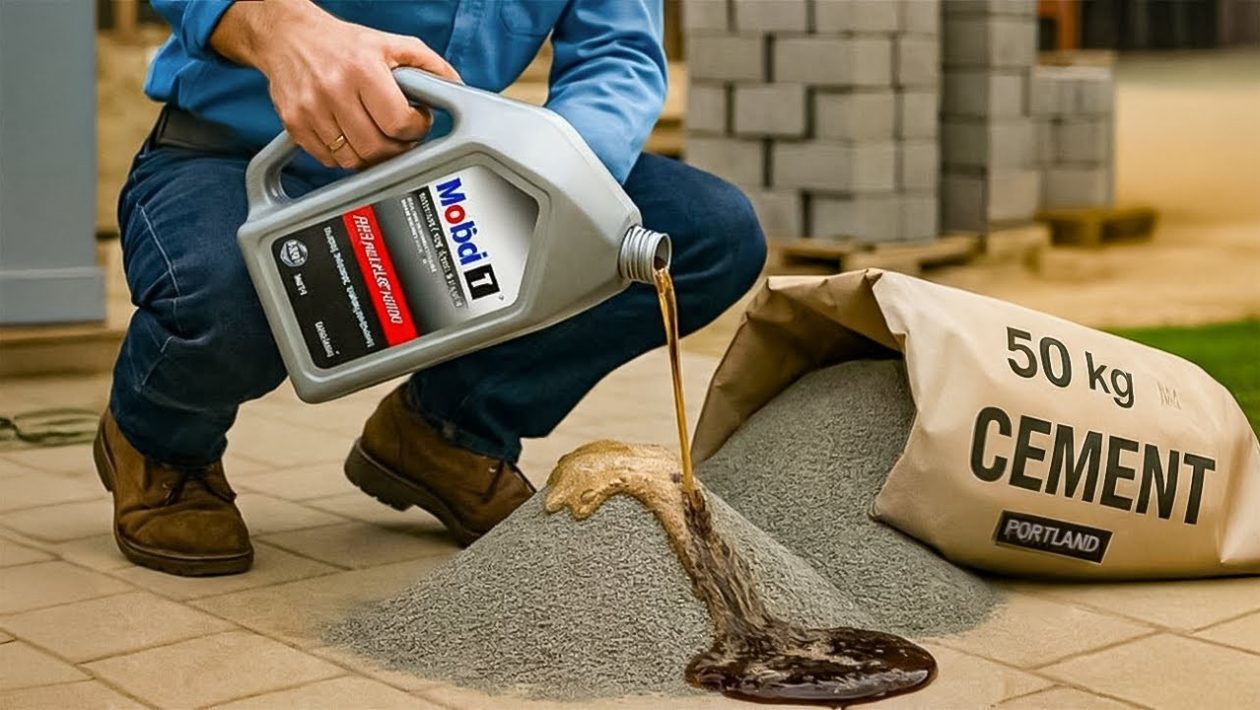
One of the most unusual combinations is mixing engine oil directly into dry cement. While it may seem like a harmless material science experiment, the resulting reaction fundamentally breaks the rules of concrete chemistry.
To understand why this mixture fails, you have to look at how cement hardens. Cement does not dry out like paint; it cures through a chemical reaction called hydration.
When water mixes with standard Portland cement, it triggers the formation of calcium silicate hydrate. These microscopic crystals grow and interlock, turning a wet sludge into a rock-hard, load-bearing structure.
How Oil Sabotages Hydration
Engine oil is highly hydrophobic, meaning it actively repels water. Introducing it into a cement mix creates an immediate physical barrier at the microscopic level.
The thick oil coats the raw cement particles in a slick, impenetrable film. When water is eventually introduced to the mix, it cannot reach the cement powder trapped beneath the oil.
Because the water and cement cannot interact, the hydration process is severely stunted. The crystalline bonds required for structural strength never form.
The Physical Reality of the Mixture
Instead of a solid, durable block, the resulting mixture behaves erratically. The material often cures into a crumbly, greasy paste with an entirely different texture than standard concrete.
If a small amount of water manages to bypass the oil and react with some of the cement, the overall structure remains fatally compromised. The cured block will possess only a fraction of its intended compressive strength.
Under even minimal stress or weight, the modified cement snaps, flakes, or crumbles entirely.
Misguided Innovation and Admixtures
Some DIY experimenters test oil mixtures in an attempt to create makeshift water-resistant concrete. Others mistakenly believe it might result in a form of lightweight concrete by trapping fluid pockets within the matrix.
Modifying concrete is a legitimate science. Professional engineers frequently use specialized chemical admixtures to entrain air, reduce water content, or increase moisture resistance.
However, raw motor oil is not an engineered admixture. It does not chemically bind with the cement. It simply sits trapped inside the pores of the material, creating weak points throughout the entire structure.
Legitimate lightweight concrete relies on expanded shale, clay, or precise foaming agents—never heavy petroleum products.
Environmental and Safety Hazards
Beyond inevitable structural failure, adding motor oil to building materials creates a severe environmental hazard. Because the oil never chemically bonds to the cement matrix, it remains in a liquid state within the porous material.
Rain, ground moisture, and temperature fluctuations will inevitably force that oil out of the cement over time. This toxic runoff leaches directly into the surrounding soil and local groundwater.
Using cement as a creative way to dispose of waste oil is highly ineffective. It also violates fundamental environmental protection guidelines across the United States.
Standard building materials require exact conditions to function safely. Swapping water for engine oil guarantees immediate material failure and long-term environmental damage.