
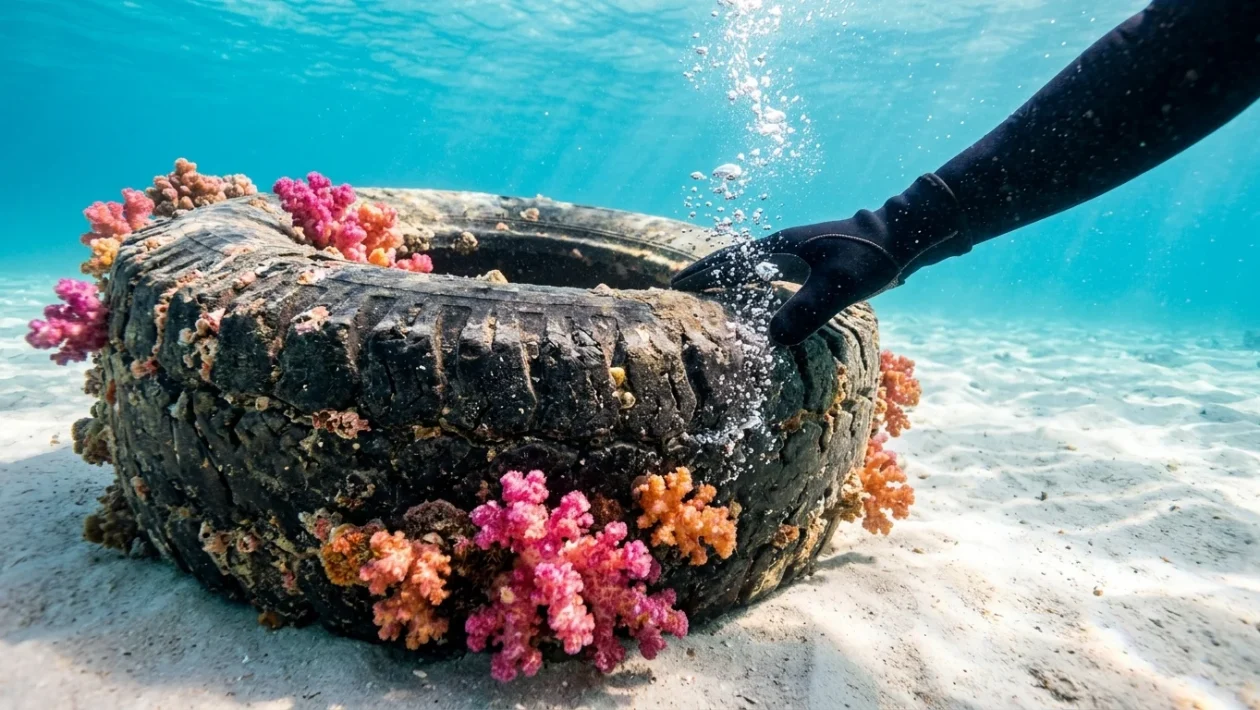
Discarded rubber tires scattered across the ocean floor destroying natural coral reefs.
Environmental initiatives are usually designed to restore ecosystems and reverse human impact. However, some well-intentioned ideas end up doing the exact opposite.
In the 1970s, the United States launched a massive ecological experiment. The plan was to build a colossal artificial reef by dumping two million discarded tires into the ocean.
Authorities backed the proposal, believing it would expand habitats for marine life. Over half a century later, the project stands as a prime example of how a theoretical environmental solution can become a devastating oceanic hazard.
The Birth of the Osborne Reef
The experiment, known as the Osborne Reef, took place off the coast of Fort Lauderdale, Florida. Planners wanted to use millions of scrap tires to extend an existing concrete reef.
The expectation was simple: corals would eventually attach to the rubber surfaces, spawning a vibrant new marine ecosystem.
To execute the project, workers bundled the tires together using nylon straps and galvanized steel clips. However, they made one crucial mistake.
The tires were never filled with concrete. Instead, they retained trapped air and water inside their casings, a fatal engineering flaw that doomed the entire structure.
Why the Tires Destroyed the Ocean Floor
Decades of exposure to a harsh marine environment took a heavy toll on the binding materials. Saltwater heavily corroded the steel clips, while relentless ocean waves wore down the nylon bands.
Eventually, the structure disintegrated. Hundreds of thousands of loose tires scattered uncontrollably across the seabed.
Far from fostering new marine life, the rogue tires became underwater battering rams. They violently impacted natural coral reefs and severely altered established underwater habitats.
The Ongoing Cleanup Mission
The fallout from this failed experiment requires constant intervention. As of 2026, extensive recovery operations are still underway off the Florida coast.
According to estimates from the environmental organization 4ocean, more than 500,000 tires are still trapped at the bottom of the ocean.
To safely extract the debris, cleanup teams now rely on underwater drones and aerial mapping systems. These technologies allow crews to precisely locate and remove the remaining rubber, slowly clearing away a 50-year-old ecological mistake.


