
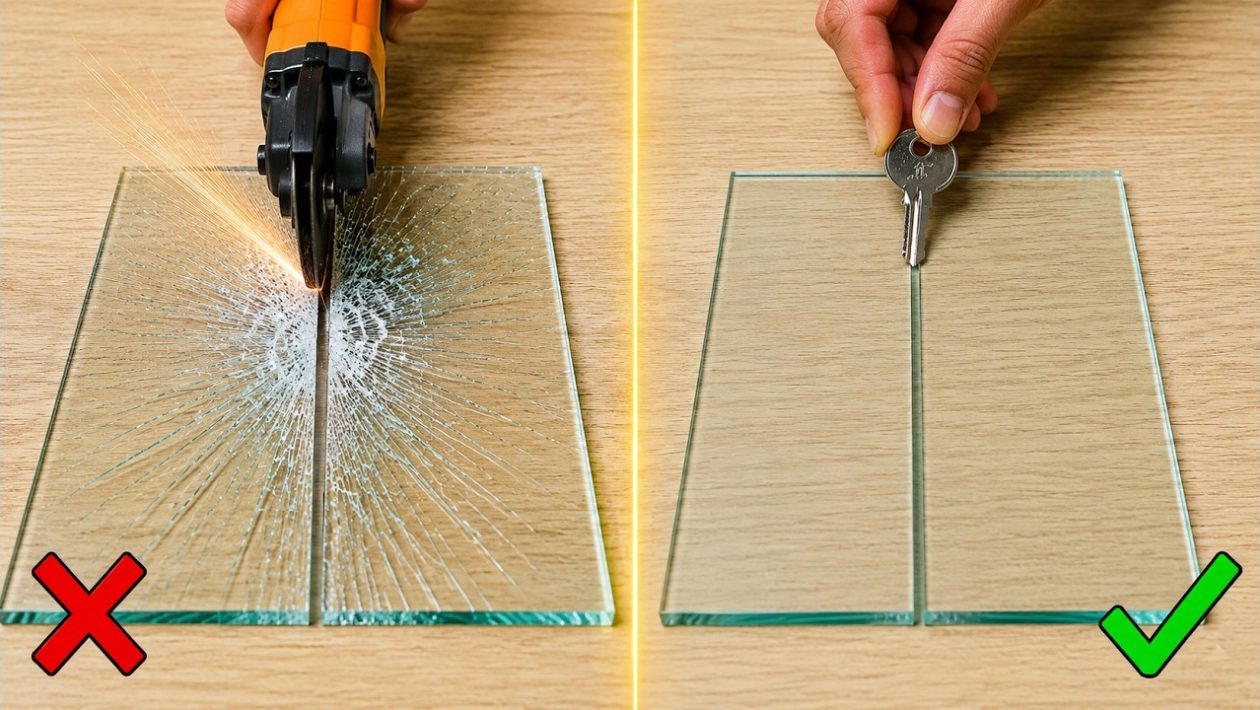
The Physics of the Perfect Break
Most DIY enthusiasts believe that cutting glass requires expensive diamond-tipped saws or complex thermal shock setups. While heat-and-ice methods are popular, they are often unreliable and prone to jagged edges. The most efficient way to achieve a clean break is by utilizing a score-and-snap technique, which leverages the stress distribution of the glass material itself.
You do not need specialized glass cutters to create a professional-grade score line. A standard, hardened steel key often possesses enough durability to etch a continuous groove into the surface of most common beverage bottles. The secret lies not in the tool, but in the consistency of the pressure applied.

A sharp, hardened steel key being used to etch a uniform line around the body of a glass bottle.
Executing the Score
To begin, place the bottle on a stable, flat surface. Hold the key firmly between your thumb and forefinger, ensuring the tip is angled at approximately 45 degrees against the glass. You are not trying to dig into the material; you are aiming to create a thin, consistent scratch line that travels 360 degrees around the circumference.
Stability is the priority. Use your non-dominant hand to rotate the bottle slowly and steadily while keeping your dominant hand—the one holding the key—perfectly still. This creates a uniform “weak point” in the glass structure. If you stop and start, or if your line drifts, the glass will likely fracture along the wrong path during the final separation step.
Thermal Stress: The Final Separation
Once you have a visible, continuous score line, you need to introduce thermal stress to force the glass to split exactly where you marked it. A clean break is best achieved by applying heat directly to the score line, followed by rapid cooling.
- Heat: Use a butane torch or a carefully controlled candle flame to heat the glass directly along the score line. Rotate the bottle slowly over the flame for about 30 to 45 seconds to ensure even thermal expansion.
- Cooling: Immediately dip the heated score line into ice-cold water. The contrast between the expanded, heated glass and the sudden contraction from the cold water will cause a stress fracture to propagate along your score line.
Safety and Finishing
Glass edges are razor-sharp. After the bottle has separated, do not attempt to handle the edges with your bare hands. Use a piece of medium-grit sandpaper or a diamond-grit hand file to smooth the perimeter. Work in a circular motion to bevel the edge, which removes the microscopic shards that pose a cutting hazard.
Always perform this process in a well-ventilated area. If you find the bottle is not splitting easily, do not force it. Simply re-score the line slightly deeper and repeat the heating process. Patience is the ultimate factor in achieving a professional finish with minimal equipment.




