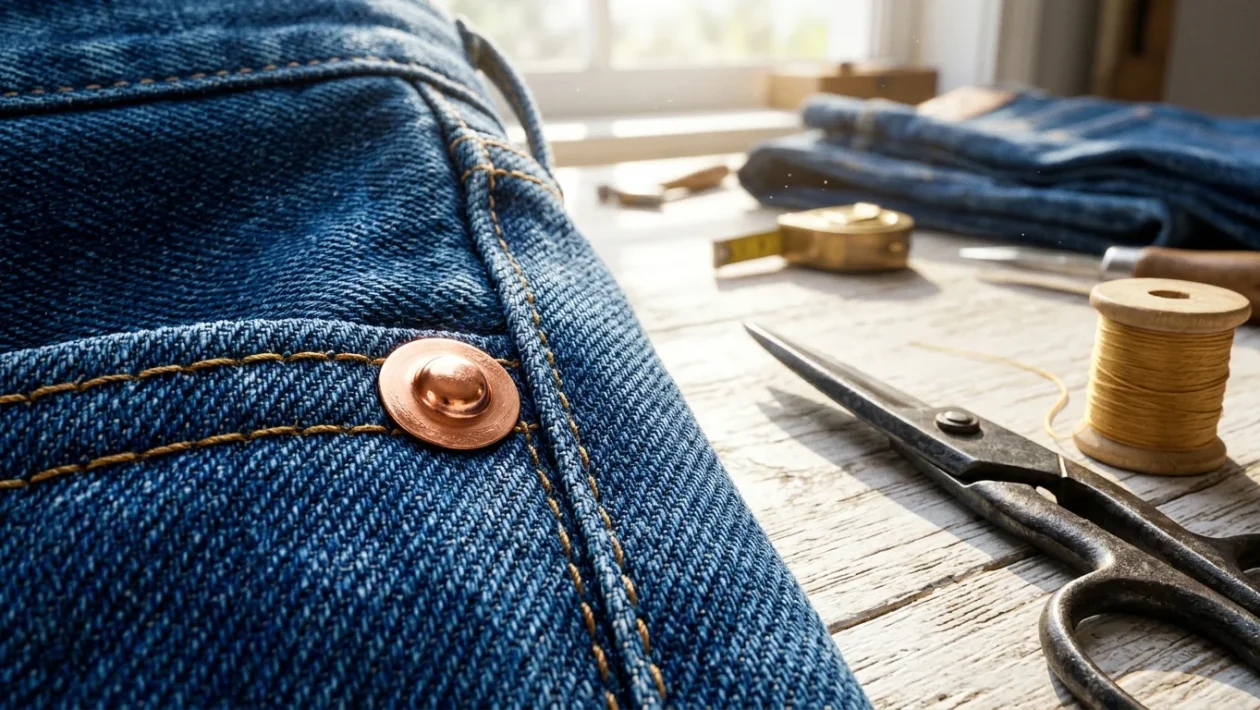
Close-up of a classic copper rivet on the pocket seam of blue denim jeans.
A 19th-Century Solution for Heavy Labor
Those tiny metal buttons on the pockets of your jeans are not just decorative details. Known as rivets, they have a highly practical history and their true function is deeply rooted in garment durability.
Before denim became a global fashion staple, these metal studs solved a massive problem for 19th-century workwear. Workers in mines and heavy manual jobs constantly tore their pants at high-stress points.
The rivets were specifically placed to reinforce areas prone to ripping, particularly the pocket corners and the base of the fly, ensuring survival in demanding labor environments.
The $68 Partnership That Changed Fashion
In 1871, Jacob W. Davis, a Latvian immigrant tailor based in Reno, Nevada, found a fix. He started attaching copper rivets to the pants he made for his clients, triggering a radical shift in the textile industry.
His simple idea drastically improved the lifespan of the garments. However, Davis lacked the $68 needed to file a patent for his breakthrough invention.
To secure his design, Davis partnered with a San Francisco fabric merchant named Levi Strauss in 1872. The duo officially registered the patent in 1873, introducing the world’s first riveted jeans.
For the next 17 years, Levi Strauss & Co. held the exclusive rights to manufacture riveted work pants. This functional feature quickly transformed into a definitive brand identity mark.
Why Rivets Remain Today
The exclusive patent expired in 1890, allowing competitors to flood the market with their own riveted designs. The metal studs evolved from a structural necessity into a distinctive feature of authenticity.
Facing new competition, Levi’s scrambled to strengthen its commercial identity. The company trademarked the famous two-horse label in 1886, the distinctive red tab in 1936, and the stitched arc on the back pockets in 1943.
Modern manufacturing techniques and reinforced stitching mean these tiny discs are no longer structurally required. Yet, the buttons on the jeans remain today simply to honor the rugged heritage and true essence of classic denim.