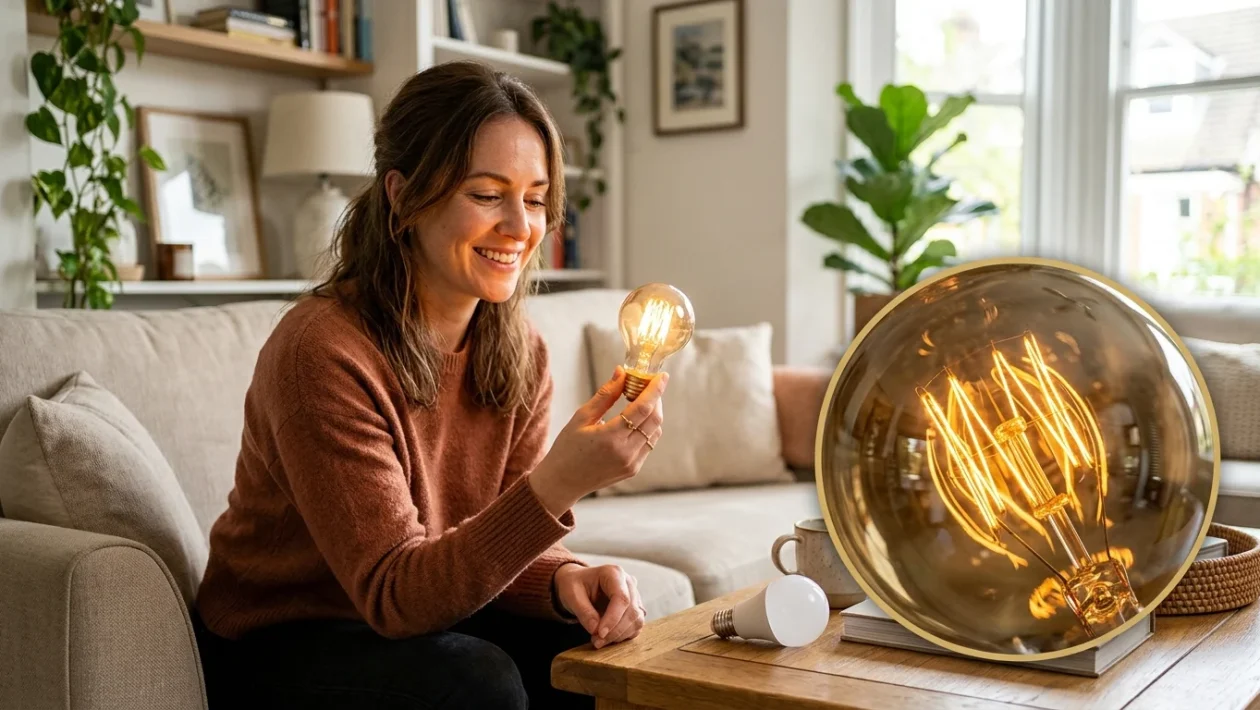
Years ago, replacing traditional incandescent bulbs with LEDs seemed like an undeniable upgrade. Consumers eagerly bought into the promise of slashed energy bills, decade-long lifespans, and modern efficiency.
Today, a growing backlash is sweeping through households. The reality of daily LED use simply has not matched the marketing hype.
While utility costs have dropped, many homeowners now complain of chronic eye fatigue and a distinct loss of domestic coziness. The technology designed to fix all lighting problems has introduced a host of new ones.
The “Warm White” Deception
A glowing traditional light bulb emitting a warm, yellow light.
The biggest disappointment for consumers stems from color temperature. Packaging routinely promises a “warm white” glow, yet the actual light often feels cold, sterile, and better suited for a corporate office.
Cheap LED bulbs frequently emit a subtle bluish tint. Biologically, the human body reacts instinctively to light color—warm, yellowish tones trigger relaxation, while cooler tones signal the brain to stay alert.
Flooding a living room or bedroom with harsh, cool lighting effectively destroys the calming atmosphere required to unwind at the end of the day. Consumers are discovering that real lighting quality requires checking the Color Rendering Index (CRI), not just wattage.
The Invisible Flicker Effect
The problem extends well beyond color. Low-cost LEDs built with substandard electronics often suffer from a strobe effect that is invisible to the naked eye.
This rapid, constant flickering forces the brain to overwork. The result is a combination of eye strain, headaches, and general irritability during the evening hours.
A simple smartphone camera test reveals the truth. By pointing a phone camera at an illuminated LED bulb, users can see if the screen shows distinct waves or banding. If it does, the light source is unstable and degrading the home’s comfort.
The Lifespan Myth
Manufacturers designed LEDs to last for years in theory, but practical application tells a remarkably different story.
Voltage fluctuations, cheap manufacturing, and poor internal cooling cause premature burnouts. The electronic components inside LED bulbs generate heat that must escape to prevent damage.
When placed inside enclosed glass fixtures, the lack of ventilation rapidly degrades the bulb’s electronics. Replacing an expensive, “long-lasting” bulb every few months quickly erases any promised energy savings.
Where LEDs Still Shine
The technology is not fundamentally flawed, but it requires highly strategic placement.
LEDs remain the superior choice for high-visibility, functional areas. Garages, hallways, bathrooms, and outdoor security fixtures benefit heavily from their intense brightness.
In transient spaces where residents do not linger to relax, the sterile nature of the light is irrelevant, and the energy efficiency is maximized.
The Return to Coziness
Living rooms, bedrooms, and children’s nurseries demand ambient mood lighting. A harsh, flickering LED easily ruins the atmosphere of a quiet evening.
To reclaim their domestic sanctuaries, consumers are actively seeking alternatives. Many are upgrading to high-end dimmable systems and warmer filament-style LEDs.
Others are simply abandoning modern tech altogether, tracking down classic incandescent bulbs while they are still available to buy.