It happens every summer. You haul a massive, heavy watermelon home from the grocery store, slice it open, and find a pale, flavorless mess.
Picking a perfectly ripe, juicy watermelon is not a game of chance. It comes down to a few specific visual and physical cues that indicate exactly what is happening under the rind.
Instead of guessing, use these proven indicators to find the sweetest fruit in the bin.
Locate the Field Spot
Every watermelon has a distinct resting spot where it sat on the ground while growing in the field. This is the very first thing you should check before putting a melon in your cart.
You want this spot to be a creamy, buttery yellow or even orange. If the spot is white, pale, or completely missing, the melon was picked far too early.
A deep yellow field spot guarantees the fruit spent enough time on the vine to develop its natural sugars.
Inspect the Webbing
Those ugly brown, web-like lines on a watermelon are actually a sign of premium quality. This webbing shows how many times bees pollinated the flower during the growing process.
More pollination directly translates to a sweeter, more robustly flavored fruit. Do not shy away from a melon that looks a little scarred or scratched up by these brown veins.
Look for a Dull Rind
Human instinct draws us toward shiny, perfect-looking produce. When it comes to watermelons, a glossy exterior is a warning sign.
A shiny rind indicates the watermelon is underripe. A perfectly ripe watermelon will always have a dull, matte finish across its entire surface.
The Weight Test
A ripe watermelon consists of roughly 92 percent water. Because of this, it should feel unexpectedly heavy for its size when you pick it up.
Find two or three melons of similar size and lift them one by one to compare. The heaviest melon of the bunch will have the highest water content, making it the juiciest option.
Check for Uniform Shape
Irregular bumps, lumps, or a lopsided shape indicate that the watermelon received inconsistent sun or water during its growth cycle. Stick to melons that are perfectly symmetrical.
Growers often categorize watermelons into two distinct shapes: elongated and round. The rounder melons tend to be sweeter and more flavorful, while the elongated ones are typically more watery.
Give It a Thump
The classic knock test is famous for a reason, even if many shoppers do it incorrectly. Give the underbelly of the watermelon a firm tap with your knuckles.
A ripe melon delivers a deep, hollow sound, somewhat like a tenor drum. If it yields a dull, flat, or solid thud, the flesh inside is likely overripe, thick-rinded, or mealy.
Examine the Stem
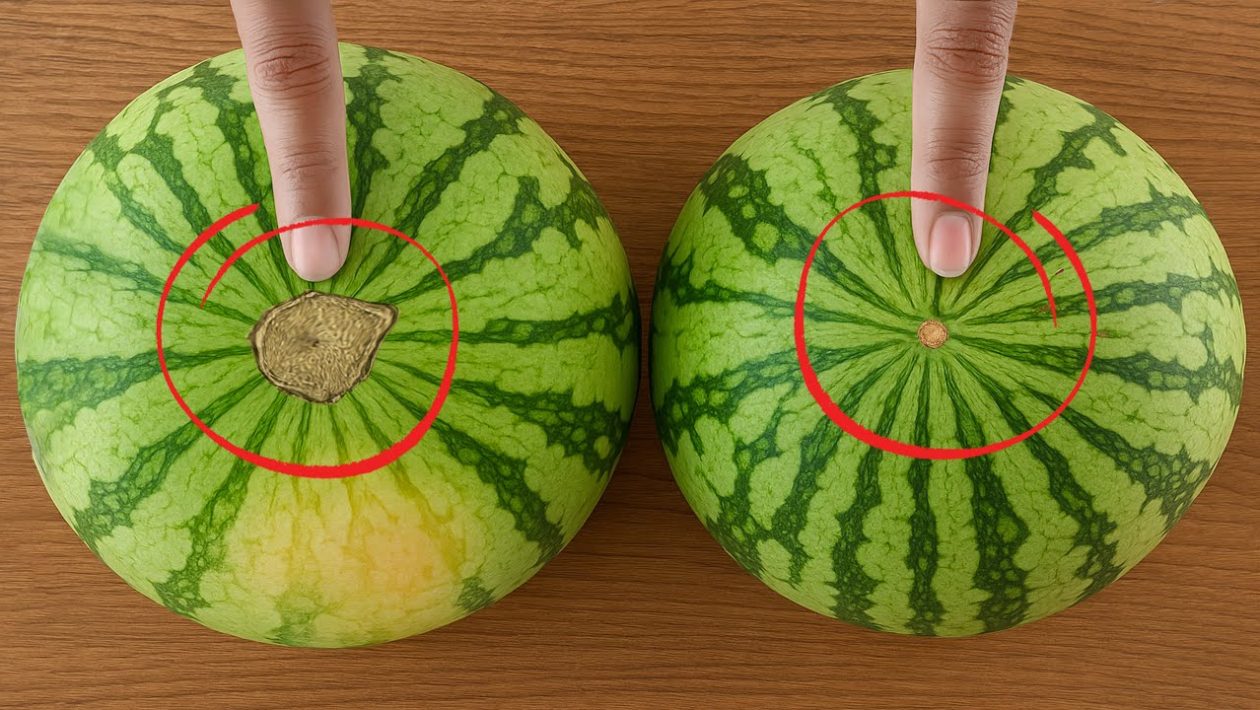
If the watermelon still has a small piece of stem attached, take a close look at it. The condition of the stem tells you exactly when the farmer harvested the fruit.
A dry, brown stem means the melon had time to fully ripen on the vine before being cut. A green, flexible stem is a dead giveaway that the watermelon was harvested prematurely and will lack sweetness.