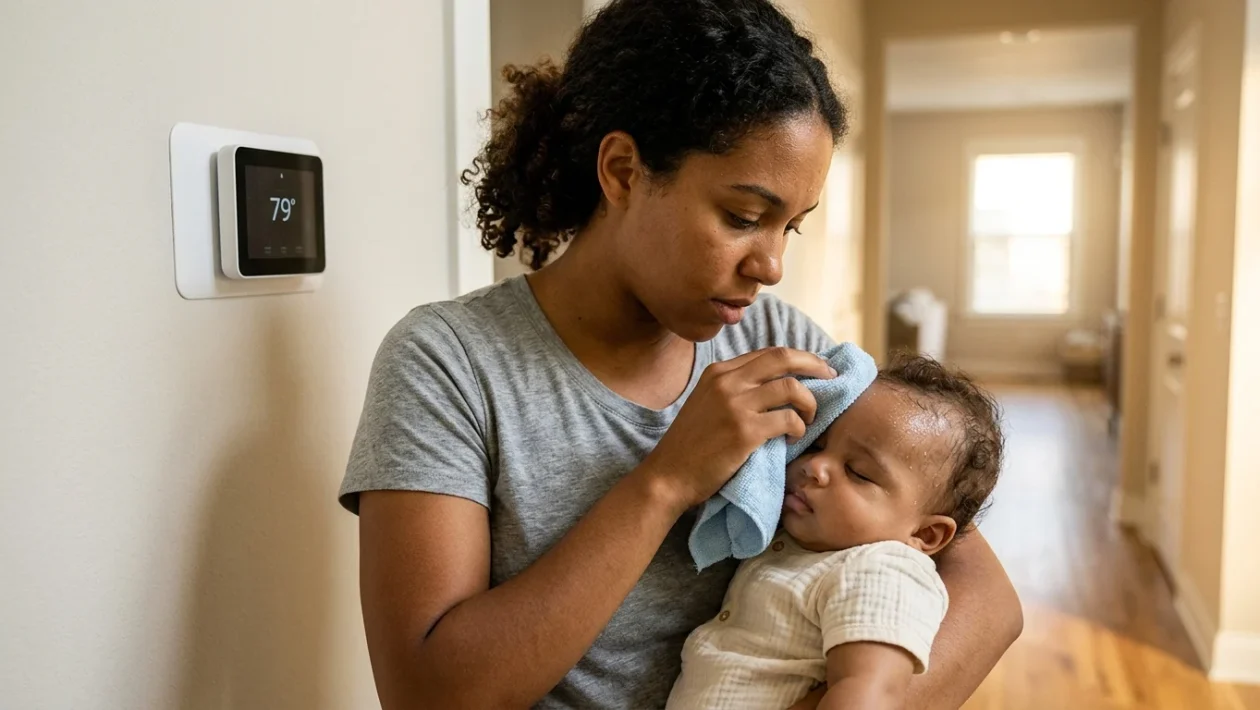
A digital home thermostat mounted on a wall displaying temperature settings.
A digital home thermostat mounted on a wall.
During sweltering summers, public officials and corporate websites often echo the same cost-saving mantra. They urge residents to set their thermostats to 78 degrees Fahrenheit (25.6 C), or even 81 F (27.2 C), to avoid massive utility bills.
But that advice ignores a crucial reality: a single temperature target cannot safely accommodate every human body or home environment.
Before having children, one energy costs researcher successfully kept her summer electric bills under $200 by leaving the thermostat at 79 F (26.1 C). She and her husband simply adapted by sleeping without blankets and taking cold showers.
Then, the summer after her daughter’s first birthday, the infant began vomiting in the middle of the night and developed small bumps across her chest. The parents initially blamed blueberries, completely cutting acidic foods and changing her milk.
The diet changes did nothing. It was only when they lowered the hallway thermostat to bring the infant’s bedroom down to 74 F (23.3 C) that the nighttime vomiting abruptly stopped.
The True Cost of Air Conditioning
An outdoor air conditioning condenser unit sitting outside a brick house.
Every cooling system operates differently based on its design, age, and maintenance history. Homes also vary wildly in insulation quality, square footage, sun exposure, and local climate.
While 78 F (25.6 C) might keep a lid on financial costs, it is not an official safety threshold. Most U.S. households actively seek an indoor temperature closer to 72 F (22.2 C) during the summer.
Lowering the indoor temperature forces an air conditioner to work significantly harder, especially when outside temperatures hit 95 F (35 C). During peak summer months, air conditioning can easily consume more than 50% of a home’s total energy usage.
However, running the AC does more than drop the temperature; it strips humidity from the air. According to the National Weather Service, if it is 90 F (32.2 C) outside with 60% humidity, the air will actually feel hotter than 100 F (37.8 C) because human sweat cannot evaporate effectively.
Smarter Ways to Beat the Heat

A modern ceiling fan circulating air inside a home.
Families can reduce the heavy lifting required from their cooling systems through simple environmental adjustments. Closing curtains on sun-facing windows and avoiding oven use during the hottest parts of the day keeps internal temperatures manageable.
Air movement from ceiling or portable fans also makes rooms feel cooler, allowing for a slightly higher thermostat setting. But there is a dangerous tipping point to this strategy.
The Centers for Disease Control and Prevention explicitly warns against using fans when indoor temperatures climb above 90 F (32.2 C). When the surrounding air is hotter than human skin temperature—which hovers between 90 and 94 F—a fan acts like a convection oven, dangerously accelerating the transfer of heat into the body.
Targeting the Right Spaces
A single hallway thermostat rarely reflects the temperature in a sunny, upstairs bedroom. Experts recommend using inexpensive household thermometers to measure the specific rooms where people sleep or spend the majority of their time.
Instead of trying to cool an entire house equally, families should gather in shaded rooms or lower floors. Cooling the body directly with damp cloths, cold showers, ice packs, and regular hydration provides immediate relief without touching the thermostat dial.

People cooling off and resting in a shaded public area.
Recognizing the Breaking Point
Tragically, people die indoors every year because they shut off functional air conditioners to save money during high heat. Infants and individuals with chronic health conditions require cooler spaces for much longer periods than healthy adults.
Households must monitor each other for early signs of heat stress. Symptoms include dizziness, weakness, intense thirst, nausea, confusion, or unusual fatigue.
If someone experiences confusion, a loss of consciousness, or a highly elevated body temperature, it indicates heat stroke. This is a severe medical emergency requiring immediate hospital intervention.
For those struggling to pay summer electricity bills, help is available. Residents can call the local 211 hotline to find free, air-conditioned cooling centers, splash pads, public pools, or libraries.
Utility companies often offer payment plans or cost subsidies to prevent disconnections during heat waves. Furthermore, state and local governments routinely fund programs to help lower-income residents insulate their homes and upgrade inefficient appliances.