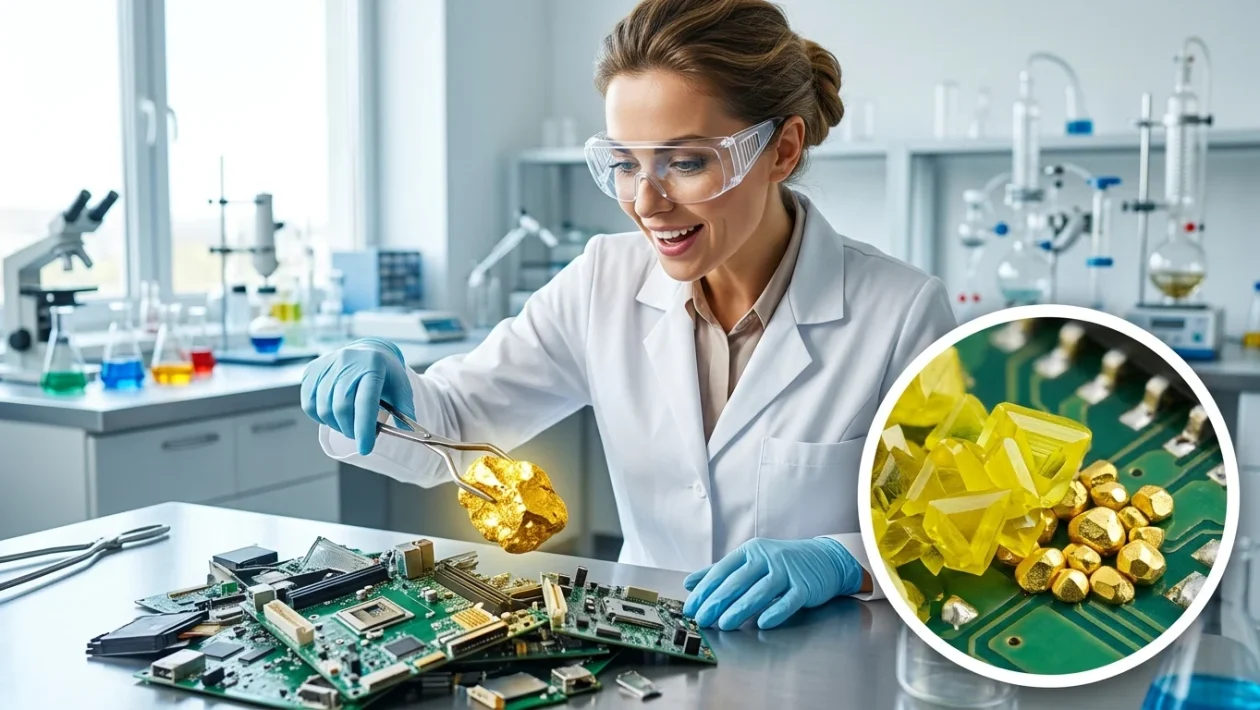
The global push to recover precious metals from electronic waste has long been stalled by high costs and heavy pollution. Now, a major scientific breakthrough is offering a safe, highly efficient alternative to traditional mining.
Scientists at ETH Zurich, a prestigious Swiss public university founded in 1854, recently achieved an unprecedented milestone. The research team successfully recovered 22-carat gold from common electronic waste without inflicting any environmental damage.
Hitting 99% Purity Without Toxins
Researchers at Flinders University in Australia have pushed the boundaries of e-waste recycling even further. They developed a complementary process that yields gold of exceptionally high purity, completely bypassing the dangerous chemicals traditionally used in mineral refinement.

Researchers from ETH Zurich discovered an innovative process enabling the extraction of 22-carat gold from discarded electronic components.
Initial data from the Australian team reveals the extracted gold reaches over 99% purity. This level of refinement is notoriously difficult to achieve, even with conventional industrial techniques.
The breakthrough centers on replacing cyanide—a highly toxic compound standard in gold extraction—with trichloroisocyanuric acid (TCCA). TCCA is a safe, widely available substance commonly used for water disinfection.
The Sulfur Polymer Secret
The true innovation lies in a specialized sulfur polymer designed to selectively bind to dissolved gold. Once the gold is captured, a simple, controlled heating or chemical treatment releases the precious metal in its purest form.
Because the polymer can be reused multiple times, the method is highly sustainable and economically viable for large-scale operations.
Reshaping the Global Mining Economy
This toxic-free approach does more than clean up e-waste recycling; it signals a fundamental paradigm shift for the mining industry. By eliminating cyanide, the new process neutralizes severe environmental and health risks while feeding directly into a circular economy.
The immediate benefits of the process include:
- Drastic reduction of global electronic waste
- Highly effective and profitable gold recovery
- Accelerated growth of the circular economy
- Creation of high-skilled industrial jobs
Industry experts project this innovation will generate substantial new employment opportunities. As the technology scales for commercial use, emerging roles will span technology waste management, chemical engineering, and industrial sustainability.