Imagine your current laptop trying to calculate every possible route a nationwide delivery truck could take to maximize fuel efficiency. It would freeze up, overheat, and completely crash. Quantum computing is the ultimate heavy-duty wrench that fixes this processing bottleneck permanently. We are talking about machines that can solve complex logistical problems in three minutes that would take today’s most advanced supercomputers roughly 10,000 years to crack.
IBM just dropped a massive bombshell on the tech industry this spring. They are officially investing a staggering US$10 billion to develop a fully functional, large-scale quantum computer.
This is not just another shiny silicon valley gadget upgrade. This is a fundamental rewiring of how humans process information, and it is going to overhaul everything from medical research to how we protect our bank accounts.
The Truth About the Quantum Computing Revolution
Standard computers speak a very simple language. They process information in bits, which are strictly ones or zeros, like a basic light switch flipped on or off.
Quantum computers throw those basic rules right out the window. They use “qubits,” which can exist as a one, a zero, or both at the exact same time. It is a mind-bending concept, but it allows these machines to test millions of different possibilities simultaneously.
Canada is actually no stranger to this revolution. Companies like British Columbia’s D-Wave Systems have been pioneers in the quantum space for years. But IBM’s massive capital injection is what will finally drag this sci-fi concept out of the laboratory and into commercial reality.
Peeking Inside IBM’s 10 Billion Dollar Wallet
You do not drop ten billion dollars on a whim. Building these machines requires precision engineering that makes a Swiss watch look like a child’s toy.
A huge chunk of that budget goes into creating extreme hardware environments. Quantum processors generate practically zero heat, but they are incredibly sensitive to outside interference. Even a slight change in room temperature or a microscopic vibration can destroy a calculation.
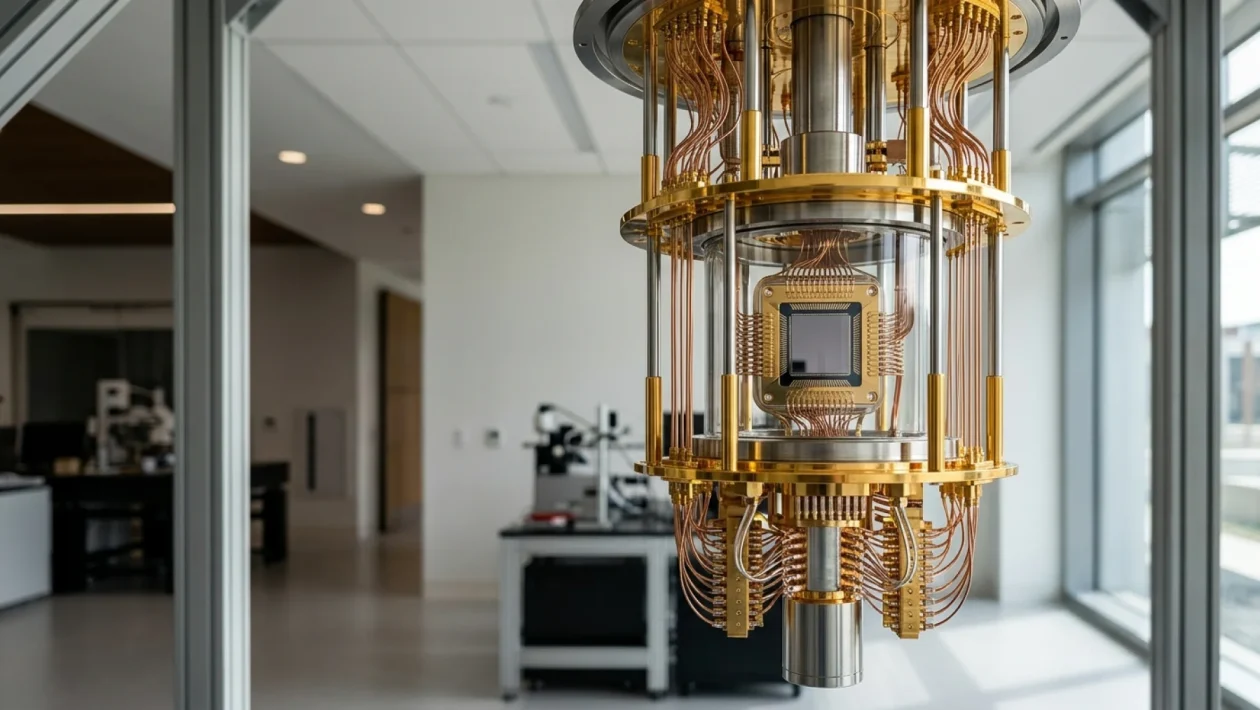
To combat this, the processors are housed in complex “chandeliers” that cool the chips to absolute zero. Interestingly, IBM relies heavily on their world-class microelectronics facility right in Bromont, Quebec, to help manufacture the advanced packaging needed for these hyper-sensitive components.
How You Build a Technological Megaproject
Executing a megaproject of this scale requires a flawless, step-by-step assembly line of innovation. Here is exactly how scientists pull off a quantum calculation.
- Supercooling the Core: Technicians plunge the entire quantum processor down to minus 273 degrees Celsius, making it colder than deep space.
- Isolating the Environment: The system is sealed in a heavy vacuum chamber to block out any electromagnetic noise from the outside world.
- Microwave Pulses: Researchers fire precisely calibrated microwave beams at the qubits to feed them the data they need to process.
- Extracting the Answer: The qubits settle into a final state, and the machine translates that quantum data back into standard code a normal computer can read.
Why Launching in 2029 Changes the Game
Setting a hard deadline for 2029 is IBM planting a massive flag in the ground. They are telling the world that large-scale quantum utility is less than three years away.
By that time, the hardware will finally be stable enough to handle massive workloads without crashing. The implications for everyday life are massive, especially when you compare the raw specs.
| Standard Supercomputer | Quantum Computer (2029) |
|---|---|
| Solves one path at a time | Analyzes all paths simultaneously |
| Struggles with complex molecules | Easily maps new lifesaving drugs |
| Vulnerable to future hacks | Creates unbreakable encryption |
When this technology fully matures, standard processing is going to look like we are communicating with tin cans and string.
“Quantum computing is not going to replace your desktop computer. It is going to sit behind the scenes, tackling the massive, impossible problems that currently bring standard servers to their knees.”
Frequently Asked Questions
Will a quantum computer replace my home PC?
Absolutely not. You do not need a multi-million dollar, supercooled machine to check your email or stream movies. Normal computers will stick around for everyday tasks, while quantum machines will handle heavy-duty global research.
Why do they need ten billion dollars to build it?
The parts are not exactly sitting on shelves at your local hardware store. Every single cooling mechanism, vacuum seal, and processor chip has to be custom-engineered from scratch by highly paid specialists.
Is my online banking still safe?
For now, yes. While a fully realized quantum computer could theoretically crack current passwords, banks and tech giants are already developing “quantum-safe” encryption to protect our data long before 2029.
🤝 Thank you for reading! The world of processing power is shifting faster than ever, and keeping up with the hardware can feel like a full-time job.
💡 I want to hear from you. What do you think about IBM dropping ten billion dollars on a single tech project? Do you think the 2029 timeline is realistic, or just optimistic marketing?
📱 Share your thoughts with your friends and colleagues, and let’s get a real conversation going about the future of computing.
👇 Good luck navigating the tech landscape out there, and I will catch you in the next breakdown!