
Detailed close-up view of the Martian surface captured by NASA’s Psyche spacecraft.
NASA has released a captivating sequence of images captured by the Psyche spacecraft as it skimmed aggressively past Mars.
The probe is currently navigating the vast distance toward the main asteroid belt between Mars and Jupiter. Its ultimate mission is to intercept and study the metal-rich asteroid Psyche.
While the spacecraft won’t reach its final target until July 2029, it executed a critical close approach of the Red Planet in May 2026.
The Martian surface photographed from low orbit by an interplanetary spacecraft.
Passing at a distance of just 4,609 kilometers (2,864 miles), Psyche beamed back unprecedented views.
Because of its position relative to the Sun, Mars initially appeared as a distant crescent. As Psyche closed the gap, its cameras resolved vivid details of the surface, highlighting rugged impact craters and the planet’s expansive south polar ice cap.
A High-Speed Gravity Assist
Spacecraft rarely travel in straight lines.
To conserve precious fuel, engineers map out complex trajectories that utilize the gravitational pull of major planets.
During the month-long Mars flyby, Psyche harnessed the planet’s gravity to tweak its flight path and gain the necessary momentum for the long trek ahead.
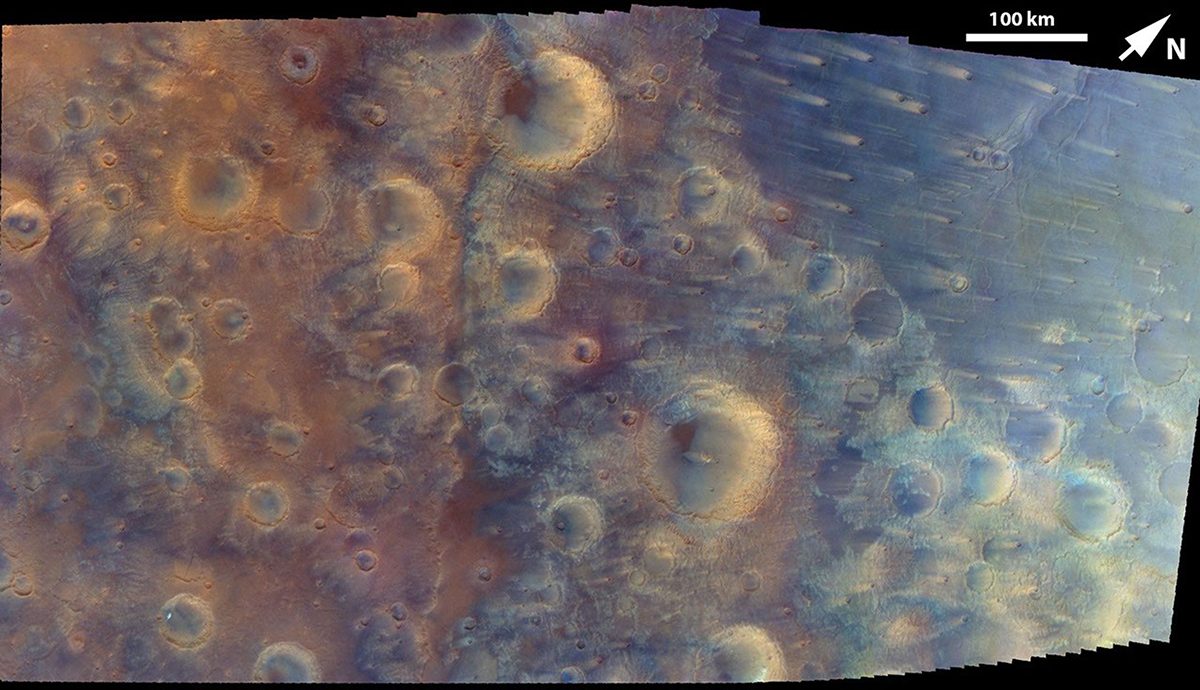
A highly detailed view of the heavily cratered terrain scarring the Martian landscape.
The flyby also served as a rigorous stress-test for the probe’s onboard instruments.
Psyche carries a multispectral imager—a pair of advanced cameras designed to photograph celestial bodies across multiple wavelengths of light.
According to Lindy Elkins-Tanton, principal investigator for Psyche at the University of California, Berkeley, the team pushed their equipment to the limit.
“The mission’s imager, magnetometer, and gamma-ray and neutron spectrometer teams worked overtime to make full use of this planetary encounter, and all instruments delivered great results,” Elkins-Tanton said.
“We didn’t anticipate big discoveries, given how extensively the planet has been studied, but we did complement Mars science with the data we collected through Psyche’s unique perspective.”
Scanning Planetary Chemistry
Among the most distinct features documented was Huygens, an enormous double-ringed crater measuring 470 kilometers (290 miles) across.
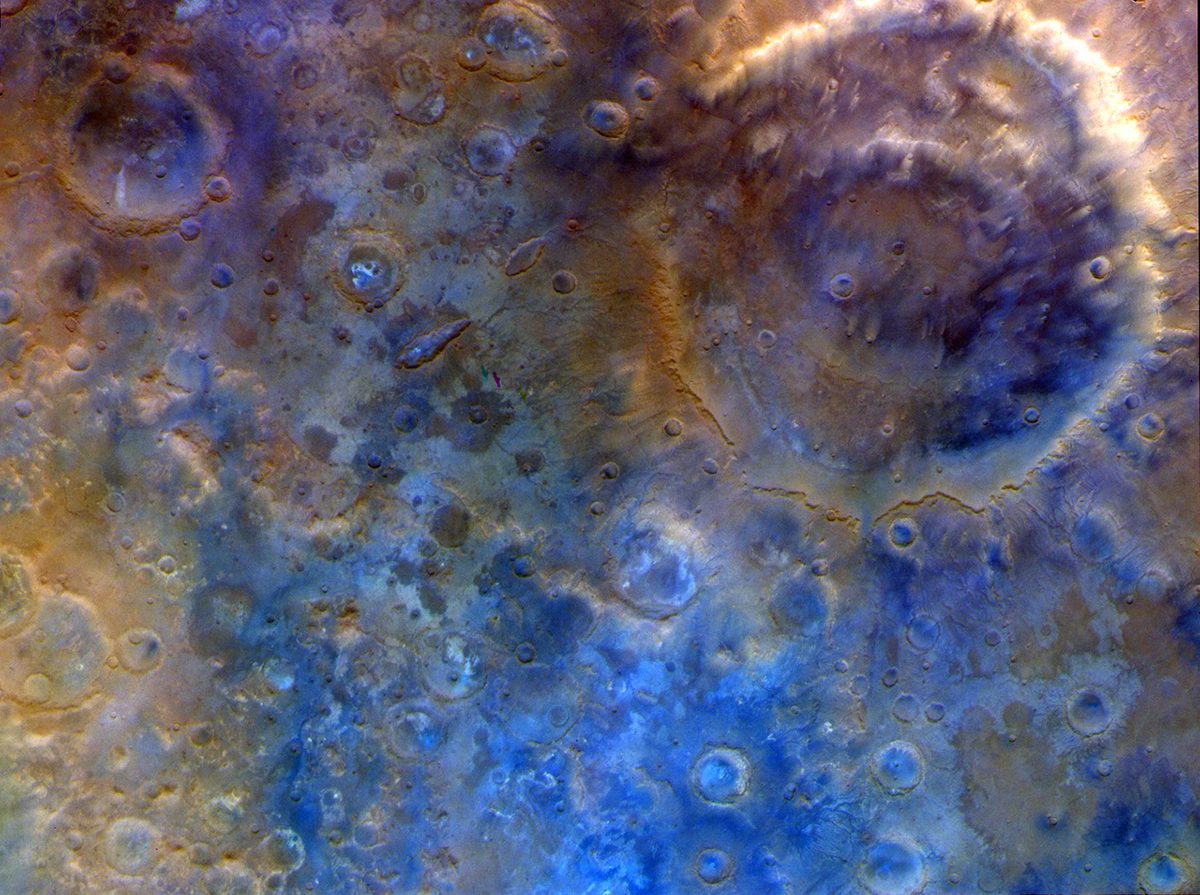
A false-color map of Mars highlighting the massive, double-ringed Huygens crater.
As the cameras rapidly snapped photos, the probe’s gamma-ray and neutron spectrometer analyzed the planet’s chemical makeup.
When high-energy cosmic rays bombard a celestial body, surface elements absorb the energy and emit unique signatures of neutrons and gamma rays.
“Around the time of Mars closest approach, the neutron spectrometer detected a count-rate enhancement close to what we anticipated,” said David Lawrence, science lead for the spectrometer at the Johns Hopkins Applied Physics Laboratory.
“As expected, we didn’t detect gamma rays from Mars, but we put the instrument through its paces, and it performed excellently.”
Reading the Magnetic Field
The spacecraft is also equipped with a highly sensitive magnetometer.
Its primary job is to determine whether the target asteroid is the remnant metallic core of a destroyed early planet. The Mars flyby gave the instrument its first taste of an actual planetary magnetic signature.
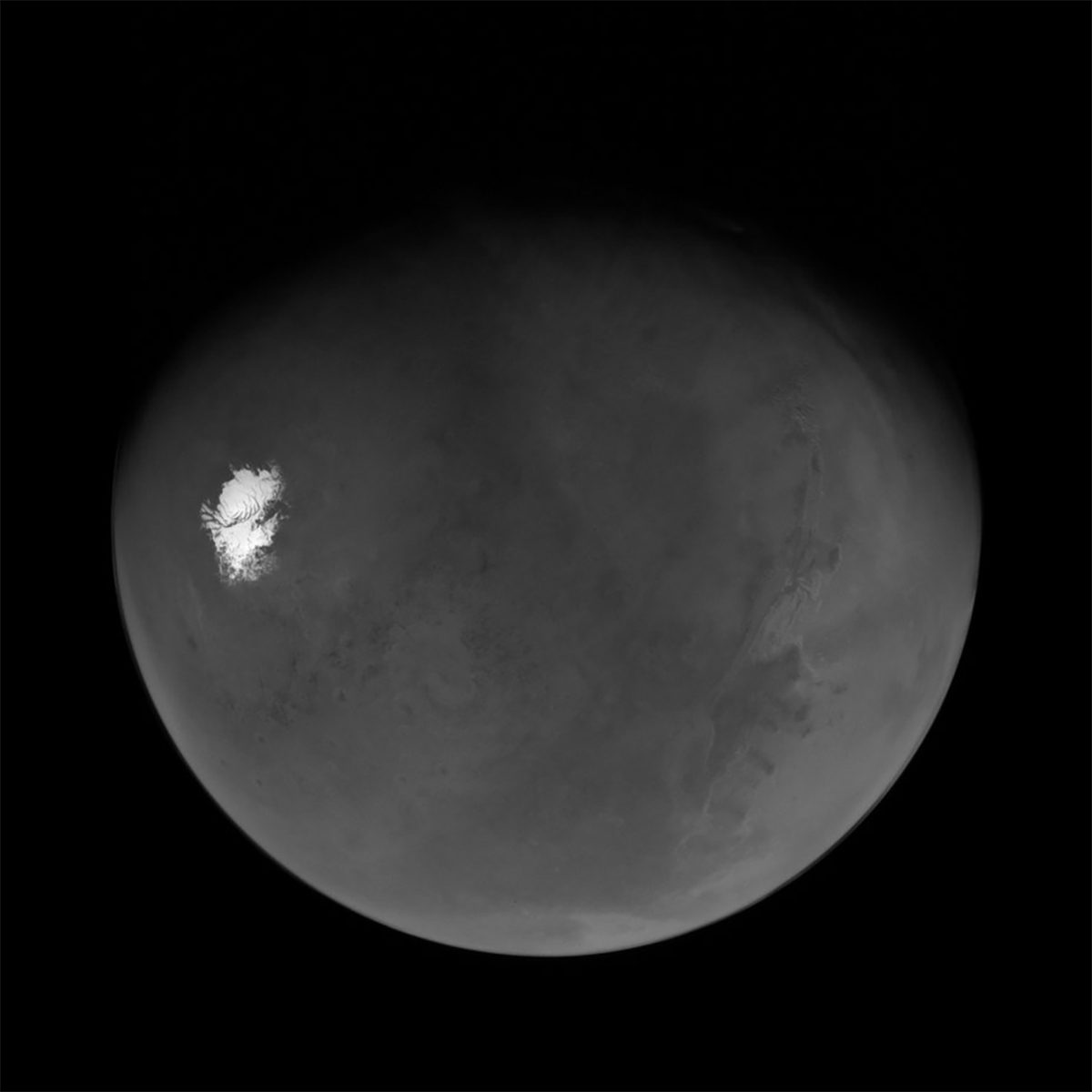
A nearly full view of the Red Planet featuring the sprawling Valles Marineris canyon system.
Ben Weiss, Psyche’s deputy principal investigator at the Massachusetts Institute of Technology, noted that the magnetometer recorded a massive spike in activity.
“As the spacecraft passed close to Mars, the magnetometer saw an intense uptick in magnetic field corresponding to the bow shock region, where the solar wind slams into the planet’s magnetic field,” Weiss explained.
Pinpointing the Martian Moons
Alongside planetary mapping, the visual team used the flyby to hunt for tiny satellites.
Jim Bell, the imager instrument lead at Arizona State University, said the cameras managed to pinpoint the Martian moons Phobos and Deimos from extreme distances.
This served as a crucial practice run for locating tiny, undiscovered moonlets that might orbit the asteroid Psyche.
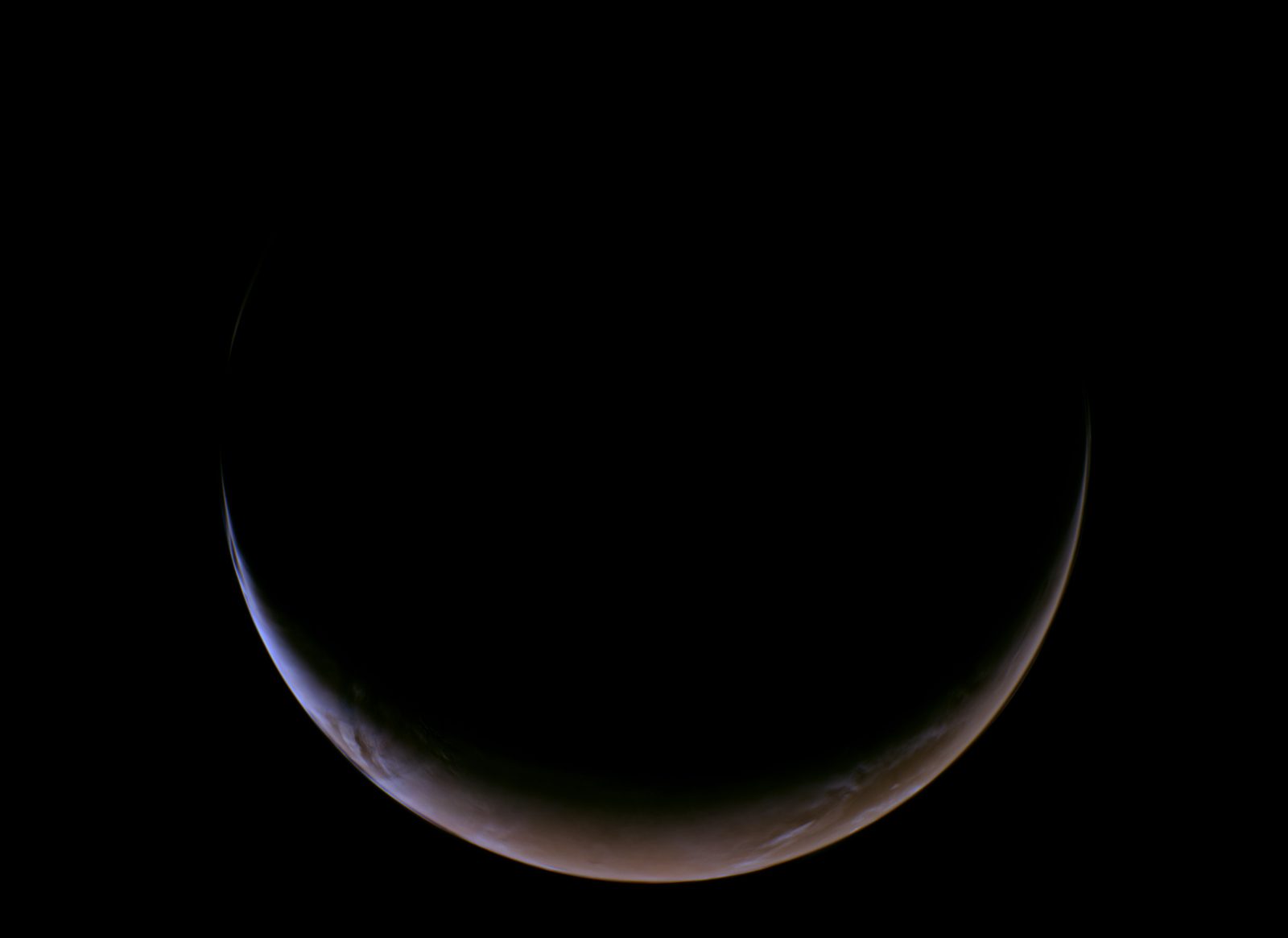
A sweeping crescent view of Mars captured during the spacecraft’s high-speed approach.
With the Martian detour successfully completed, mission control is now focused entirely on the void of deep space.
“This gravity assist was years in the making, and the navigation team nailed it,” said Bob Mase, Psyche’s project manager at NASA’s Jet Propulsion Laboratory.
“Psyche flew by Mars on exactly the trajectory we needed to set us on a path to rendezvous with the asteroid in the summer of 2029.”