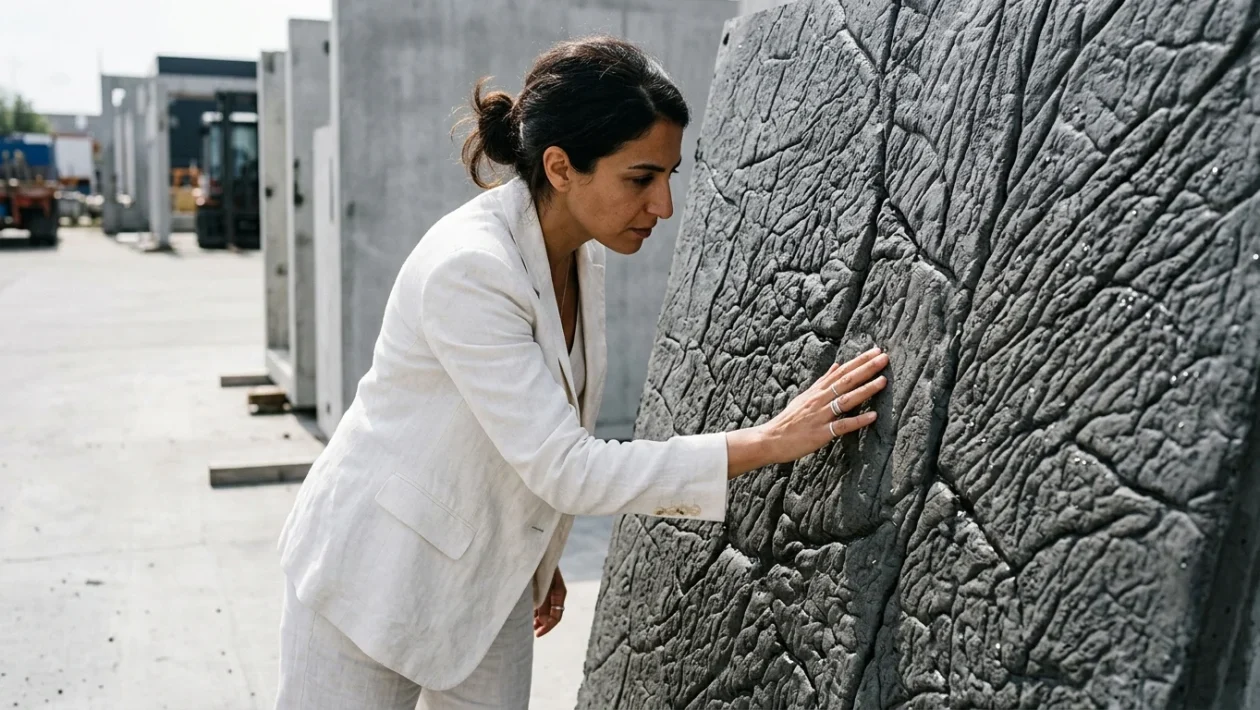
Close-up of cracked, bio-inspired cement tiles designed to trap water and naturally cool building surfaces.
A close look at the engineered crack patterns on the bio-inspired cement tiles.
When temperatures spike, humans rely on sweat. As moisture evaporates from our skin, it silently pulls heat away in one of nature’s most efficient cooling processes.
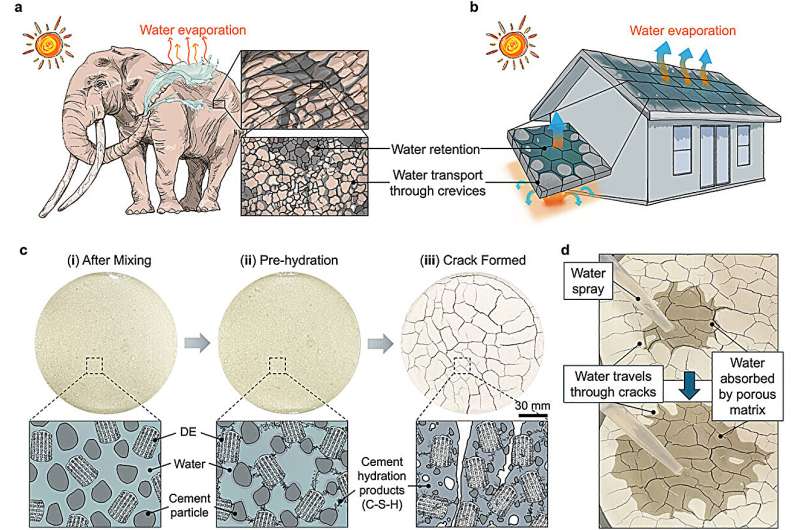
African elephants face intense savanna heat, but they lack the biological machinery to sweat. Instead, they rely on inches-thick, dark gray skin covered in a deep network of wrinkles and cracks.
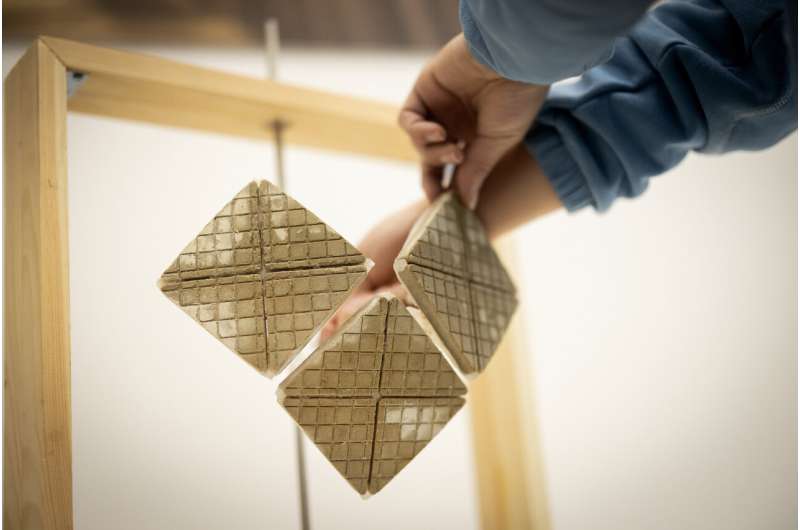
A detailed view of the water-trapping channels formed on the surface of the cooling tiles.
“Elephants have a network of cracks in their skin that trap water,” says Dorit Aviv, an associate professor of architecture at the Weitzman School of Design. “When they spray themselves, that water stays put and evaporates slowly, cooling them over time.”
Buildings That Sweat
The concept of engineering a building to sweat was initially pitched to Aviv by Shu Yang, a materials scientist at Penn Engineering. Aviv immediately saw the potential to make urban environments more thermodynamically efficient.
Their collaboration led to a breakthrough recently published in Advanced Materials. Aviv, Yang, and Syracuse University’s Kun-Hao Yu developed a low-cost, cement-based tile that captures, holds, and slowly evaporates water. The system cools exterior surfaces entirely without fans, compressors, or moving parts.
Thermal imaging demonstrating the temperature differences between the new tiles and traditional stucco.
Outperforming Traditional Stucco
During testing with infrared heating and periodic watering, the temperature beneath the bio-inspired tiles held steady at 89.6°F (32°C). In stark contrast, cracked commercial stucco reached 107.6°F (42°C), and non-cracked stucco soared to 125.6°F (52°C).
This passive approach could fundamentally shift how we manage indoor climates. Americans spend roughly 90% of their time indoors, and buildings account for about 40% of primary energy use nationwide.
Heating, cooling, and ventilation consume nearly half of that energy load. “A passive, bio-inspired cooling facade like this could lower surface temperatures by 10 to 20°F (6 to 11°C) compared to traditional stucco,” Yang notes.
Mechanical air conditioning consumes vast amounts of fossil fuels and actively dumps indoor heat outside, worsening urban heat islands. The elephant-inspired tile flips this dynamic, cooling the building’s outer skin directly through natural phase change.
Engineering the Perfect Crack
Turning a structural flaw into a cooling mechanism was no easy feat. On conventional building materials, water droplets bead up, bounce off, or run straight down the wall before they can trigger any meaningful cooling.
The researchers needed a way to dictate the path of every single drop. “In conventional construction, cracks signal weakness, the beginning of a material’s decline,” says Yang. “But by engineering where and how they form, we made networks of tiny channels that act like capillaries capable of pulling water across the surface and holding it in place.”
To build the tiles, the team mixed ordinary Portland cement with diatomaceous earth—a highly porous material made from fossilized algae. The wet mixture is cast into thin tiles, partially hydrated, and dried under strict conditions.
As the material shrinks, stress releases along predetermined patterns, forming a precise lattice of cracks instead of random, unpredictable fractures.
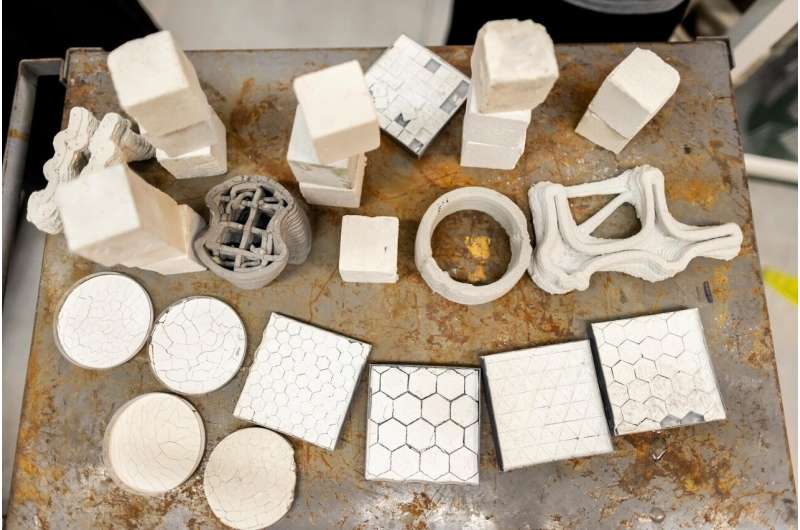
A comparison of water absorption and distribution between standard materials and the engineered cooling tiles.
A 20-Hour Cooling Cycle
“We realized that storing water and moving water are actually two different problems,” explains Yu, who conducted the experiments as a postdoctoral researcher in Yang’s lab.
The microscopic pores of the diatomaceous earth act as tiny reservoirs, soaking up water in milliseconds. Meanwhile, the engineered crack network functions as a canal system, distributing the moisture evenly across the tile’s honeycomb-like structure.
This wicking action works effectively even against gravity on sloped walls. The hexagonal geometry forces water to zigzag laterally rather than draining straight down to the ground. Because the surface stays uniformly wet, the evaporation process provides sustained cooling for up to 20 hours.
Scaling for a Hotter Future
The immediate viability of this technology lies in its scalability. The team proved that the specialized cement mixture can be sprayed onto large panels using standard hopper guns, paving the way for cost-effective onsite construction.
“Extreme heat is already the deadliest climate-related hazard, and we’ve spent decades trying to seal buildings off from the environment,” Aviv says. By designing materials that collaborate with natural physics, architects can fundamentally rethink urban heat management.
The ultimate vision integrates these tiles with smart building systems. By syncing automated watering cycles with real-time weather forecasts, buildings would only receive a precise charge of water when severe heat is imminent.
“Now that we understand how water moves through these patterned tiles, we can start treating water as something we manage very precisely instead of simply spraying more of it,” says Yu. “By combining these materials with weather forecasts and automated water delivery systems, we could supply just enough water, exactly where and when it’s needed.”