A groundbreaking retinal implant capable of partially restoring sight in blind patients has officially been approved for commercial use in Europe.
Known as PRIMA, the device is the first of its kind globally to restore functional central vision in people suffering from severe vision loss, allowing them to read and see fine details again.
“We’ve had patients who could recognize the face of the Queen and others who’ve drawn the Sydney Opera House through the device,” says Darius Shahida of Science Corporation, the Alameda, California-based company behind the technology.
Targeting an Irreversible Disease
The PRIMA system is designed for patients with geographic atrophy, a progressive and irreversible form of dry age-related macular degeneration. The condition affects roughly 8 million people worldwide by slowly destroying the macula as retinal cells die and fail to regenerate.
Current treatment options are severely restricted. In the United States, doctors can only offer two FDA-approved eye injections that block retina-damaging proteins.
“The PRIMA implant is an impressive achievement,” says Sunir Garg at Wills Eye Hospital in Philadelphia. “We have two FDA-approved medications for the treatment of geographic atrophy that slow down the progressive disease, but unfortunately, cannot bring back lost vision.”
Engineering Artificial Sight
The surgical intervention involves inserting a pinhead-sized implant directly beneath the retina. Patients then wear a specialized pair of glasses equipped with a frame-mounted camera.
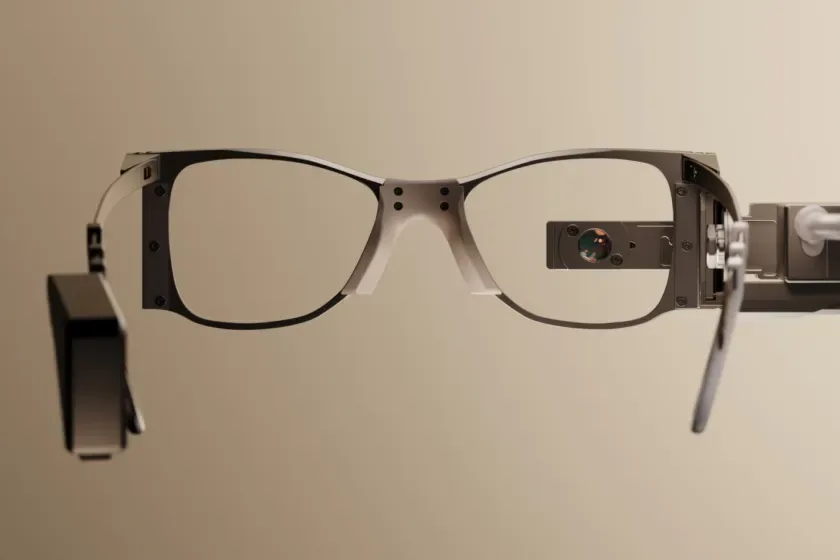
The glasses that are used alongside the implant.
The camera captures visual data, processes it, and projects the images onto the implant’s microchips using near-infrared light. Because humans cannot see near-infrared wavelengths, the system operates without interfering with any residual natural vision.
Once hit by the light, the chips generate electrical pulses that stimulate retinal bipolar cells. Normally, macular degeneration destroys the rod and cone cells that feed electrical signals to these bipolar cells. The PRIMA device simply bypasses the dead cells, allowing the bipolar cells to send new electrical signals straight to the brain.
The specialized glasses generate their own electricity directly from light, functioning similarly to solar panels. “This means patients don’t need a tethered power source,” Shahida notes.
From Blind to Seeing
A clinical study published in October 2023 demonstrated the implant’s efficacy, showing it restored central vision and improved visual acuity in approximately 80 percent of cases.
“Normal vision in the US is 20/20 and blindness is 20/200,” says Frank Brodie of Science Corporation. “Patients using PRIMA reached about 20/160, so they went from blind to not blind.”
According to Brodie, most side effects were minor, strictly related to the surgery itself, and fully resolved within two months. “The physical recovery is quick, and some people feel better within a day,” he says. Following surgery, patients undergo training to master head positioning and pupil alignment with the glasses.
Before the technology becomes standard care globally, researchers will need long-term safety data from larger patient groups. Experts like Garg note the importance of identifying which specific patient characteristics yield the highest success rates.
The Path to US Approval
PRIMA recently secured a CE certification mark under the European Union Medical Device Regulation, clearing it for immediate clinical use across the EU and the UK.
The first commercial surgeries will take place soon in Germany, followed by a wider rollout in the UK later this year. “We’ve already selected sites in Germany, trained surgeons there and plan to begin our first surgical procedures soon,” Shahida confirms.
In the United States, PRIMA has already landed Breakthrough Device and Humanitarian Use Device designations from the FDA. Shahida describes these designations as “an important pathway toward approval in the United States.”
The Science Corporation team is already looking ahead to new applications. According to Brodie, researchers are currently evaluating the implant’s potential to treat Stargardt disease, another aggressive condition that deteriorates the macula.