Every time that heavy outdoor compressor hums to life, your hard-earned cash is being funnelled straight to the utility company. We are staring down the barrel of May 2026, and with electricity rates consistently inching upwards, paying to cool an inefficiently sealed house is basically financial self-sabotage. But you do not have to choose between a sweltering living room and a brutal hydro bill.
By targeting the mechanical inefficiencies in your home’s cooling setup, you can immediately slash your monthly costs. You just need to know exactly where your system is working harder than it needs to. Let us break down the exact maintenance moves that keep your home feeling like a meat locker while keeping your wallet comfortably full.
Achieving Real AC Energy Savings
The pursuit of true AC Energy Savings starts with understanding the heavy lifting your system does. Statistics show that space cooling can account for up to 50% of the average North American home’s summer energy consumption. That is a massive chunk of your monthly budget dedicated to just a few degrees of comfort.
You cannot manage what you do not measure, so start by looking at your habits. Simple behavioral adjustments often yield the highest return on investment.
| Common AC Mistake | The Better Move |
|---|---|
| Setting the dial to 68°F (20°C) | Setting it to 72°F (22°C) while running a ceiling fan |
| Ignoring furnace filter changes | Swapping out the filter every 30 days |
| Cooling entirely empty rooms | Closing the supply vents in unused guest bedrooms |
How To Stop Bleeding Cash Through Neglected Equipment
Your central air conditioner is essentially a massive breathing machine. When its lungs are clogged, it draws significantly more amperage to pull the same amount of air. A quick trip to a local hardware store like Canadian Tire for a stack of fresh pleated filters will pay for itself within the first few weeks of operation.
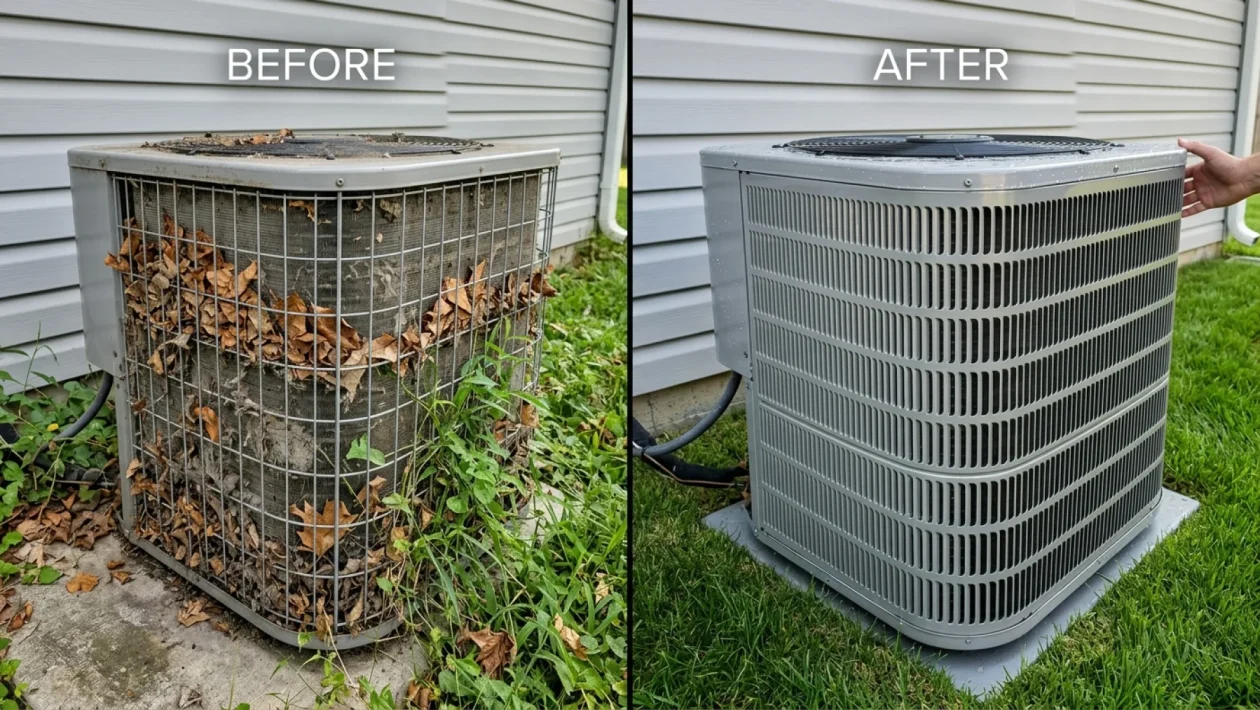
The outdoor unit, known as the condenser, is equally important. If it is choked by last fall’s dead leaves or overgrown bushes, it cannot effectively release the heat it pulled from your home.
Here is your weekend protocol to optimize airflow:
- Kill the power: Always flip the breaker in your electrical panel before touching your outdoor condenser.
- Clear the perimeter: Remove leaves, branches, and that stray lawn chair within a strict two-foot radius of the unit.
- Wash the fins: Take a standard garden hose (no pressure washers!) and gently spray down the exterior fins to clear out embedded dirt and pollen.
- Swap the lung: Head down to the basement, pull out the indoor furnace filter, and replace it with a fresh one to guarantee unrestricted airflow.
Taming The Thermostat Every Time It Clicks On
If you are still manually adjusting a dial on your hallway wall, you are leaving money on the table. Technology has advanced rapidly, and automating your climate control is the single smartest upgrade a homeowner can make.
Installing a smart thermostat, like a Toronto-born Ecobee, allows the system to learn your daily routine. It automatically stops cooling an empty house while you are grinding away at work, and aggressively pre-cools the space just before you pull into the driveway.
“Homeowners waste hundreds of dollars a year treating their thermostat like a gas pedal. Set a baseline temperature, use scheduled setbacks for when you leave the house, and let the HVAC system run its natural, efficient cycles.” – Dave Miller, Master HVAC Technician
Frequently Asked Questions
Does turning off the AC completely during the day save money?
Usually, no. If you turn the system entirely off while at work, your house absorbs hours of radiant heat. Your air conditioner then has to work overtime at maximum capacity to pull all that built-up humidity and heat out of the drywall and furniture. Setting the temperature up by 4 to 5 degrees while you are gone is far more efficient.
Can a ceiling fan actually lower my cooling bill?
Absolutely, but only if you use it correctly. Fans cool people, not rooms. The wind-chill effect on your skin allows you to comfortably raise the thermostat by up to 4 degrees without noticing a difference in comfort. Just remember to turn the fan off when you leave the room.
How often should I service my air conditioner?
You should perform a DIY filter swap monthly and rinse the outdoor unit every spring. However, you should hire a licensed professional every single year to check the refrigerant charge and inspect the electrical contactors. Running an AC with low refrigerant will destroy your compressor and your electric bill simultaneously.
Wrapping It Up
💡 Taking control of your energy consumption does not require an engineering degree, just a little weekend elbow grease and a proactive mindset.
🤝 Whether you are installing a smart thermostat or simply taking five minutes to swap out a dirty filter, every small adjustment keeps more of your hard-earned cash in your wallet.
📱 Share your thoughts in the comments below or pass this guide along to a neighbour who is tired of overpaying the utility company.
👇 Good luck with your home maintenance this weekend, and stay cool out there!