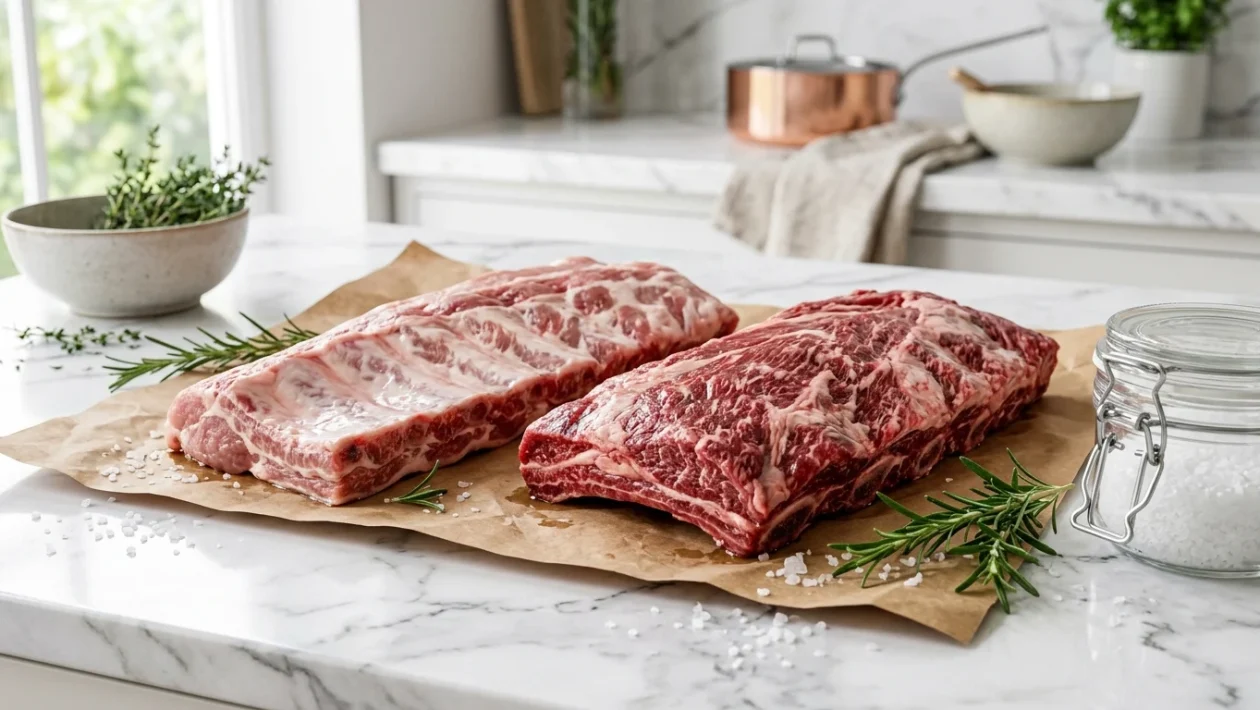
Close-up of fresh meat cuts at a butcher counter.
Standing at the meat counter often leads to a familiar dilemma: should you take home pork ribs or beef ribs?
Both cuts are barbecue staples, but they carry distinct differences in nutritional value. Your final choice ultimately depends on your dietary goals, specifically regarding calories, protein, and total fat content.
Breaking Down the Calories
Every cut of meat varies slightly based on size and preparation, but baseline numbers offer a clear head-to-head comparison.
For every 100 grams of meat, beef ribs pack between 290 and 400 kilocalories. Pork ribs come in slightly lighter, ranging from 270 to 350 kilocalories for the exact same portion size.
If you are strictly monitoring your daily caloric intake, pork offers a minor advantage—before you factor in heavy barbecue sauces or marinades.
Raw meat being safely stored and prepared for cooking.
Protein and Fat Content
When it comes to building muscle and staying full, both options deliver solid results.
A 100-gram serving of beef ribs yields between 17 and 25 grams of protein. Pork ribs match this almost identically, offering 16 to 25 grams of protein per 100-gram serving.
The real separator between the two proteins is fat. Pork ribs consistently test lower in total fat content compared to their beef counterparts.
Proper Storage Guidelines
Buying meat in bulk requires proper handling to prevent foodborne illness and maintain quality.
The Food Safety and Inspection Service (FSIS) outlines strict storage rules for both cuts. You can safely keep either pork or beef ribs in a standard refrigerator for three to five days.
For long-term storage, wrap the ribs tightly and place them in a freezer set to -12.8 C. Under these frozen conditions, the meat remains safe to consume for six to 12 months.