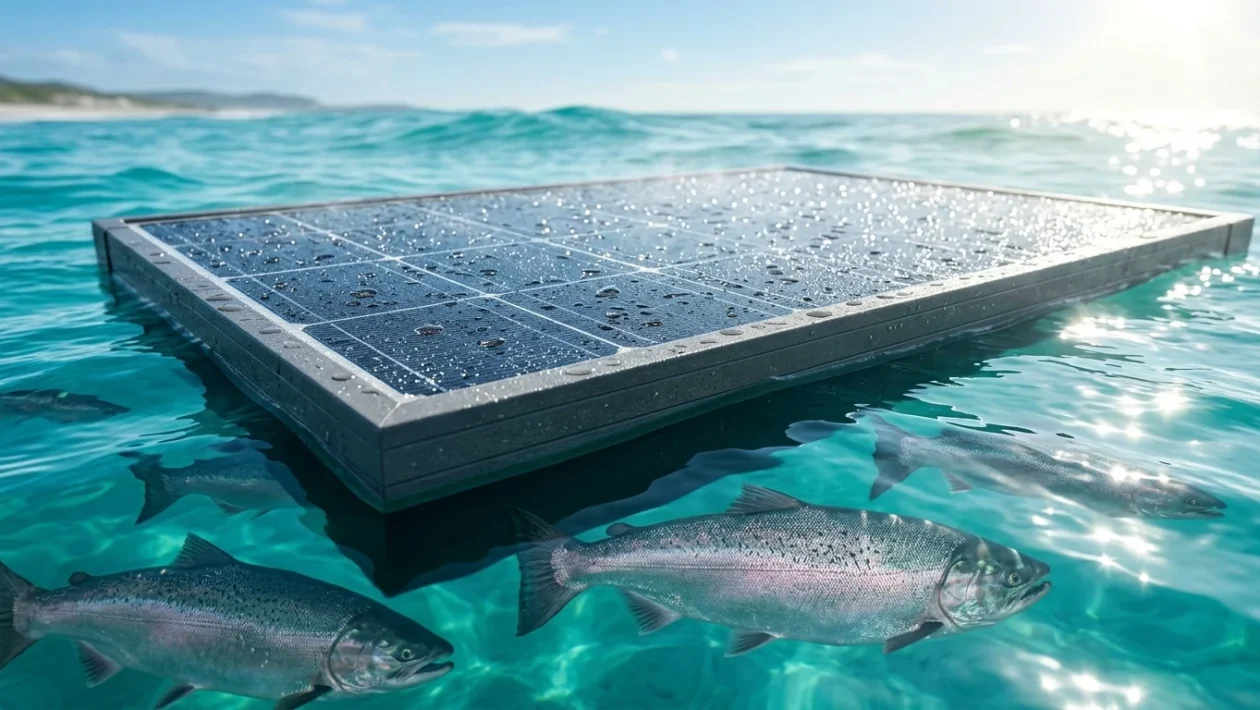
Offshore fish farming is notorious for burning massive amounts of diesel fuel. Mowi’s Huar Norte salmon farm in Los Lagos, Chile, wanted to break that cycle.
The company replaced its heavy reliance on diesel generators with a floating solar farm to cut emissions and improve efficiency.
The engineering upgrade successfully silenced the industrial operation—but it also triggered an unexpected ecological side effect beneath the surface.
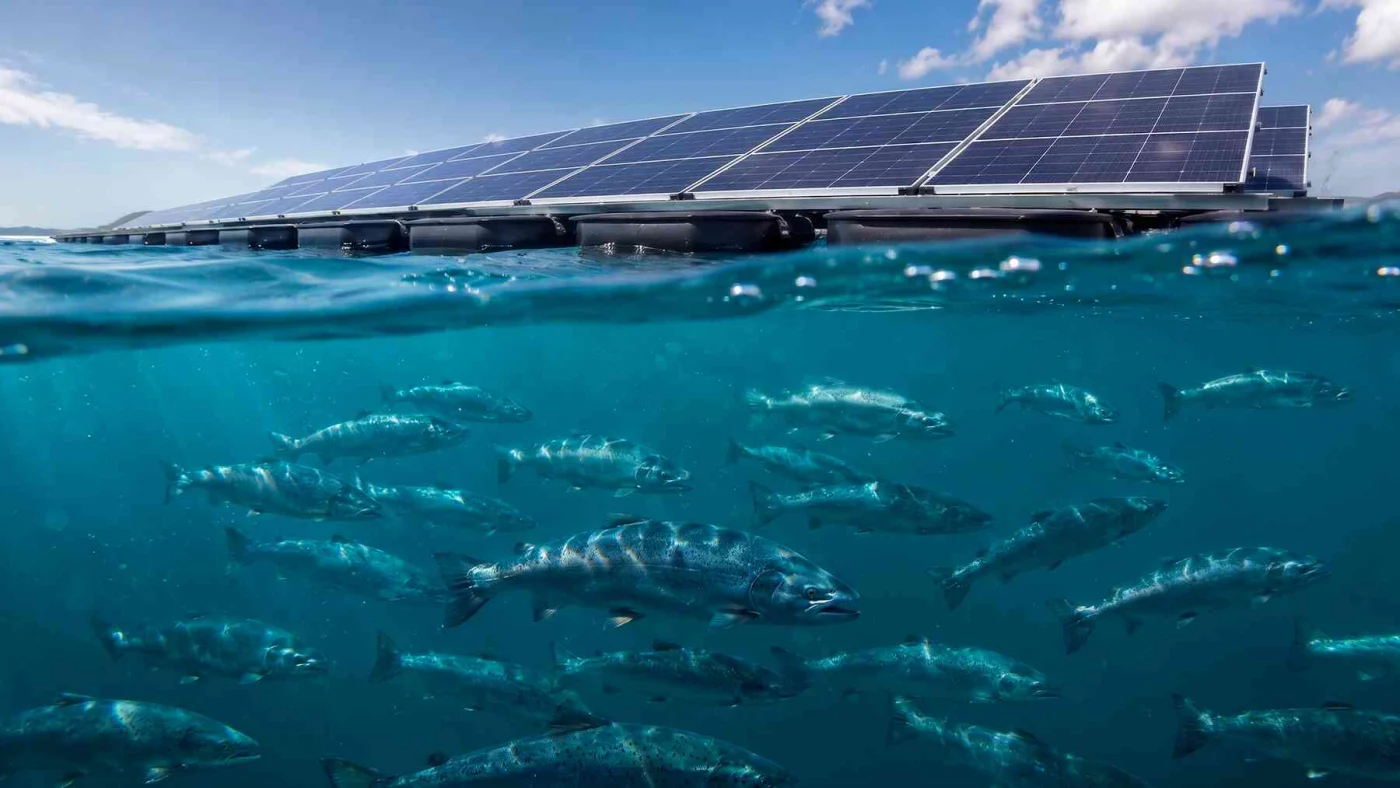
Floating solar panels covering the holding pens at an offshore marine facility
The Heavy Cost of Diesel Power
For years, the Huar Norte facility relied entirely on diesel engines to maintain constant power.
These generators produced a massive carbon footprint and caused relentless underwater vibrations.
The constant mechanical noise stressed the fish and created a punishing, fume-filled work environment for the staff.
Building a Hybrid Ocean Grid
Mowi partnered with three major energy and aquaculture firms to overhaul the site.
The AKVA group constructed resilient holding pens, while Alotta Energy provided the floating solar grid as a service.
Fjord Maritime completed the hybrid system by installing advanced battery storage packs for seamless power management.
The new setup now covers 57% of the farm’s energy demands.
This transition eliminates the need for more than 36,000 gallons of diesel annually, keeping 386 tons of carbon out of the atmosphere.
Because the site requires far fewer fuel delivery boats, the underwater acoustics have fundamentally changed.
Once the diesel engines were turned off, a deep silence settled over the Los Lagos waters.
An Accidental Sanctuary for Salmon
While farm workers celebrated the clean air and quiet, a new dynamic unfolded below.
The sprawling solar arrays cast vast shadows over the holding pens. Thousands of salmon immediately claimed this footprint as their preferred habitat.
The canopy of solar panels offered perfect protection from harsh sunlight and predatory seabirds overhead.
Combined with cleaner water and a sudden drop in mechanical vibrations, the floating grid became an ideal gathering space.
This behavior mirrors observations in Norwegian waters, where Alotta Energy previously built the world’s northernmost floating solar plant. In that region, cod quickly adapted to utilize the same man-made shade.
By solving an industrial emissions problem, engineers inadvertently constructed a thriving marine sanctuary.