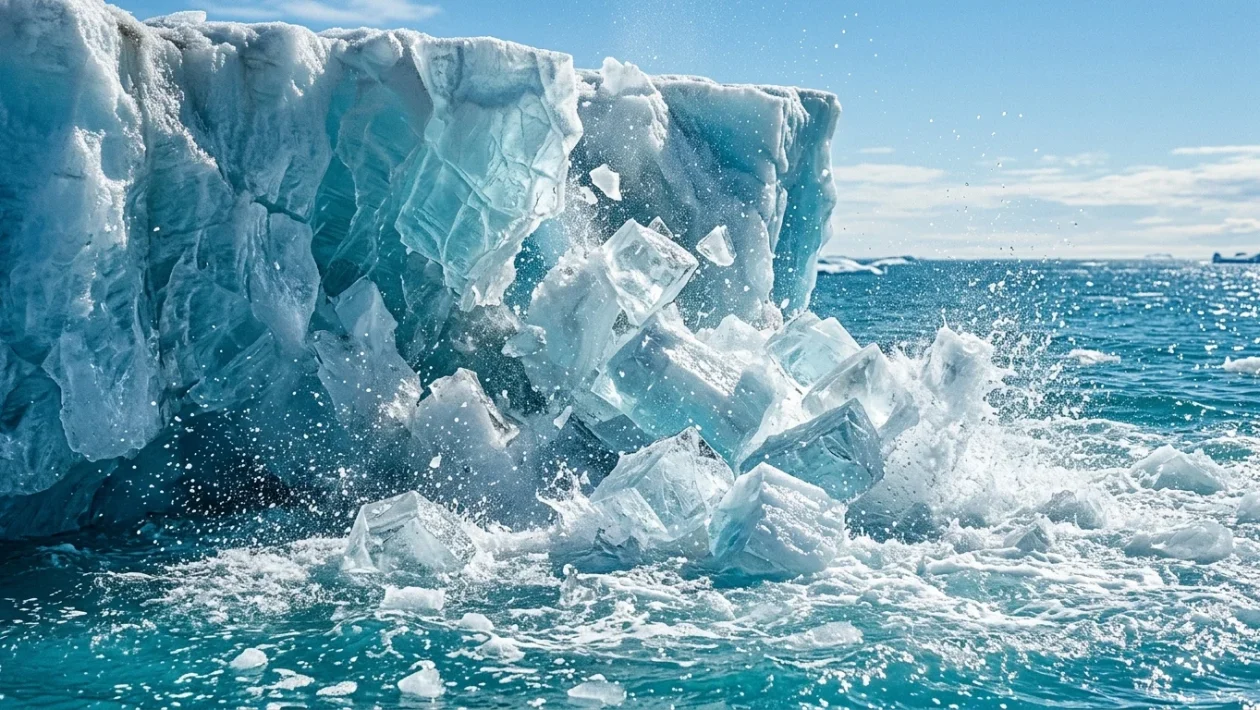
Massive tabular iceberg A23a floating and fragmenting in the ocean.
Iceberg A23a, one of the oldest and largest icebergs on Earth, is rapidly falling apart.
After nearly four decades adrift, the colossal ice mass is succumbing to warmer waters north of South Georgia Island in the South Atlantic. Once twice the size of Greater London, the megaberg has shed over half its original volume.
It currently spans 1,770 square kilometers and measures 60 kilometers across at its widest point. At the start of 2025, A23a weighed an estimated one trillion tons, but experts now predict it will vanish as a coherent structure in a matter of weeks.
A 39-Year Journey
A23a’s story began in 1986 when it calved from the Filchner Ice Shelf in Antarctica. Almost immediately, it grounded itself in the Weddell Sea, remaining frozen in place for more than 30 years.
In 2020, the giant finally broke free. Caught in the powerful Antarctic Circumpolar Current, it drifted through a popular maritime route known as “iceberg alley.”
By March 2025, A23a ran aground again, this time in shallow waters just 90 kilometers off the coast of South Georgia Island. It quickly dislodged itself and accelerated northward, reaching speeds of up to 20 kilometers per day before warmer oceans halted its progress.
“Rotting From Below”
The Copernicus satellite program captured A23a’s rapid disintegration in recent weeks. Huge fragments, some spanning up to 400 square kilometers, have sheared off the main block.
Countless smaller chunks now scatter across the South Atlantic. While the main mass is easily tracked, these fragments create serious, unpredictable hazards for maritime navigation and regional fishing operations.
Andrew Meijers, a physical oceanographer with the British Antarctic Survey (BAS), confirmed the stark reality of the iceberg’s demise.
“It is breaking up quite dramatically,” Meijers said. “It’s basically rotting from below. The water is too warm for it to survive. It’s melting constantly.”
Meijers noted that while A23a’s exceptional size allowed it to survive for decades, no iceberg can last forever once it leaves the protective freeze of Antarctic waters.
Wildlife Impacts and Climate Warnings
When A23a temporarily parked near South Georgia Island, scientists worried it might block critical feeding routes for local penguins and seals. A massive physical barrier forces adult animals to swim further for food, burning vital energy and reducing the nourishment they bring back to their young.
However, the iceberg’s destruction also brings an ecological upside. As A23a melts, it releases deep-sea nutrients and micronutrients, like iron, into the surface ocean.
This natural fertilization fuels phytoplankton blooms, which form the base of the marine food web and help sequester atmospheric carbon at the ocean floor. BAS has deployed autonomous vehicles to study exactly how these giant ice masses alter ocean chemistry.
While calving is a natural phase of an ice shelf’s life cycle, the broader trend alarms researchers. BAS scientists point out that giant iceberg break-offs are happening much more frequently today.
Since 2000, Antarctic ice shelves have lost approximately 6,000 gigatons of ice. Researchers attribute this rapid, massive ice loss to human-induced climate change, warning that it directly drives rising sea levels and threatens irreversible shifts in global ocean circulation.