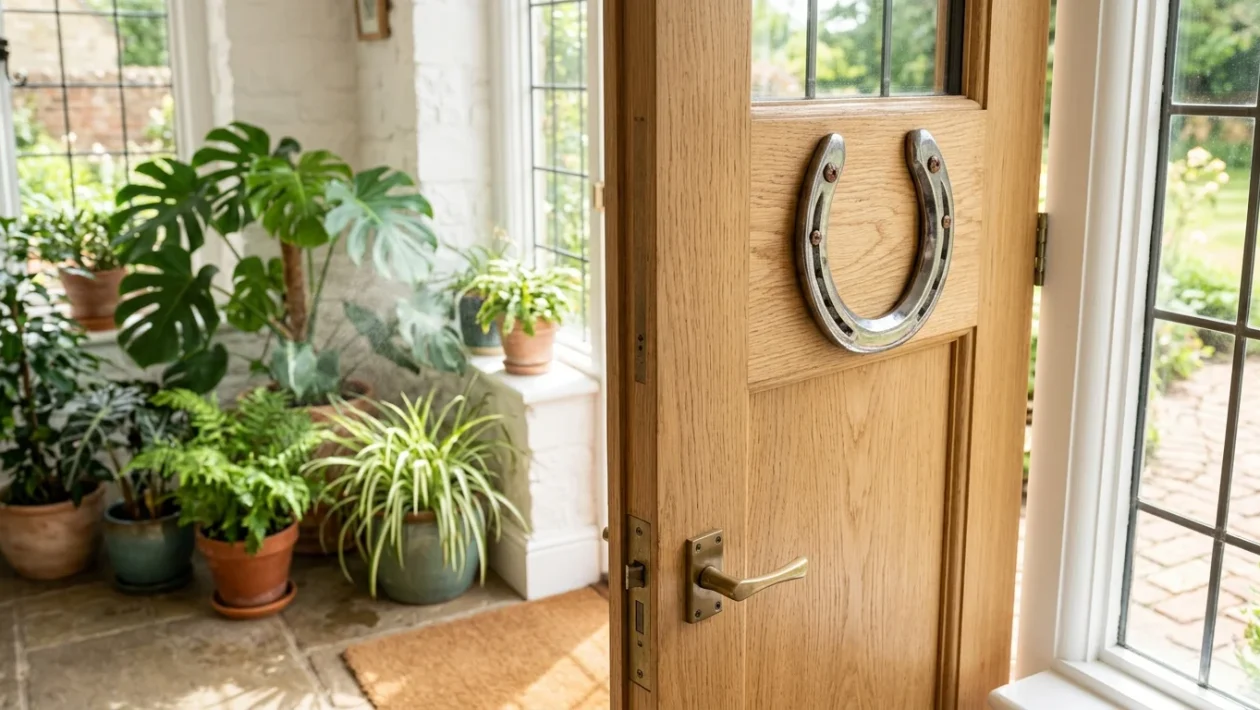
A clean metal horseshoe hanging above a front door with its ends pointing upward
Hanging a horseshoe over a front door is a common architectural detail worldwide, but in the ancient practice of Feng Shui, it serves a precise functional purpose. It is not merely a rustic decoration. Practitioners view the horseshoe as a vital tool to manipulate energy, or chi, as it enters a living space.
The Mechanics of the Metal Filter
In Chinese spatial philosophy, a horseshoe acts as a frontline defense system for the home. The traditional materials used to forge them—iron and other heavy metals—represent raw strength and endurance.
These metallic properties are believed to deflect hostile external influences. When mounted at an entrance, the heavy iron functions as an energetic filter, neutralizing negative forces before they can cross the threshold.
The Upward “U” Rule
Orientation dictates exactly how the object performs. Feng Shui principles mandate that a horseshoe must always be mounted with its ends pointing upward, forming a distinct “U” shape.
This specific geometry acts as a physical bowl. It catches, accumulates, and retains positive energy inside the house so that it does not disperse.
Conversely, mounting the horseshoe upside down is considered a critical error. An inverted horseshoe allows good luck and beneficial chi to drain out of the home and into the street. Experts advise securing the object directly above the main door frame or high up on an adjacent wall where it remains clearly visible.
Guarding the “Mouth of Chi”
Feng Shui designates the front door as the “mouth of chi.” It is the primary artery for all energy entering a property.
Because of this, any object placed near the entryway instantly impacts the harmony, prosperity, and security of the occupants. A properly positioned horseshoe anchors the home’s stability and regulates the incoming atmosphere.
However, the physical condition of the metal is just as important as its placement. A rusted, cracked, or severely degraded horseshoe introduces blocked and stagnant energy. To maintain its protective qualities, the metal must remain clean, intact, and well-cared for.