
A roll of aluminum foil applied to a residential wall to block heat and detect thermal problems.
Heatwaves are turning modern homes into makeshift climate refuges. To survive rising temperatures, people are repurposing a common kitchen staple to block out the harsh sun.
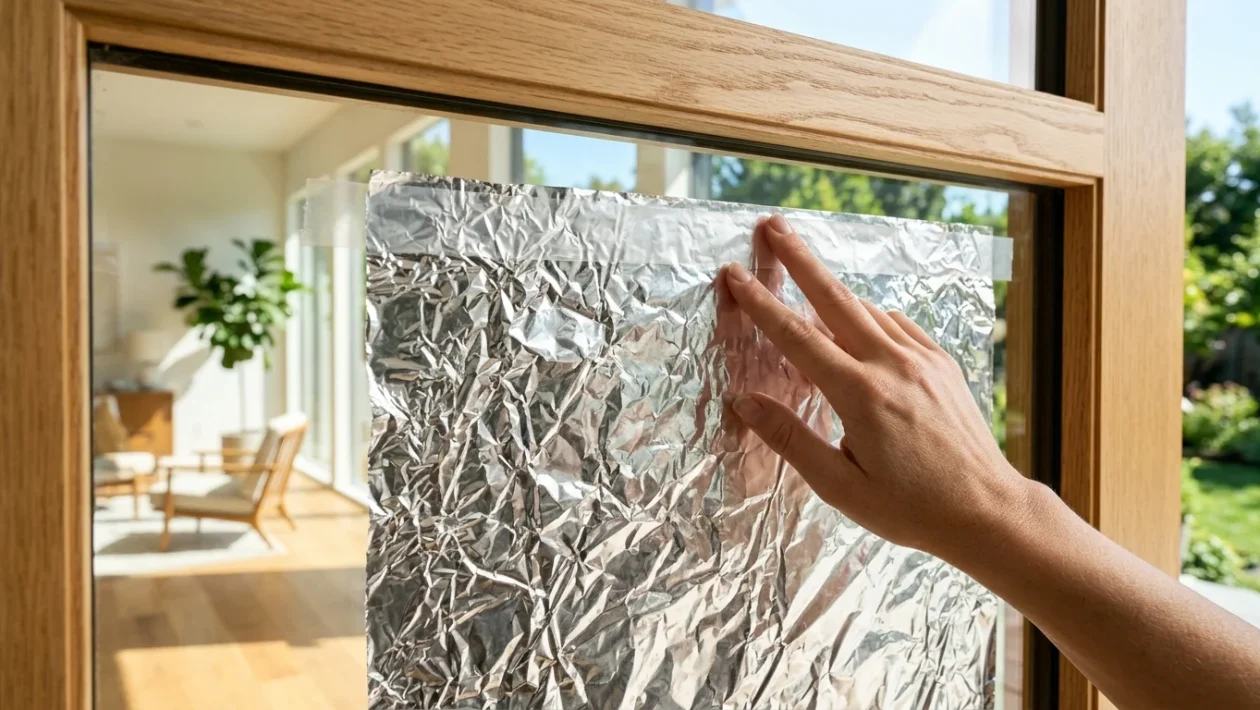
Covering windows with aluminum foil has become a widespread emergency solution across Europe. From France to Germany, city dwellers are taping foil to their glass to reflect intense heat and keep indoor temperatures bearable.
A roll of aluminum foil used as a reflective thermal barrier inside a residential space.
Architects Back the Budget Hack
Architects agree that aluminum foil is a highly effective temporary fix. Many residential buildings were simply not designed to withstand the aggressive thermal challenges of the 21st century.
Until a home undergoes proper structural climate adaptation, foil serves as an immediate protective barrier. It prevents excess solar radiation from baking the interior, ultimately saving residents money on expensive air conditioning.
Why Partial Window Coverage Fails
While foil works in an emergency, long-term solutions like thermal curtains and awnings remain the industry standard. However, experts warn that even high-end hardware fails if installed incorrectly.
According to specialists at Cortinadecor, an awning must cover the entire exposed surface of a window to be effective. Leaving even a tiny strip of glass unprotected allows heat to penetrate the room.
«In many homes, the problem is not the awning, but the surface that remains outside its coverage,» the Cortinadecor experts explain. «It is a detail that usually goes unnoticed until the first summer of use, when it is discovered that a small strip of glass receives direct sun during the late afternoon and ends up heating the room anyway.»
Orientation Dictates Protection
Sunlight shifts throughout the day. A shading mechanism that works perfectly at noon might be useless by late afternoon.
«Not all homes receive the sun in the same way, and that explains why the same awning can offer very different results,» Cortinadecor notes. «A west-facing terrace usually needs different protection than a window that only receives morning sun.»
Before investing in permanent shade solutions, professionals recommend observing how the sun moves across your specific facade. Tracking exactly when and where the light hits the glass provides much more practical value than any technical specification sheet.



