
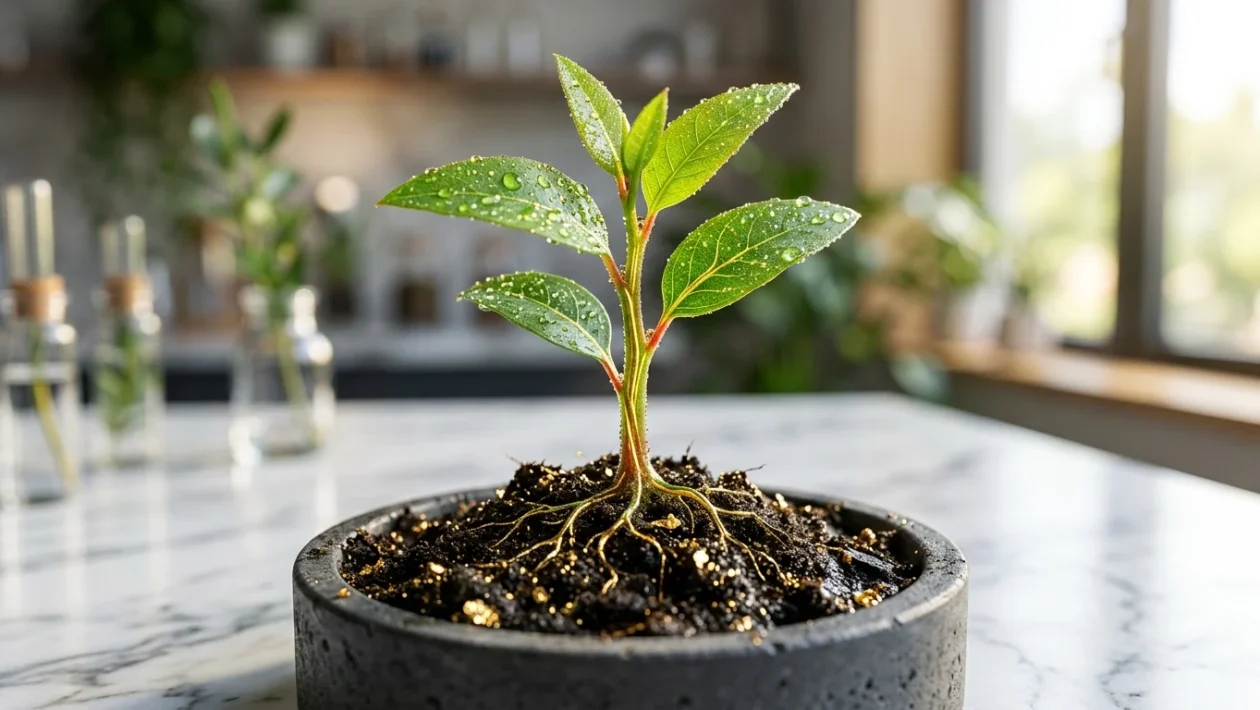
A close-up of a eucalyptus plant thriving in mineral-rich soil.
The Science of Growing Gold
The idea of a plant yielding pure gold sounds like a myth born from ancient alchemy. However, science has turned this concept into a reality through a biological process known as phytomining.
Researchers have identified specific plant species that do not produce gold, but instead absorb it directly from the earth. These plants concentrate the precious metal within their biological tissues, introducing a groundbreaking approach to ecological mining.
The process targets soils containing gold particles at concentrations too low for traditional extraction. In these environments, conventional mining is economically unviable, making the unique biology of these plants the only practical solution to recover the hidden metals.
Eucalyptus and Indian Mustard
Scientist Chris Anderson, a leading figure in phytomining research, proved that certain species are highly efficient at this task. His work highlights the remarkable capabilities of eucalyptus trees and Indian mustard (Brassica juncea).
To initiate the extraction, scientists introduce a specific chemical agent into the soil. This catalyst dissolves the microscopic gold particles, making them biologically available to the plants.
Once dissolved, the gold is pulled upward through the roots, absorbed seamlessly alongside the plant’s regular intake of water and essential nutrients.
Nature’s Bioaccumulators
Inside the organism, the plant acts as a biological pump. The gold travels through the vascular system and accumulates as nanoparticles, settling primarily in the leaves and stems.
The plant suffers no damage during this uptake. It simply stores the metal throughout its life cycle, functioning as a natural bioaccumulator.
Despite the fascinating biology, you cannot simply pluck gold nuggets from a branch. The final recovery phase relies on industrial processing.
Harvesting the Metal
Once the plants have absorbed a significant volume of gold, they are harvested and incinerated. The fire destroys the organic matter, leaving behind ashes packed with concentrated gold.
From there, conventional metallurgical methods are used to separate and refine the ashes, eventually yielding pure gold.
A Greener Future for Mining
Phytomining requires highly specific conditions: naturally gold-bearing soil, chemical catalysts, and infrastructure for large-scale harvesting and incineration. Its greatest advantage is its potential to replace destructive open-pit mining operations.
This technique drastically reduces environmental impact. It offers a practical way to extract valuable metals from contaminated land or abandoned mining tailings, cleaning the soil while still turning a profit.
Researchers are already looking beyond gold. Current studies are testing the ability of plants to accumulate platinum, palladium, and other rare metals, a shift that could fundamentally change how the world sources its strategic resources.


