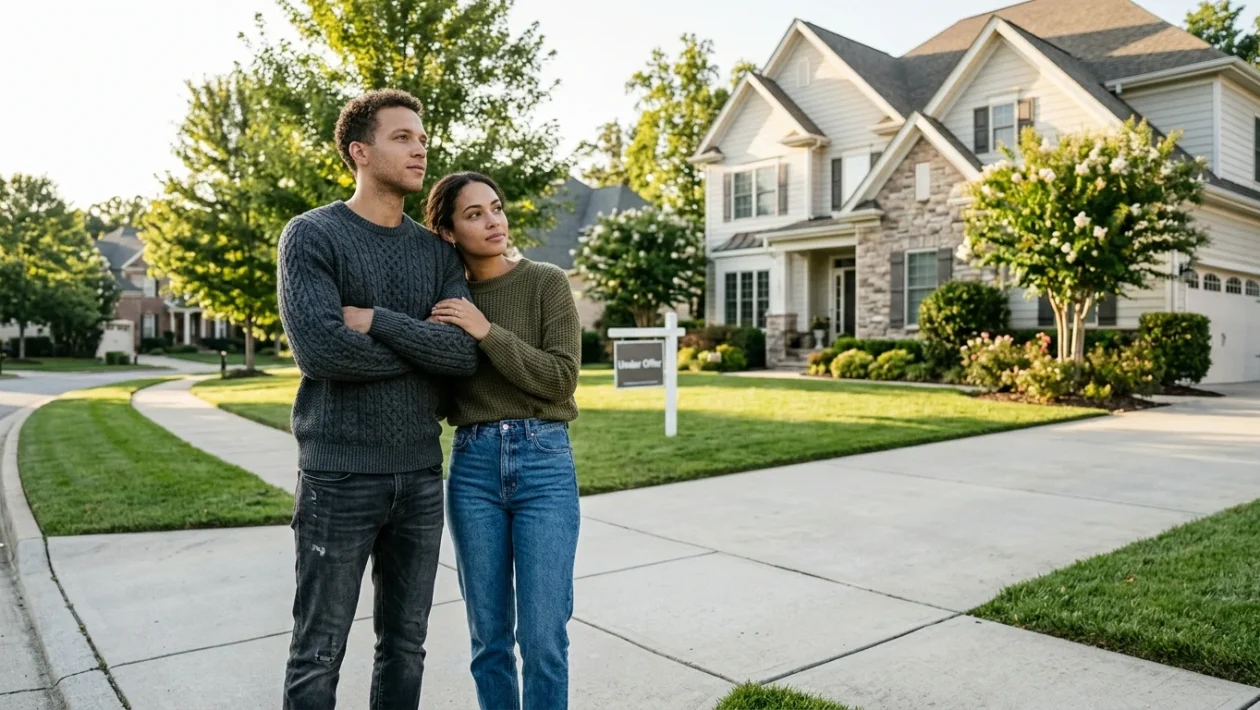
Suburban homes showing the generational divide in housing wealth
For two decades, politicians and economists have treated the U.S. homeownership rate as the ultimate scorecard for generational success. But that topline number is masking a harsh reality. New research from the Federal Reserve Bank of Minneapolis reveals a severe split within the millennial generation, proving the housing market is actively breaking along age lines.
A row of residential houses highlighting modern real estate trends.
The Minneapolis Fed developed a new metric to expose this housing blind spot. It is called the homeowners-to-population ratio, or HPOP. Instead of counting housing units, HPOP measures individual adults.
The results destroy the traditional narrative. While standard owner-occupancy rates claim national homeownership sits at 65%, HPOP reveals the actual number is closer to 53%.
The gap is brutal for young adults. Traditional metrics suggest 37% of households under age 35 owned a home in 2024. HPOP exposes the real figure: just 22%.

A neighborhood street representing the elusive millennial housing market.
Minneapolis Fed researcher Erik Hembre points out that the traditional 37% figure only counts household heads. This ignores roughly two-thirds of all adults under 35. Once you count everyone in that age bracket, the rate plummets.
“More than one in 10 U.S. adults live in owner-occupied homes without actually being owners themselves,” noted Hembre, alongside co-researchers Benjamin Horowitz and Maxine Xu. Nationally, that non-owner figure sits at 13.9%.
The traditional measure completely ignores adult children, roommates, and aging parents living under a homeowner’s roof. Hembre admitted one specific statistic shocked him: 9% of all U.S. adults aged 18 and older live in an owner-occupied home as the child of the owner.
The Cul-de-Sac Illusion
To understand the statistical distortion, researchers use a hypothetical five-house cul-de-sac. If an owner lives inside four of those five houses, the traditional occupancy rate reads 80%.
But if 14 adults actually live on that street, only half might own their home. The rest are hidden inside someone else’s ownership statistic.
HPOP also tracks demographics completely ignored by old metrics, including college students in dorms and nursing-home residents. The historical trajectory is grim for young buyers. For 25-year-olds, HPOP dropped from 20% in 2006 to 12% in 2015. By 2024, it had only crawled back to 14%.
Despite the bleak numbers, Hembre cautions against total despair. “It’s still true that most people, a majority of people, become homeowners at some point,” he said.
However, “at some point” is getting pushed significantly later. Longer lifespans and shifting economic realities mean the push for homeownership now extends well past a person’s mid-30s.
Hembre compared HPOP to baseball’s on-base percentage. Batting average only counts hits, ignoring walks. HPOP measures the true goal—actually owning the home—rather than simply sleeping inside a house someone else bought.
High Costs and Co-Residency
The gap between HPOP and traditional homeownership tracks tightly with state-level housing affordability. “I was a little bit surprised at how strong that relationship was,” Hembre noted.
Expensive housing markets like California and Hawaii show massive discrepancies between the two metrics. Meanwhile, affordable states like North and South Dakota show almost no difference. Hembre attributes this directly to co-residency rates, driven by young adults forced to live with their parents to survive.
The Millennial Wealth Fracture
Generational experts flagged this divide years before the Fed’s housing data validated it. In 2015, consultant Jason Dorsey warned that millennials were splintering. Older millennials were aligning with Gen X wealth patterns, while younger millennials faced intense financial strain.
By 2021, journalist Hillary Hoffower reported on the hardening divide between the “millennial rich” and “millennial poor.” Today, the housing market reflects a permanent fracture.
The National Association of Realtors confirms this shift. While baby boomers remain the largest buyer demographic heading into 2026, the overall first-time buyer share plummeted to a record low of 21%.
Younger millennials, ages 27 to 35, saw their share of first-time purchases drop from 71% to 60% in a single year. Meanwhile, older millennials now boast a median household income of $132,700, dominating the market as repeat buyers leveraging existing equity.
Total millennial net worth skyrocketed from $3.94 trillion in 2019 to $15.95 trillion by late 2024. But this wealth is heavily concentrated. Roughly $2.5 trillion of that growth came directly from property appreciation benefiting older millennials who bought early.
Younger millennials remain locked out of this wealth-building engine and carry heavier debts. Roughly 39% of younger millennials hold student loans with a median balance of $30,000, compared to just 27% of their older peers.
The generational fault line is not just data on a page. Hembre noted that he is 42, placing him directly on the edge of the demographic divide. “I certainly feel the issues,” he said, admitting he got onto the housing escalator slightly too late to see maximum benefits.
A Generation Cut in Half
Other Federal Reserve branches have issued similar warnings. The Federal Reserve Bank of New York reported that adults under 40 held just 4.9% of total U.S. wealth in 2019, despite making up 37% of the adult population.
While under-40 wealth surged 80% between 2019 and 2023, Fidelity data shows the gains skewed heavily toward the older demographic. The average net worth for twenty-somethings sits at $139,243. For those aged 35 to 44, it leaps to $549,600.
The Federal Reserve Bank of Boston also noted that older households are moving less often, forcing a rise in multigenerational living. Simultaneously, the Fed’s 2024 Survey of Household Economics revealed that only 35% of adults earning under $50,000 own homes, compared to 85% of high earners.
The narrative of millennials catching up is a statistical illusion. The generation is permanently severed. Older millennials are accumulating boomer-style real estate wealth, while the younger half is left padding a flawed homeownership statistic.