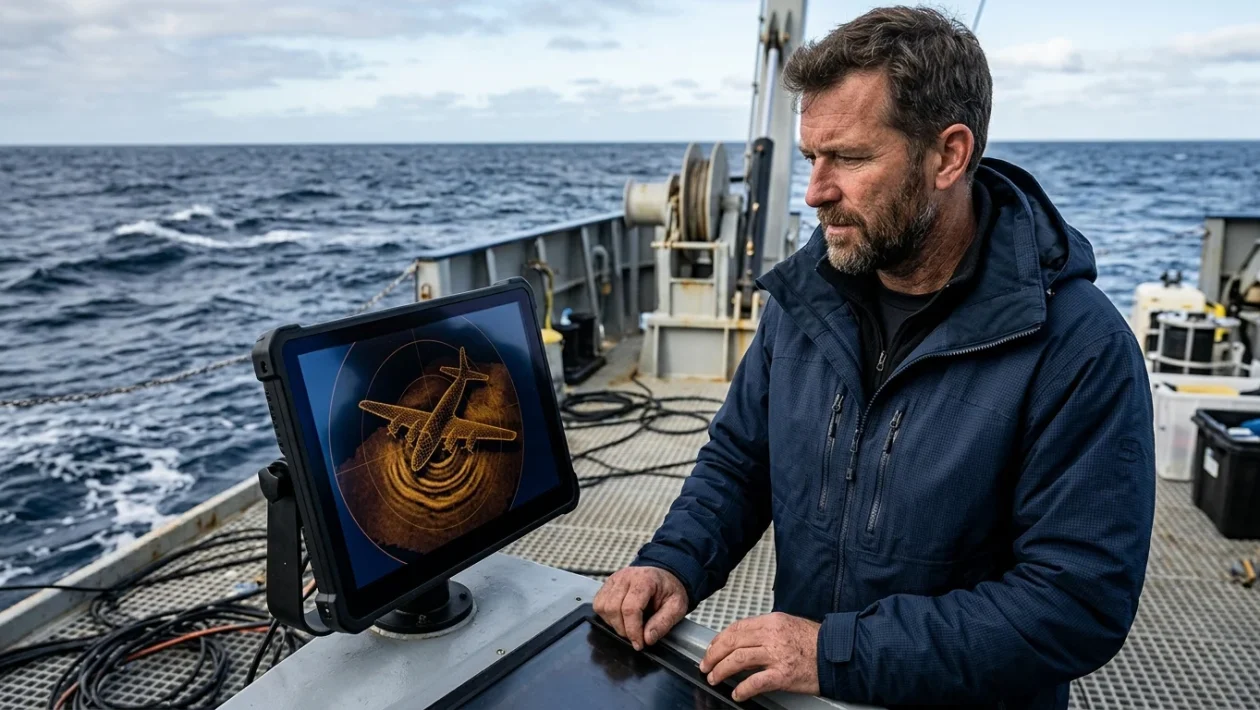
High-resolution sonar scanning the dark ocean floor to locate the sunken Pan Am Douglas DC-4 aircraft wreckage.
A Historic Aviation Tragedy
Ocean explorers have located the wreckage of a Pan Am passenger plane that crashed into the Atlantic Ocean almost 75 years ago. The discovery was announced on July 21 by search teams surveying the deep waters off the coast of Puerto Rico.
Known as the Clipper Endeavor, the Douglas DC-4 aircraft went down on April 11, 1952. The doomed flight crashed into the sea just minutes after taking off from San Juan, bound for New York’s Idlewild Airport, now known as JFK.
According to the Pan Am Historical Foundation, the plane suffered catastrophic engine failure shortly after noon local time. The aircraft, roughly the size of a modern Boeing 737, was carrying 64 passengers and five crew members.
Chaos and a Deadly Legacy
The tragedy changed the future of commercial flight. The disaster led to sweeping aviation reforms, including the immediate introduction of the mandatory pre-flight safety briefings passengers still hear today.
According to the search team’s release, the initial impact did not kill those on board. The crash sheared off the tail section but left the main cabin entirely intact.
However, the lack of safety briefings and a severe language barrier resulted in total chaos. With no coordinated evacuation procedure in place, the panicked passengers faced heavy seas as the aircraft rapidly flooded.
The plane sank in under three minutes. Despite being fully equipped with life rafts and personal flotation devices, most passengers remained trapped in their seats.
Swift rescue efforts by the U.S. Coast Guard and Air Force managed to pull 17 survivors from the water. Only 12 passengers and all five crew members lived through the disaster.
Finding the Clipper Endeavor
The breakthrough in the search occurred on the evening of June 2, when operators utilizing high-resolution sonar finally detected the lost aircraft.
Josh Gates, host of the Discovery Channel’s Expedition Unknown, shared the news in a video posted on X. He confirmed the wreckage sits nearly 2,000 feet below the surface on the ocean floor and remains largely intact.
The successful expedition was a joint effort. Gates partnered with the nonprofit Air/Sea Heritage Foundation and Deep Sea Vision, a marine exploration company based in Charleston, South Carolina.
Protecting the Wreck Site
The Air/Sea Heritage Foundation is now working directly with the Puerto Rican government. Their goal is to secure permanent protections for the underwater site and establish a formal memorial for the victims who perished.
Full details of the deep-sea recovery effort will be featured in a special episode of Expedition Unknown later this year.