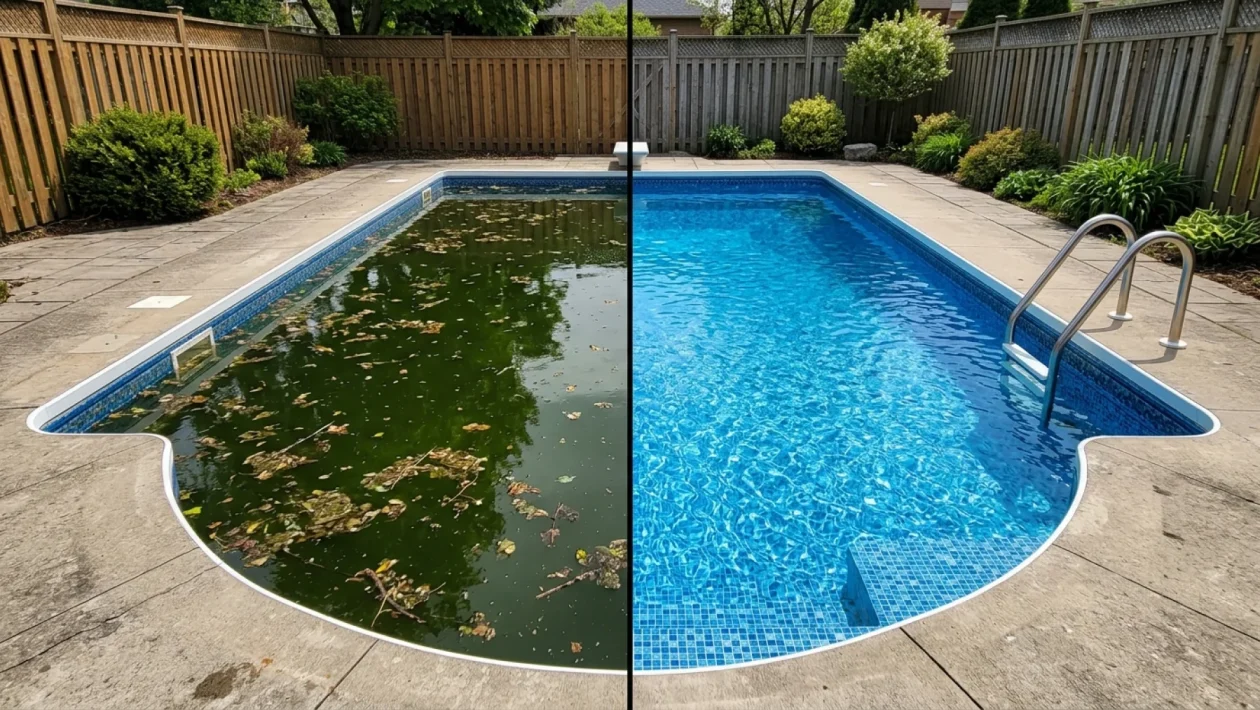
You pull off the winter cover, and you are immediately staring down a murky, green nightmare that looks more like a biohazard site than a backyard oasis. It is May 2026, the barbecue is already fired up, and you are officially behind schedule. You just want to swim, not perform a tedious backyard chemistry experiment.
Don’t panic and definitely don’t reach for your wallet to hire an overpriced service crew just yet. Getting your backyard oasis swim-ready is entirely doable with a bit of elbow grease and a smart strategy.
Here is the hard truth: 78% of homeowners drastically overspend on pool chemicals every spring. They just dump powder in and pray, rather than following a logical mechanical order.
Pool opening done fast
Let’s strip away the fluff and get right down to business so you can reclaim your weekend. Efficiency is the name of the game here.
You do not need to make six trips back and forth to Canadian Tire to get this job done. You just need to sequence your tasks properly so you aren’t fighting against your own filtration system.
The goal is to get your pump running as quickly as possible. Stagnant water is your enemy, and moving water is your best friend.
The weekend warrior’s guide
Every good tradesman knows that preparation prevents poor performance. Grab your skimmer net, a heavy-duty cover pump, and your basic tool kit before you even step foot on the pool deck.
Here is the ultimate fast-track sequence to get that water moving:
- Drain the standing water off your winter cover, scoop away the wet leaves, and carefully pull the cover off without dumping the debris into the pool.
- Remove all your winterizing expansion plugs from the skimmers and return lines.
- Reinstall your directional return jet fittings and drop in your skimmer baskets.
- Reinstall the drain plugs on your Hayward pump and filter, prime the pump basket with a bucket of water, and fire up the system.
Once you hear that pump catch and hum smoothly, you have officially won the hardest part of the battle. Now, let it run continuously.
Achieving crystal clear water
Getting the mechanics running is only half the battle, because right now, you are just circulating a green swamp. Now we need aggressive clarity.
Do not just guess your pH levels based on the colour of the water. Grab a proper liquid test kit—like a reliable Taylor Technologies set—and find out exactly what you are dealing with.
“The absolute biggest mistake people make in the spring is rushing the chlorine shock. You must balance your alkalinity and pH first, or your expensive shock will just burn off doing absolutely nothing.” — Dave MacLeod, Master Pool Technician.
To keep your expectations grounded, here is exactly what your progress should look like once the chemicals hit the water:
| Time Elapsed | Water Appearance |
|---|---|
| Hour 1 | Cloudy, green, and sad |
| Hour 12 | Milky blue and opaque |
| Hour 24 to 48 | Crystal clear and swim-ready |
Frequently Asked Questions
Do I really need to scrub the winter cover before folding it?
Absolutely yes. If you fold it up wet and dirty, it will breed mold and smell like a high school locker room by the time you pull it out next fall.
Why is my pool pump surging or spitting air?
You likely have a suction leak or you did not lubricate your pump lid O-ring properly. Double-check all your connections and ensure the water level is halfway up your skimmer faceplate.
Can I swim immediately after adding liquid shock?
No way. You need to wait until the chlorine levels drop back down to a safe range, typically between 1 and 3 parts per million (ppm). Give it at least 24 hours and test it again.
Wrapping up the weekend
🤝 Good luck tackling that backyard swamp and reclaiming your patio this weekend.
💡 Remember to take it step-by-step, balance your water chemistry first, and let your pump do the heavy lifting for you.
📱 If this straightforward guide saved your Saturday, share your thoughts below or forward this to a buddy who is still staring blankly at a green puddle.
👇 Now grab your skimmer net, fire up that pump, and let’s get swimming!