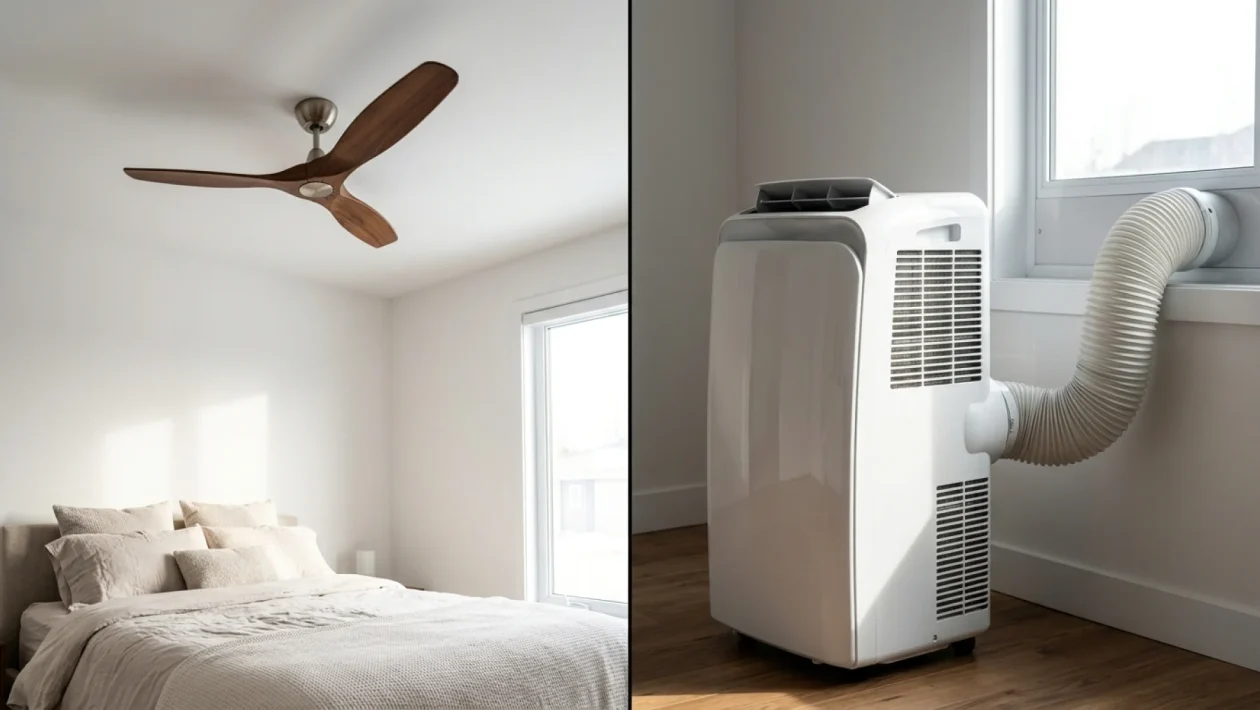
Forget the dread of opening your next electricity bill. Running a cooling system all night shouldn’t cost a small fortune, yet millions of North Americans are bleeding money while they sleep. The definitive solution to your soaring utility footprint is likely already hanging above your mattress.
By simply understanding the raw physics of what you plug into your wall, you can drop your overnight energy consumption by an absolute landslide. The debate between spinning blades and freezing compressors ends right now.
Cooling costs exposed: The heavyweights of home comfort
We’ve all been there—tossing and turning in a hot bedroom, deciding whether to suffer the sticky air or suffer the financial hit. When you look closely at the numbers, the reality is incredibly stark.
A standard overhead fan consumes roughly 50 watts of power on average. If you leave it spinning for a solid eight hours while you sleep, it burns a measly 0.4 kWh of electricity.
Meanwhile, dragging a heavy-duty portable AC into your room—like that beastly Danby model you grabbed at Canadian Tire—is a completely different ballgame. An average portable air conditioner guzzles a massive 1 kWh every single hour.
The ultimate ceiling fan vs AC showdown
Energy efficiency experts have run the numbers, and the difference is massive. While an air conditioner physically extracts heat from the space, a fan simply moves air to evaporate sweat from your skin. You feel cooler, but the room’s actual temperature hasn’t changed.
Because these systems operate differently, their power requirements are wildly unbalanced. A standard portable AC utilizes up to 20 times more electricity than a basic ceiling fan over the exact same time period.
Your overnight power comparison breakdown
Let’s look at the hard data. If you are trying to manage your household budget, knowing your baseline consumption is the ultimate weapon against bill shock.
| Cooling System (8-Hour Night) | Estimated Power Usage |
|---|---|
| Standard Ceiling Fan | 0.4 kWh |
| Single Split-System AC | 5.8 kWh |
| Portable AC Unit | 8.0 kWh |
| Multi-Split AC System | 13.1 kWh |
Whether you are on Time-of-Use pricing with Hydro One or dealing with a tiered rate out west, you can easily figure out your exact nighttime cost. Here is the foolproof formula to calculate exactly what your appliances are costing you:
- Find the wattage rating label on your cooling device (usually on the back panel or motor housing).
- Divide that exact wattage by 1,000 to convert it into kilowatts (kW).
- Multiply that kW number by the hours you sleep (e.g., 8 hours).
- Multiply the final result by your local utility’s specific kilowatt-hour rate.
Mastering the hybrid method
You don’t have to choose just one extreme. The smartest handymen and HVAC pros know that combining these systems is the ultimate sweet spot for absolute comfort and maximum savings.
“The biggest mistake homeowners make is blasting the AC at 68 degrees all night. If you set your thermostat to 77 degrees and turn on a ceiling fan, the wind-chill effect makes it feel identical, but your compressor works half as hard.”
Keep your doors and windows shut tight to trap the conditioned air. The ceiling fan will distribute that heavy, cool air evenly across your mattress instead of letting it uselessly settle on the floor.
Frequently Asked Questions
Will running my AC all night push me into a higher billing tier?
It absolutely can. Many utility companies utilize tiered pricing structures. If heavy AC usage pushes your monthly consumption over the baseline limit, every extra kilowatt-hour you burn gets billed at a much higher premium rate.
Does a ceiling fan actually lower the room’s temperature?
No. Fans cool people, not rooms. They create a wind-chill effect on your skin through evaporation. Leaving a fan running in an empty, unoccupied room is a complete waste of electricity.
Are newer portable ACs more energy-efficient?
Yes, modern inverter-style portable units are vastly superior to the clunky models from a decade ago. However, even the most efficient portable compressor still consumes significantly more power than a simple electric fan motor.
🤝 It’s time to take control of your home’s energy consumption. You now have the exact numbers and strategies to make a smart, wallet-friendly decision tonight.
💡 Remember this rule of thumb: if the bedroom is unbearable, use the AC to bring the ambient temperature down, then switch to the ceiling fan to maintain your comfort while you sleep.
📱 Share your thoughts in the comments below! Have you switched to the hybrid cooling method, or are you still loyal to the icy blast of your window unit?
👇 Good luck keeping cool this summer, and keep a close eye on those utility bills!