If you think autonomous driving is just a beta experiment confined to California highways, you are officially behind the curve.
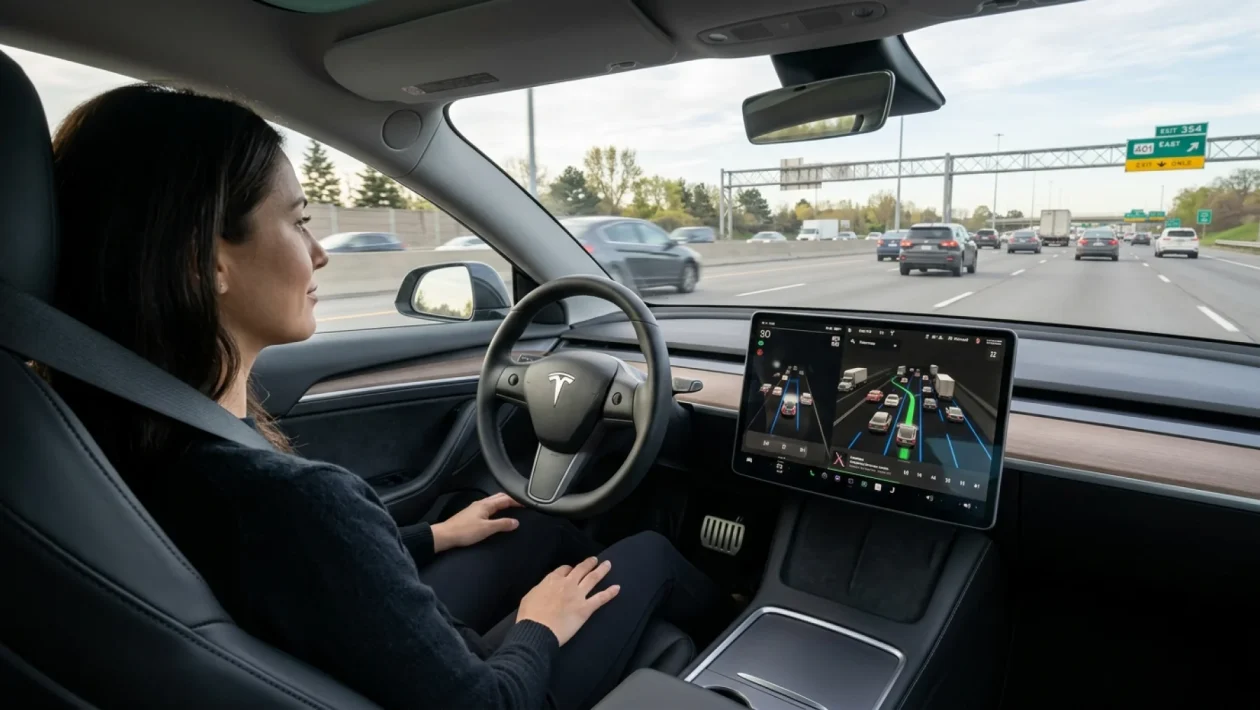
The regulatory dam has finally broken, and the Tesla FSD Expansion is suddenly shifting into high gear on an international scale.
What happens across the pond directly dictates the software updates hitting the driveway of your Canadian home, and this recent European rollout is the ultimate proof.
Let’s pop the hood on this regulatory breakthrough and figure out exactly why this overseas momentum is going to change the way you drive to work.
Tesla FSD Expansion
We are officially moving past the cautious testing phase and entering mainstream, global adoption.
As of May 2026, Tesla is aggressively rolling out its Full Self-Driving (Supervised) software to drivers in Lithuania.
This isn’t just a random geographical launch; it’s a calculated strike in a massive automotive revolution.
In the autonomous tech world, data is king. A surprising hard fact: a single autonomous test vehicle can generate over 4 terabytes of driving data in just one day.
Every single mile driven by these newly activated European cars feeds directly into the massive global neural network, making the system smarter for everyone.
Hits Europe
Cracking the European market is notoriously difficult due to some of the strictest road safety regulations on the planet.
The real catalyst happened last month when the Dutch automotive regulator, RDW, gave the provisional green light for the FSD system on public roads.
Because of how EU regulations work, other member states—like Lithuania—can recognize that Dutch approval as a backdoor for their own localized rollouts.
Even Canadian automotive and mobility tech giants like Magna International monitor these European regulatory shifts like hawks.
They know that once the EU sets a safety standard for supervised autonomy, North American regulators will quickly adapt their own frameworks to match.
How This Global Shift
When international regulators finally start playing ball, the entire global automotive industry shifts its focus.
This rapid European expansion forces legacy automakers to scramble, pushing the boundaries of what they offer in their standard vehicle trims back home.
Here is a quick breakdown of how these distinct regions handle the autonomous transition:
| Region | FSD Rollout Approach |
|---|---|
| North America | Aggressive beta testing, faster consumer access. |
| European Union | Strict regulatory hurdles, slower but standardized approvals. |
“When notoriously strict European agencies like the RDW green-light supervised autonomy, it immediately pressures North American regulators to modernize our own aging traffic laws.” – James Collins, Lead Automotive Systems Analyst.
Changes Your Commute
You might be wondering how a software update in Vilnius affects your morning drive down the Don Valley Parkway or the I-95.
It all comes down to the way machine learning scales and improves the Tesla FSD Expansion capabilities right inside your own garage.
- Edge Case Capture: European roads have distinct layouts, roundabouts, and pedestrian behaviors that train the AI to handle unpredictable scenarios better.
- Network Acceleration: More cars running FSD globally means the system’s central neural network learns and refines its decision-making exponentially faster.
- Faster Local Updates: A smarter core system results in highly polished, robust over-the-air (OTA) updates hitting your vehicle’s dashboard with fewer bugs.
Ultimately, your car becomes a safer, more predictable machine because it learned how to navigate a chaotic cobblestone street thousands of miles away.
Frequently Asked Questions
Will European approvals speed up self-driving laws in Canada?
Absolutely. Transport Canada frequently looks to European safety standards when modernizing local automotive guidelines. When the EU standardizes an autonomous tech framework, it provides a proven blueprint for North American lawmakers to follow.
Do I need to buy new hardware to get these FSD improvements?
If you own a modern Tesla with the latest hardware suites (like HW3 or HW4), you are generally covered. The beauty of this global expansion is that the core improvements are delivered entirely via over-the-air software updates.
Is Full Self-Driving completely hands-free now?
No. The current iteration rolling out is still “Supervised” FSD. This means you must remain attentive, keep your hands near the wheel, and be ready to take over instantly. The tech is incredible, but the driver remains legally responsible.
🤝 Good luck navigating the changing landscape of modern driving, because the future is arriving much faster than we anticipated.
💡 Whether you love the idea of a robot chauffeur or prefer gripping the steering wheel yourself, there is no denying that the tech in our driveways is evolving overnight.
📱 I’d love to hear how you feel about sharing the road with AI-driven vehicles in your city.
👇 Share your thoughts in the comments below, and let me know if you would trust your daily commute to the latest autonomous software!