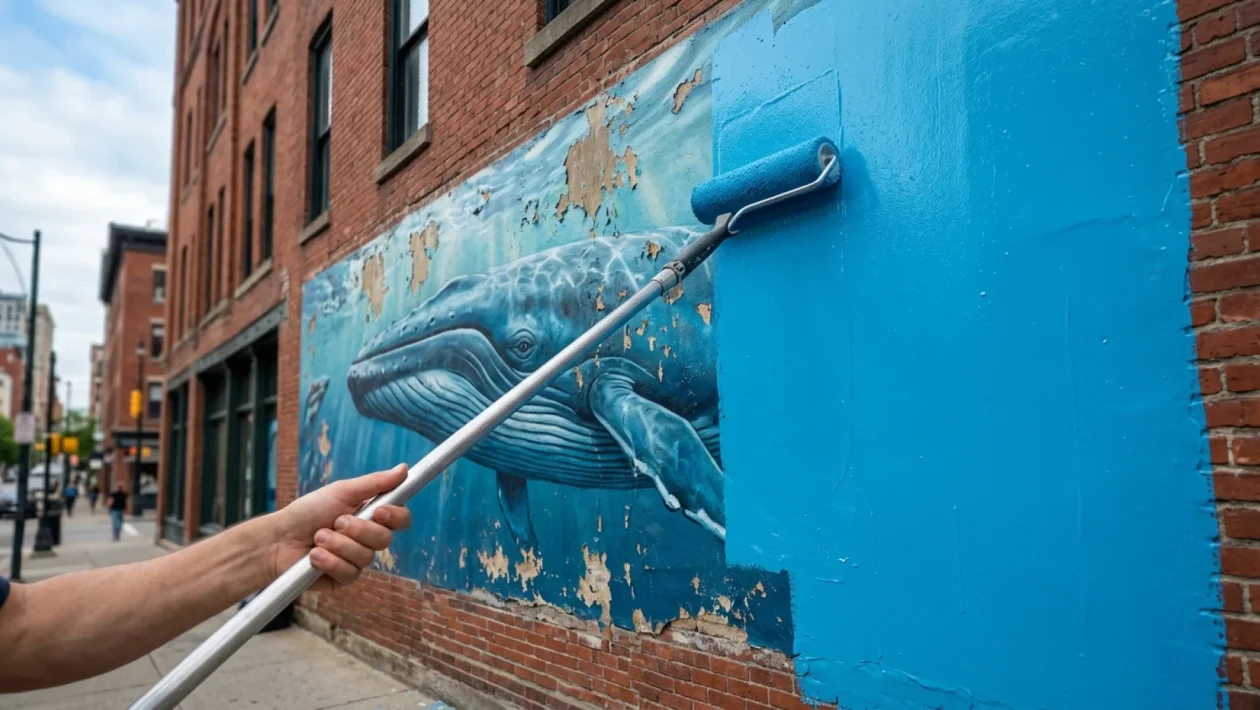
Imagine coming home to find someone took a heavy-duty roller to your life’s work just to slap a corporate soccer billboard over it. That is exactly what is happening in downtown Dallas right now, and it has triggered a massive legal standoff. With the 2026 World Cup rapidly approaching, city organizers and property owners just made a highly controversial, eight-story mistake.
The renowned marine artist Wyland is bringing down the legal hammer after his iconic “Ocean Life” mural was abruptly painted over for a FIFA World Cup promotion. This is not just a localized turf war over city aesthetics. It is a fundamental clash between corporate advertising budgets and federal laws designed to protect public art.
If you own a building, manage commercial real estate, or just appreciate the massive murals that give our North American cities their soul, you need to pay attention. We are going to break down exactly why this Wyland mural lawsuit is sending shockwaves from Dallas all the way up to developers at major Canadian firms like EllisDon.
The Wyland mural lawsuit: Dissecting the core dispute
Wyland’s attorneys have officially fired off a cease-and-desist letter to the property owner, the City of Dallas, and FIFA. The claim is straightforward but carries massive legal weight. Wyland states he never gave approval for his decades-old artwork to be altered, modified, or covered up.
Organizers tried to play defense, telling local news stations that the new FIFA mural is meant to celebrate the upcoming tournament and that they intended to preserve “part” of the original piece. Wyland completely rejected that narrative.
He publicly fired back, stating, “They’re telling people, ‘oh, we reached out to Wyland, we reached out to the Wyland Foundation.’ They did no such thing. So it was really disrespectful at every level.” This lack of communication is exactly what transforms a simple misunderstanding into a high-stakes federal lawsuit.
How FIFA painting over a 30-year landmark happened
For nearly three decades, “Ocean Life” has spanned eight massive stories on a downtown Dallas high-rise. It is part of Wyland’s legendary series of whaling walls that dot cities across the globe. You do not just erase thirty years of cultural heritage with a few buckets of industrial Sherwin-Williams paint without facing extreme backlash.
When FIFA promotions started gearing up for the 2026 matches, property managers clearly saw dollar signs. They viewed an eight-story canvas where a beloved whale mural already existed.
Instead of commissioning a new wall, crews were sent in to paint over Wyland’s historic marine life. They swapped community heritage for a temporary sports advertisement, severely miscalculating the legal protections surrounding established public art.
| Property Owner Perspective | Federal Artist Rights (VARA) |
|---|---|
| Buildings are private assets and owners control the exterior aesthetics. | Artists retain moral rights to prevent destruction of recognized public works. |
| Lucrative short-term advertising contracts (like FIFA 2026). | Statutory damages for unauthorized alteration can reach $150,000+ per work. |
What sparked a federal art battle under VARA
Here is the hard truth that many commercial property owners fail to understand: buying the brick and mortar does not mean you own the copyright to the art painted on it. Wyland’s lawsuit is anchored in the Visual Artists Rights Act (VARA), a powerful piece of federal legislation enacted in 1990.
VARA grants artists “moral rights” to their work. This prevents the intentional distortion, mutilation, or modification of visual art that would harm the artist’s honor or reputation. If a piece is of “recognized stature,” VARA actually prevents its destruction entirely.
To put the financial risk into perspective, just look at the famous 5Pointz case in New York. A developer whitewashed a building covered in aerosol art without proper notice. The result? A federal judge ordered the developer to pay the artists a staggering $6.7 million in damages.
To avoid this exact type of expensive legal nightmare, property owners must follow a strict process before touching a recognized mural:
- Conduct an Art Audit: Determine if the piece qualifies as a work of “recognized stature” under federal law.
- Locate the Artist: You must make a good-faith, documented effort to contact the original creator.
- Provide 90 Days Written Notice: The artist legally has 90 days to safely remove the artwork at their own expense if possible.
- Secure a Written Waiver: If the work cannot be removed without destroying it, the artist must sign a specific VARA waiver consenting to the destruction.
“Corporate sponsors and developers often assume a signed check for the wall space bypasses the artist’s legacy. As this Wyland lawsuit proves, violating VARA is the fastest way to turn a celebratory marketing campaign into a devastating public relations and financial disaster.” — Marcus Thorne, Commercial Real Estate & Arts Attorney.
Frequently Asked Questions
What is the Visual Artists Rights Act (VARA)?
VARA is a federal law passed in 1990 that grants visual artists specific moral rights. It protects their work from unauthorized alteration, distortion, or destruction, regardless of who physically owns the building or canvas.
Can a property owner ever paint over a mural legally?
Yes, but they must follow strict protocols. They need a signed VARA waiver from the artist at the time of creation, or they must provide 90 days’ written notice allowing the artist to remove or document the work before any demolition or painting begins.
Will Wyland’s Dallas mural be restored?
Once a mural is heavily painted over, physical restoration is often impossible. Legal actions in these cases typically seek significant financial damages and public injunctions to penalize the unauthorized destruction and deter future violations.
Conclusion
🤝 Let’s get one thing straight: protecting our urban landscapes requires a baseline level of respect between property owners and the creators who bring those walls to life. You cannot simply erase decades of history for a quick promotional paycheck.
💡 This lawsuit is a wake-up call for every developer and city council across North America. Before you roll on that layer of primer, you better make sure you have the legal right to do so.
📱 Share your thoughts on this legal battle with me! Do you think property owners should have total control over their walls, or should federal art protections always trump corporate advertising?
👇 Good luck to the organizers trying to untangle this mess before the first whistle blows in 2026. They are going to need it.