The River as a Sorting Machine
Most amateur rockhounds treat a riverbed like a random collection of gravel. They pick up a stone, turn it over once, and toss it back. To a geologist, however, a river is a powerful, million-year-old sorting machine.
Water does not move rock randomly. It acts as a hydraulic classifier, winnowing material by density, shape, and size. When you walk a riverbank, you aren’t just looking at rocks; you are looking at the end result of a massive geological process that has stripped minerals from deep underground formations and deposited them in specific “traps” downstream.
Beyond the “What Is This?” Mentality
The secret to finding precious stones like diamonds isn’t having X-ray vision; it’s asking the right question. Instead of asking “what is this stone,” professional gem hunters ask, “what brought this here?”
Diamonds are heavy and chemically inert, meaning they survive the trip downriver better than softer minerals. Because of their high specific gravity, they tend to settle in the same areas as gold and other heavy minerals. If you are looking at a stretch of river that looks uniform and flat, you are likely looking at a graveyard of boring rocks. You need to identify the energy changes in the water flow.
Identifying High-Potential Deposits
To find diamonds or other precious minerals, you must locate where the river loses energy. When a fast-moving stream hits a curve or an obstacle, it dumps its heaviest load. These are your primary search zones:
- Inside Bends: As water rounds a corner, it slows down on the inside bank, creating a natural deposition zone for heavy material.
- Behind Large Boulders: Massive rocks act as physical dams, creating eddy currents where water velocity drops to near zero, allowing heavy stones to drop out of the flow.
- Bedrock Cracks: If the river floor is exposed bedrock, look for natural fissures. These act as “riffles” in a sluice box, trapping denser stones that have been tumbled for miles.
The Physical Traits of Diamond-Bearing Gravel
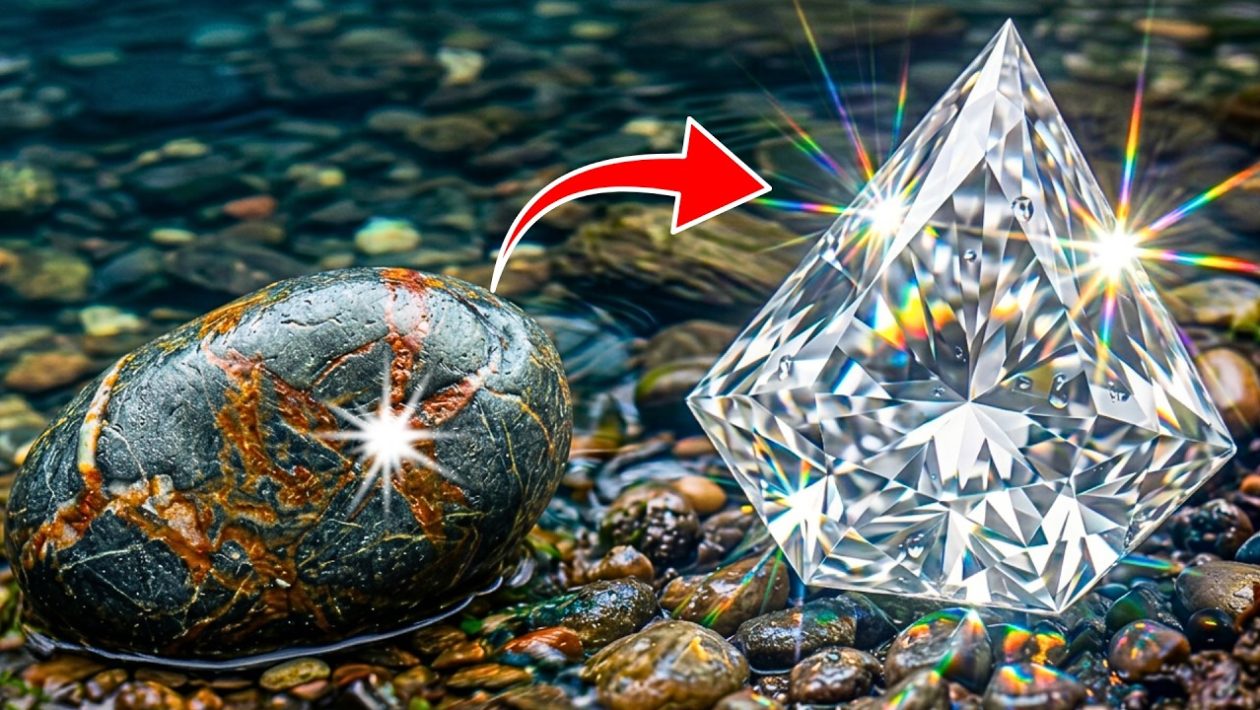
Diamonds don’t often look like the polished stones you see in a jewelry store window. In the field, they are often covered in a “skin” or a frosted, resinous coating that makes them look like dull, slightly greasy glass fragments. They often appear rounded because they have spent eons being battered against other rocks.
Professional prospectors don’t just look for the diamonds themselves; they look for the “indicator minerals” that travel with them. These include garnet, ilmenite, and chromite. These minerals are denser than typical river quartz and are often found in the same concentrated pockets. If you find a high concentration of dark, heavy, “pathfinder” minerals in a gravel trap, your chances of finding a diamond in that same deposit increase exponentially.
Essential Prospecting Habits
Success in the field comes down to patience and mechanical sorting. You cannot find hidden gems by merely walking along the surface. You must be prepared to dig into the substrate, specifically targeting the contact layer between the top-level gravel and the underlying bedrock or clay layer.
Use a simple screen or a classification sieve to filter out the largest, most obvious rocks. By removing the bulk material, you expose the smaller, denser fraction where the gems are hiding. It is tedious work, but it changes the game from blind luck to calculated geological exploration.
Always verify your findings using basic field tests. Diamonds are incredibly hard and will easily scratch glass, and they possess a unique way of refracting light even when covered in grit. If you find something that feels significantly heavier than the surrounding stones and displays a suspicious luster, keep it isolated for a professional appraisal.